An enormous eagle spreads its wings protectively over sumptuous fabrics, evergreen trees, monarch butterflies, and a canoe piloted by a fairy: this is Pacific Northwest Ballet’s new The Sleeping Beauty.
 Pacific Northwest Ballet principal dancer Dylan Wald and soloist Leah Terada as King and Queen Papillon. Photo © Angela Sterling.
Debuting for only two weekends, this brand new production emerges from a collaboration between Tlingit glass artist Preston Singletary (on his first foray into set design), costume designer Paul Tazewell (recently nominated for an Oscar for Wicked), puppet designer Basil Twist (award-winning collaborator with multiple ballet companies), and stagers Doug Fullington and Peter Boal (who painstakingly combed the notes from the original 1890 production for choreographic inspiration). The resulting blend of cultures and history creates a unique fairytale world, tied to tradition but rooted to the Pacific Northwest.
To get a peek into this 15 month production journey, I spoke with Lead Dyer from the costume department, Wyly Astley. She describes the creative process as “thrilling,” possibly a once-in-a-career opportunity. Nearly 300 costumes were built completely from scratch. Astley is especially struck by the hundreds of hands that touched every single item. From her work dying the fabrics, all the way through the 150,000 rhinestones meticulously applied by hand, several generations of artists created this visual spectacle from scratch. Astley likened the collaboration to “mycelium” under the forest floor – nearly 100 artisans working toward something that manifests spectacularly above ground.
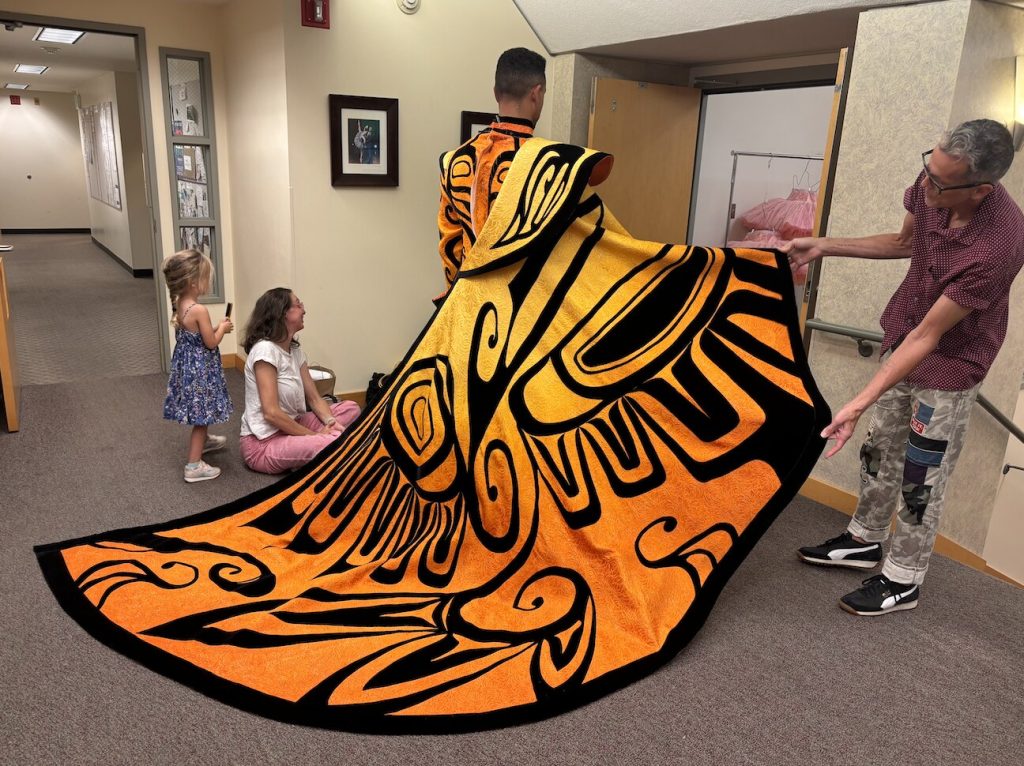 Rob Newton, PNB staff Costume Technician showing off the cape worn by soloist Dammiel Cruz-Garrido. Photo courtesy of Wyly Astley.
When weaving disparate cultures together, there is always a danger of misappropriation. I asked Astley to comment on this. She notes that Singletary ensured artisans like Astley remain thoughtful about their designs, by coaching them about the specific ratios and shapes inherent to formline design. “Formline” refers to a concept found in Northwest Coast art: think gently curving lines, blocks of color and shape, abstract representations of animals, and creative use of negative space. Singletary advised the artisans on which shapes and colors can be used and how to use them, while supporting artistic license to abstract the concepts. This included his collaboration with Tazewell, who used both Singletary’s drawings and his own dream-like lines. Astley notes, before a single item left the drawing board, Singletary reviewed the designs. This blend of rigor and imagination manifests as design that is instantly recognizable as Northwest Coastal but abstracted and fantastical at the same time.
I attend the evening of February 1st, the night after opening and am fortunate to get a backstage tour. There, waiting for their cues, lie Basil Twist’s puppets: an enormous ogre and a cadre of mice. The ogre’s mask delights with colors and facial features instantly recognizable as originating in the Pacific Northwest. Next to the mask stands his hilarious pair of outsized green feet with fungal nails and grey-brown fur. Behind the ogre lie a long row of furry brown mice, sporting cartoon-like yet fearsome gritted teeth and red eyes. These are Carabosse’s posse, slightly silly and campy, operated by four dancers in black, lightening the dark tone of her character. Our tour guide points out some details that further root this production to the Pacific Northwest. For example, all the flowers in the garland dance are endemic to this region. As I pass by – and try not to stare – bedazzled dancers chat, warm up, and rehearse, adding to my excitement. I find my way to my seat about thirty seconds before curtain, where the house is absolutely packed and buzzing.
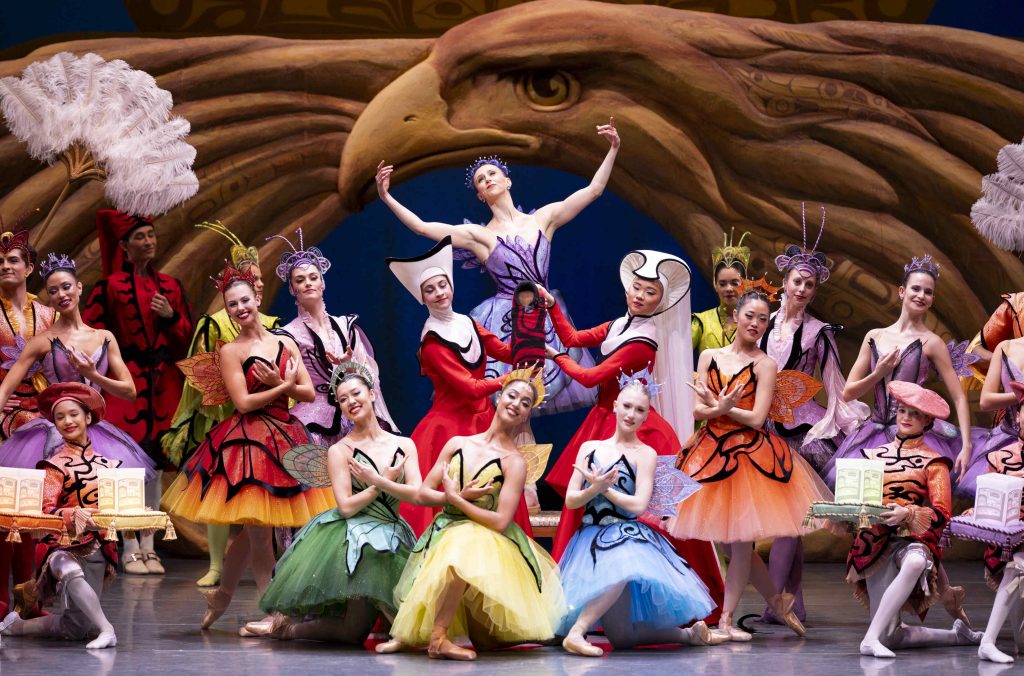 Pacific Northwest Ballet principal dancer Elle Macy as the Lilac Fairy, with company dancers and PNB School students. Photo © Angela Sterling.
Once dancers start parading onstage, my hungry eyes cannot get enough of this sumptuous visual feast. The royal court glides in graceful folds of matte, silk-like fabric, hand-dyed by Astley in ombre oranges and yellows. Black velvet formline appliques recall monarch butterflies. The fairies and their attendants, by contrast, glitter in subdued hues spanning the rainbow. Each entourage parades slowly so we can relish every moment, every color, every unusual shape, every sparkle. I am especially delighted by a tiny detail on the Lilac Fairy’s tutu: the underside is dyed a slightly darker shade of purple as if dipped in plum sauce, a feature I’ve never seen in a tutu.
In fact, around thirty tutus are brand new to this production, many taking over one hundred hours to make. The classic pancake shape is reserved for Aurora – frosted like a pink cupcake in a French patisserie window – and a select few others. All the other dancers sport unusual silhouettes and rich colors. The fairies’ tutus, for example, contain yards of tulle but, according to Astley, no internal structure. They look like flowers plucked hours ago and plopped behind someone’s ear: slightly wilted but retaining juicy rainbow colors, a unique hybrid between classical and romantic tutus. Their male attendants’ tunics end in two bulbous, bouncing, brightly-hued peplums. The hunting party don wide-brimmed hats held snug against their heads, with capes draped jauntily across one shoulder. They preen about in heeled boots, which Astey notes were also made from scratch. They are entirely dyed in deep mint green, with satiny coral fabric lining their capes.
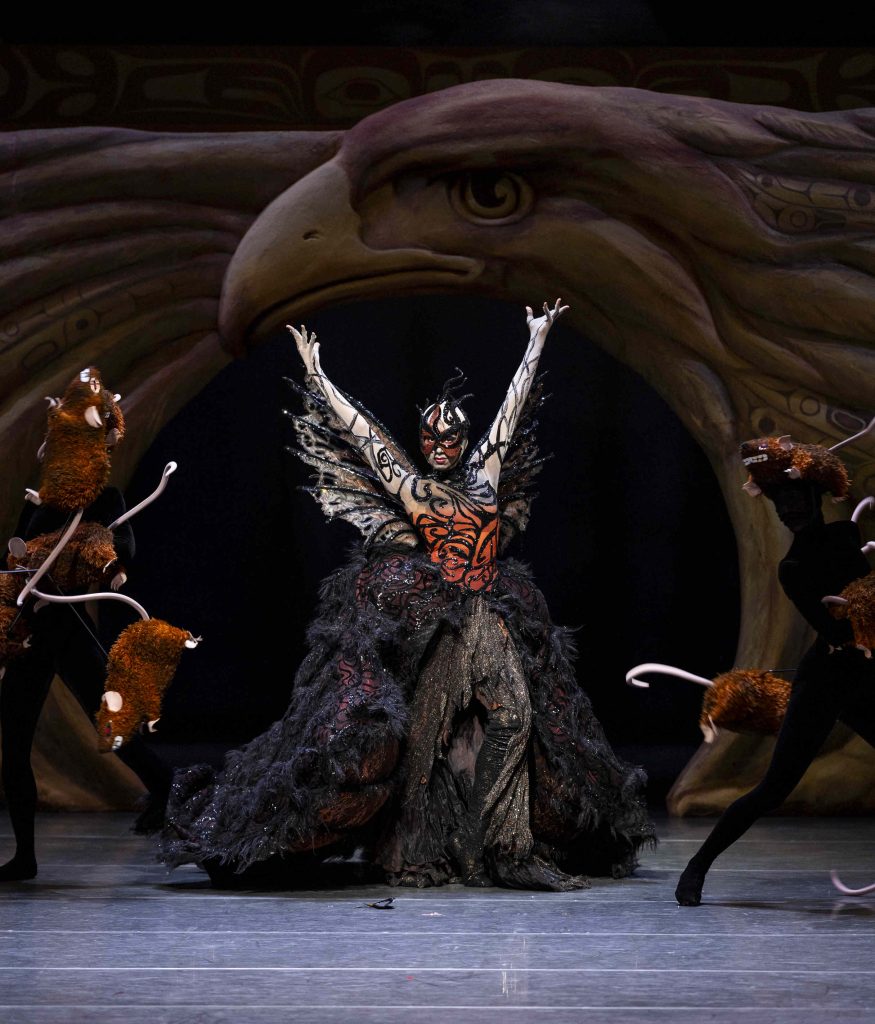 Pacific Northwest Ballet soloist Amanda Morgan as the wicked fairy Carabosse. Photo © Angela Sterling.
I cannot go any further without talking about Carabosse. Every time she is on stage, I can’t help but bring my opera glasses to my eyes to admire every detail of her costume and every campy gesture (played this evening by Amanda Morgan). She looks like she lives in the eaves of a decrepit house, where spiders deposit their egg sacs, and ancient cobwebs accumulate sooty grime. Giant, bouncing cocoons under her skirt serve as her disguise in Act II, folding up over her head then flapping flamboyantly to reveal greyish, vampiric skin. Tiny wisps of black feather-like fringe float like clouds of black dust with her every move. Her dragon-like wings seem to be decaying, riddled with holes but sparkling with dark magic.
All of the dancing is of course impeccable, but a few moments stand out. Audrey Malek’s Fairy Canari is delightful. Jazzy hands erupt from her core as she embodies the excitement and joy of this brief role: she makes those 45 seconds unforgettable. The role of Princess Florine allows Juliet Prine to showcase her impeccable balance and gorgeous port de bras. Sarah-Gabrielle Ryan (Aurora) and Christopher D’Ariano (Prince Desire) achieve the most daring lift I’ve seen in ballet. As Aurora leans forward, a diagonal line forms from the tip of her extended leg down to her head. From stillness, she then lifts her standing leg off the floor as the Prince holds her in a classic fish lift. This feat appears impossible but they repeat it three times. I am on the edge of my seat each time, positive they can’t pull it off, but of course they do.
Then it’s over. I join in the standing ovation, my eyes satiated. I call this a massive success: by drawing thoughtfully on influences from both Europe and the Northwest Coast, this production enlivens a 135-year-old ballet. Imagination and rigor blend deliciously like the ombre of the hand-dyed fabrics, shepherding this classic story into the future.
Pacific Northwest Ballet presented Peter Boal’s new staging of The Sleeping Beauty, onstage at Seattle Center’s McCaw Hall January 31 – February 9, 2025 (and streaming for digital subscribers February 13 – 17.) For tickets and information, contact the PNB Box Office, 206.441.2424 or PNB.org.