Projected at the back of the cavernous Chapel Performance Space at Good Shepherd Center, Steve Paxton is larger than life, rehearsing Goldberg Variations in 1987. He is mostly upright, with a lightness that allows any impulse to pull him at any moment. Wiggles initiate from the sternum, sending him into little hops and spins, quick focus changes, and idiosyncratic gestures. In front of the projection two dancers improvise, seemingly in their own world, but qualitatively riffing on Paxton’s movements. Here is a trio of three soloists, two who are here, and one who is no longer, except for, of course, in the way that a person with a profound influence continues to live on in others.
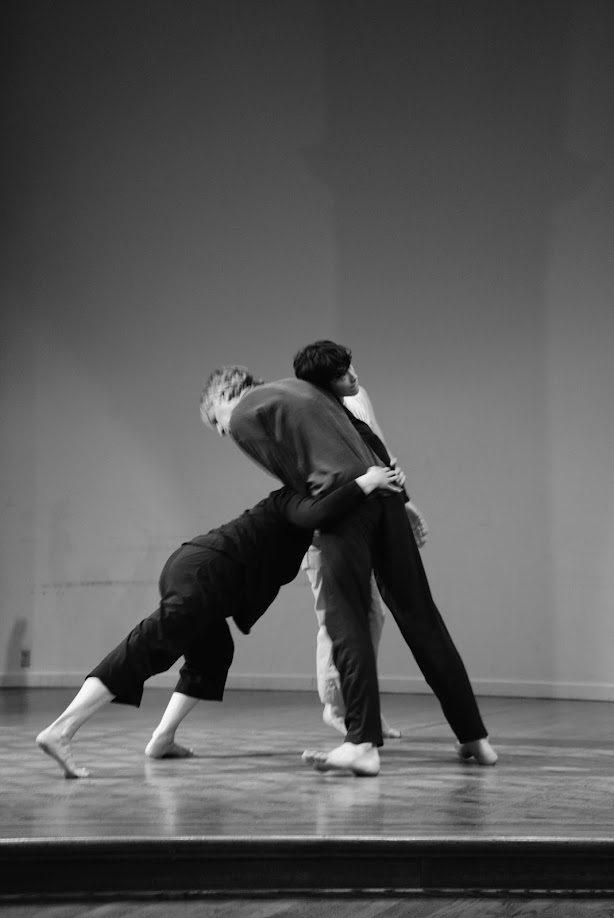 Photo by Rodrigo Sanchez @sodrigo.ranchez
This could not be more perfectly illustrated than in the opening preshow of Remembering Steve Paxton. Every few minutes a new dancer swaps into the trio, each showing the way the Paxton’s dance combines with their own one-of-a-kind movement impulses, style, and signatures. Each different from one another, but connected through a common lineage. Moments of synchronicity crystalize every so often—two bodies aligning in the angle of an arm, a turn of the head, the fall from balance. Perhaps these arise out of coincidence, or perhaps intentionally, or perhaps out of that mysterious unstoppable influence one body has on another when sharing space and time.
A short welcoming address by Janet McAlpin acknowledges the reason we are here—to remember and celebrate Paxton, who passed away in February 2024. A dancer, innovator, researcher, and teacher, he worked with such dance heavy weights as Merce Cunningham and Jose Limon. He was part of the Judson Church movement in 1960s that birthed post-modernism. But Paxton became best known for his crucial role in establishing contact improvisation, an open source approach to movement, physics, and touch that is not only practiced world-wide, but has had profound influence on contemporary dance across genres.
McAlpin’s welcome ends with a quote from Paxton.
“In the direction that your arms are hanging, make the smallest stretch that you can feel. Can it be smaller?”
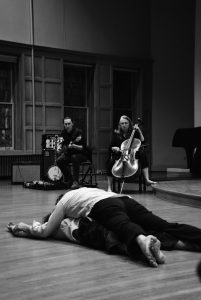 Photo by Rodrigo Sanchez @sodrigo.ranchez
I assume in reference to this quote, Karen Nelson and Nica Portavia present their duet SMALLER, along with improvisational musicians Evan Strauss and Lori Goldston. The work begins slowly, Nelson and Portavia gradually rolling to find one another. Just as I am lulled into an almost meditative state, a surprising body flop pulls me from my reverie, one body stacking onto another, matching limb for limb. From here the dance unfolds in capricious play, a real-time negotiation where two bodies grapple with a whisper of aggression. A tense counter balance gives way to a floating, bobbing movement quality. Then a hand upon the chest—a calming gesture of being with. The dancers approach the musicians and gently cup their hands as they play, feeling the music through the musicians’ bodies.
Following the duet, a series of video clips play. We see Paxton and Nancy Stark Smith (fellow founding participant of CI) spinning and falling in the iconic opening of the 1987 contact improvisation documentary, Fall After Newton. Then a short clip of from 1979, edited (by Nelson) to show the way Paxton’s spine twists and spirals through three dimensional space to redirect his momentum—the film scrubs back in forth in slow motion, allowing time to register the way Paxton played with gravity. Not just falling but riding it like a surfer catches a wave.
The third film is a longer one from 1988, a dance between Paxton and a tree blowing in the wind. Surrounded by the Vermont forest and captured on what appears to be a grainy home video (filmed by Cathy Weis), Paxton rides a different wave, this time the rise and fall of an enormous root ball on the precipice of being ripped from the ground with every huge gust of wind. At times Paxton rides along with the forces of nature, and at other times he resists—pushing against the tree through his shoulder as the massive trunk leans 45 degrees to the ground, evoking the common lean-to position of contact improv. He then plays with the concept of counterbalance, grabbing a root that’s pulled from the ground and leaning away, pulling his center of weight back and down to most efficiently counter the force of wind and the gravity on the tree. Both counterbalance and lean to are ways in which two people can support one another through shared weight, no matter the size of the person. Here, that concept on a massive scale.
There are two more clips—one a duet with Emery Blackwell, a dancer and choreographer who has cerebral palsy. Filmed in 2000 at Hanna Barn on Vashon island, Paxton and Blackwell negotiate care and effort, Blackwell pushing Paxton in his wheel chair, finding playful aggression. They push the edge of control, and the edge of laughter. Accommodation to all bodies is a fundamental tenant of Contact Improv, and the curation of each clip begins to paint a picture of Paxton’s life work. The final clip is a 1983 duet with Lisa Nelson, a giant of her own right in the improvisational dance world, and with whom Paxton was in a long term relationship.
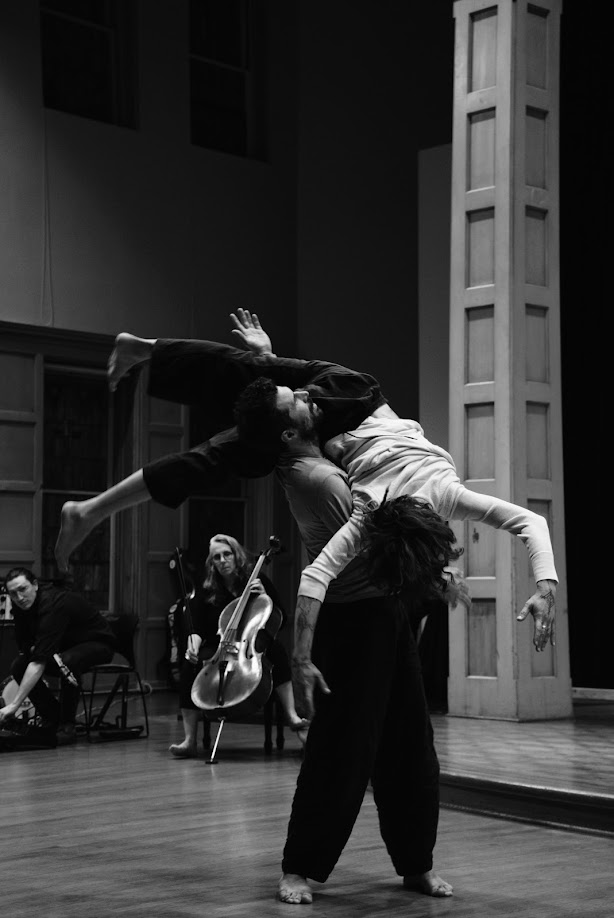 Photo by Rodrigo Sanchez @sodrigo.ranchez
The projections end, and dancers return to the stage for Ensemble Tribute “replay.” The first image of a dancer spinning with another on their shoulder instantly recalls the first video clip. The eight performers sequentially make their way through each video, drawing inspiration and recalling images and approaches we’ve just witnessed on the screen, recombining together to make a new dance. The performers include many local improvisors with their own influence in the scene: Sheri Cohen, Scott Davis, Hannah Rice, Aaron Swartzman, Christian Swenson, Alia Swersky, and Karen Nelson, who worked closely with Paxton and has been studying, teaching and innovating improvisation since the late 70s.
The lineage of influence is traced wider still as dozens of dancers rise up from the audience to join in the evening’s final offering, Paxton’s famous score, the Small Dance. Paxton’s recorded voice enters over the loudspeakers. He calmly invites us to come to standing, and to tune into the constant micro-shifts our body makes to keep us vertical, the almost invisible dance with gravity that is always with us. It is here that we hear the evening’s opening quote in Paxton’s own voice.
In the direction that your arms are hanging, make the smallest stretch that you can feel. Can it be smaller?
Paxton did lots of big and physical dancing. Size isn’t what matters here. What’s contained in this quote is the attention to attention, the expansion of perception, the invitation to go deeper, the focus on sensation. In a performance setting, Contact dance could be slighted as boring or esoteric, but really it is a form, both in doing and witnessing, that asks for closer attention. When something isn’t primarily presentational, it gives us space to tun in, to notice details, to expand our perception.
It would be hard to truly capture the influence of Paxton’s practices. A lifetime of researching and passing on embodied knowledge, likely to thousands, many of whom have and will pass that knowledge on to many others, and to others, and so on. Each who learns will make it their own, will let it bleed into other areas of their lives. While he may have been of the most influential thinkers in dance of the 20th century, he was also, of course, a beloved friend and teacher. It’s clear, sitting in the Chapel Performance Space, that Paxton and his practices personally touched so many in the room. He will not be forgotten soon, and the lineage of his body may live on forever.
Remembering Steve Paxton performed January 24, 2024 as part of the Wayward Music Series at the Good Shepherd Center.


