A chiming bell rings through a dry-ice fog. The sound of rain patters. Torsos glisten softly in silver tops. The focus of each of the seven Whim W’Him dancers gets tugged to the rafters at different times, lifting their sternums. This upward thrust of the chest is a motif throughout Unconditional yet, never feels like a repeated movement. It’s rather as though I am witnessing a phenomenon—as if the dancers’ hearts are being pulled by a force beyond themselves. Company director and choreographer Olivier Wevers draws inspiration for the piece from a poem by Jeff Foster called Forget Unconditional Love.
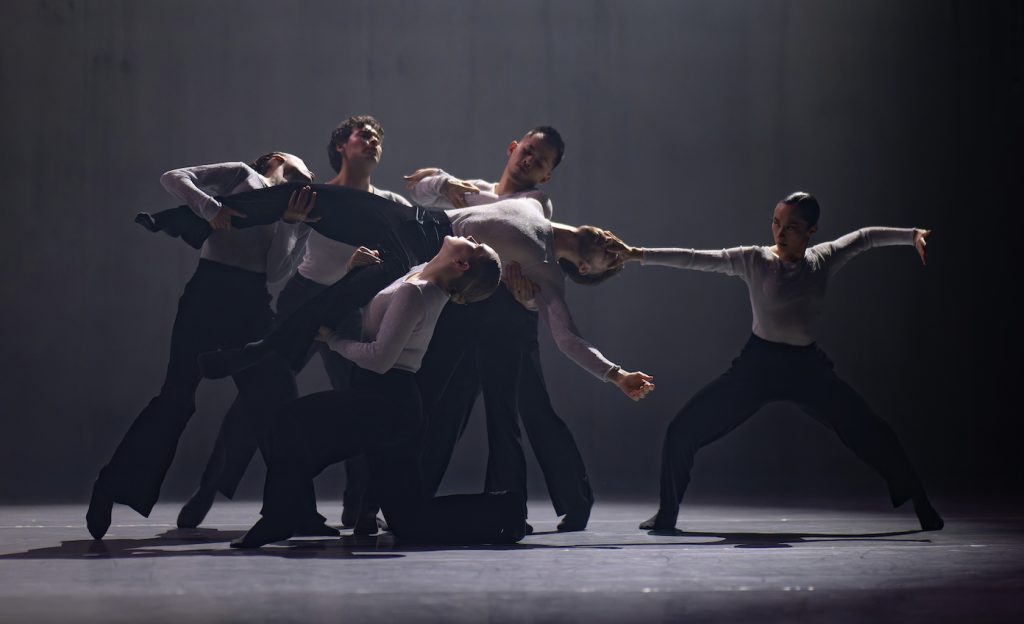 Photo by Jim Coleman
The dancers climb on each other, stacking, crawling, and shifting like a human river. I can’t tell when one leaves the ground or returns. I can’t tell who is taking the weight or how the dancer on top surrenders themselves to riding the wave below. It’s a visual relationship metaphor—what does it look like to yield? To be supported? Sometimes they grab someone out of the pile unseen, and the pack turns on one dancer Lord-of-the-Flies style. Organic and amoeba-like, this group movement reminds me of the hive-mind style in Crystal Pite’s Emergence and Season’s Canon. The performers move with striking synchronicity, especially considering five of the seven —Owen Fulton, Stella Jacobs, Aliya Janov, Daeyana Moss, Ashley Rivette—are new to the company this season.
There are many moments when the choreography aptly embodies the unachievable aspect of the unconditional love referenced in Foster’s poem. When the dancers open their mouths in silent screams, I see the line about how unequivocal love is, “…an impossible goal that makes you violent inside.” They walk like their feet are stuck in the heavy sands of a dream. As if the dancers are physically communicating the words “…messy, deeply conditioned human love.”
The chaotic, inescapable aspects of relationships and destiny are themes referenced throughout the program. Choreographer Robyn Mineko Williams explores the concept of “ito” in a piece by the same name. From the program notes, in Japanese folklore, ito is the idea that “a red string is tied between the little fingers of couples who will find each other in life again and again in different times, places, or circumstances.”
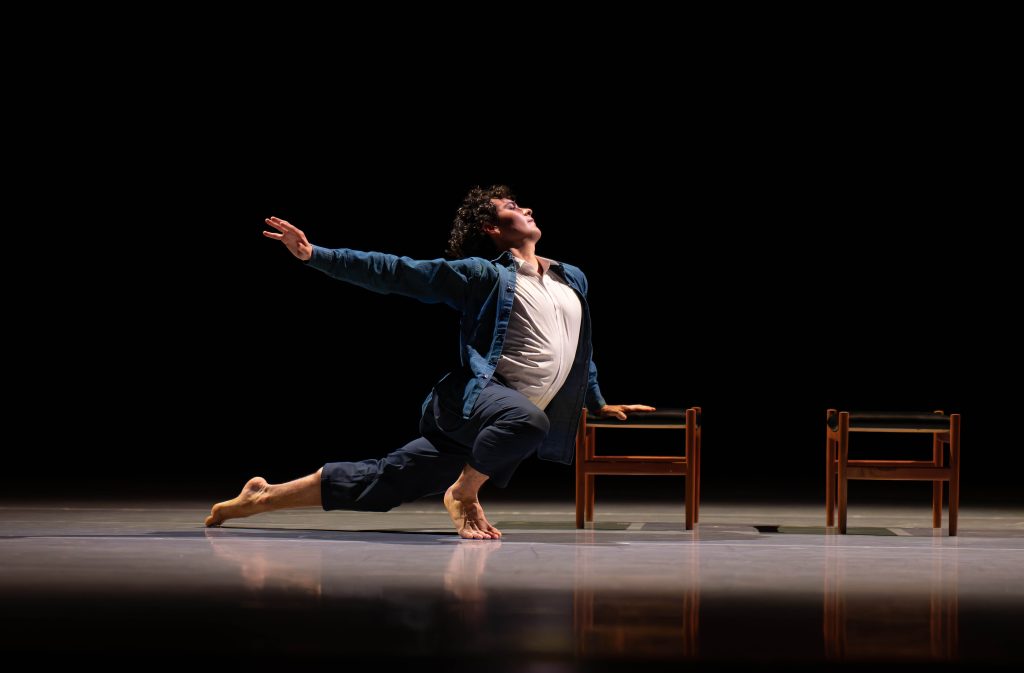 Photo by Jim Coleman.
This fleeting filament of fate is masterfully expressed in Ito, both choreographically as well as through lighting and props. Spotlights periodically illuminate two low stools that the performers move on and around in various positions throughout the dark stage. This feng shui manipulation of space and time by spotlight* feels like snapshots of memories of a relationship.
In Ito, the movement images that blaze in my mind’s eye are when a dancer is lifted and her legs point outward in V-shape vectors. The light glows through her coppery, origami-like pleated skirt, so that we can just make out the outline of her legs, going different directions like a fork in life’s road. My favorite is when she jétes by her lover, seated on a stool, and their fingers brush midair. The ephemeral touch reminds me of the wind phone in Japan—an old-fashioned phone booth where grieving people can talk to loved ones who have died. This heart-rending ritual is a reminder that our relationships continue with impactful people in our lives whether they are physically present or not. In Mineko Williams’ piece, dancers swirl by each other, in and out of the spotlights, sometimes catching a running partner. The music, an original composition by Nate Kinsella, sometimes feels like a caress and sometimes creates so much tension it hurts.
The palpable improv groove of Diné jazz trumpeter Delbert Anderson ignites Cameron Fraser-Monroe’s choreography in the show-stopping finale, SCRAP. Talk about in the pocket! The music and movement fuse into an inseparable synesthetic Fantasia. The dancers pull against the trumpet in a languid cat-like style. They catch their breath at the sizzle of moving to the electric music. Grooving over the top of phrases, then in a quick blur, they swipe the floor with liquidy rolls. The work is punctuated by audience laughter as the dancers seem to compete in explosive dance-off-style solos and duets. Something about the playful way Kyle Sangil thumbs his nose at his fellow dancers epitomizes his stand-out performance energy. I can see why Sangil, in his third season with Whim W’Him, is one of Dance Magazine’s 2025 “25 to Watch.” Sangil isn’t the only veteran mentoring the new members into the company fold, according to Whim W’him’s blog. Jacob Beasley, in his second season, embodies how Whim W’Him movement allows him to “external[ly] manifest internal expansion.”
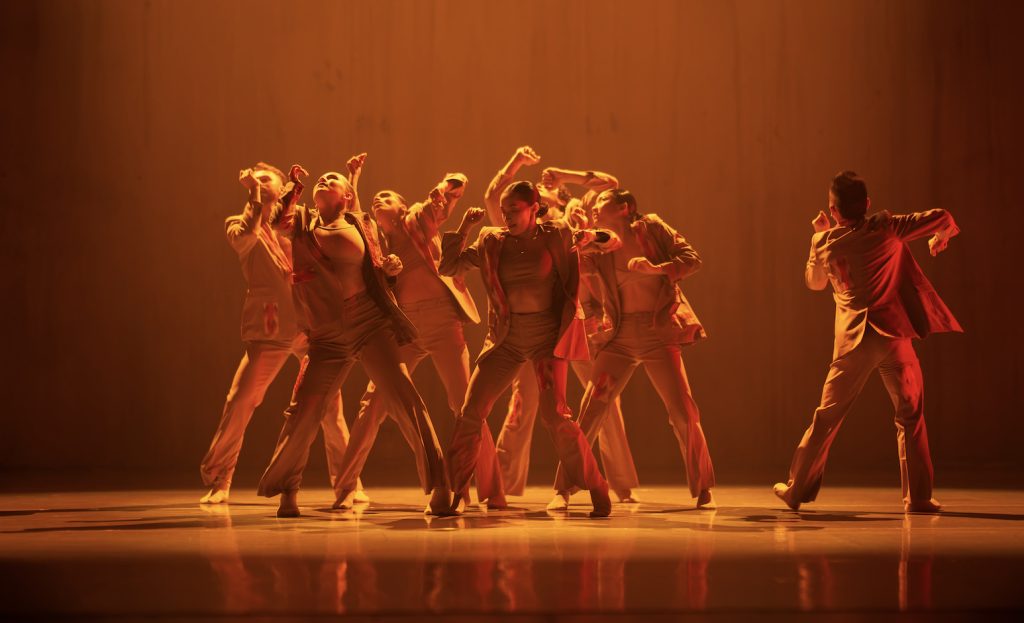 Photo by Jim Coleman
It’s such a treat that SCRAP is an Indigenous artistic collaboration of epic proportions. Fraser-Monroe, a Canadian Tla’amin First Nation member, finesses a wide range of training into his choreography. He started in Ukrainian dance and trained with World Champion Hoop Dancer Dallas Arcand, as well as with the Royal Winnipeg Ballet. Those influences are apparent in SCRAP in the constant grounded down beat echoing hoop dancers, and in the taffy-like extensions drawn from ballet. Diné costume and fashion designer Asa Benally created the business-casual, sand-colored suits emblazoned with Navajo-rug style pattern accents which infuse the piece with a fearless cool.
The Winter ‘25 program celebrates what’s universal about our human connections in ways that many times only dance can articulate. A fitting artistic achievement for Whim W’Him’s fifteenth anniversary.
*Reminiscent of how David Parsons’ use of similar lighting created the illusion of flying in his 1997 solo Caught.
Whim W’Him Winter 2025 was performed at the Cornish Playhouse on January 17th, 18th, 24th and 25th and on January 23rd at Vashon Center for the Arts. Featured photo by Jim Coleman.


