Red Marley was a bold choice. A dance colleague of mine said it first, and I immediately latched onto it because, in the queer coded language Polari, “bold” means “gay.” And yes, this piece was definitely queer—not explicitly but in an unspoken way. Content wise, nothing about this dance directly pointed to a queer anti-fascist perspective, as suggested from the work’s promotional language. The poster featuring a shirtless person from behind with their pants dropped enough to expose their ass? Sure. A chat with a queer activist friend post-show? Maybe. But the performance itself? It left us suspended in a vaguely transgressive space, where queerness was present but unannounced, like an uninvited but enthralling guest at a party.
Good Boy- Tomorrow Belongs to Me: an antifascist opera from BLUE SCREEN, the moniker choreographer Joseph Hernandez uses to umbrella his various artistic projects, was performed by an ensemble of contemporary dancers including himself, Michael Arellano, Tariq Mitri, Maya Tacon, Jane Cracovaner and Shane Donahue. The performance happened in the Mainstage theater at 12th Avenue arts on Capitol Hill and featured live music from Seattle based dream pop outfit Coral Grief with musical direction by Barret Anspach.
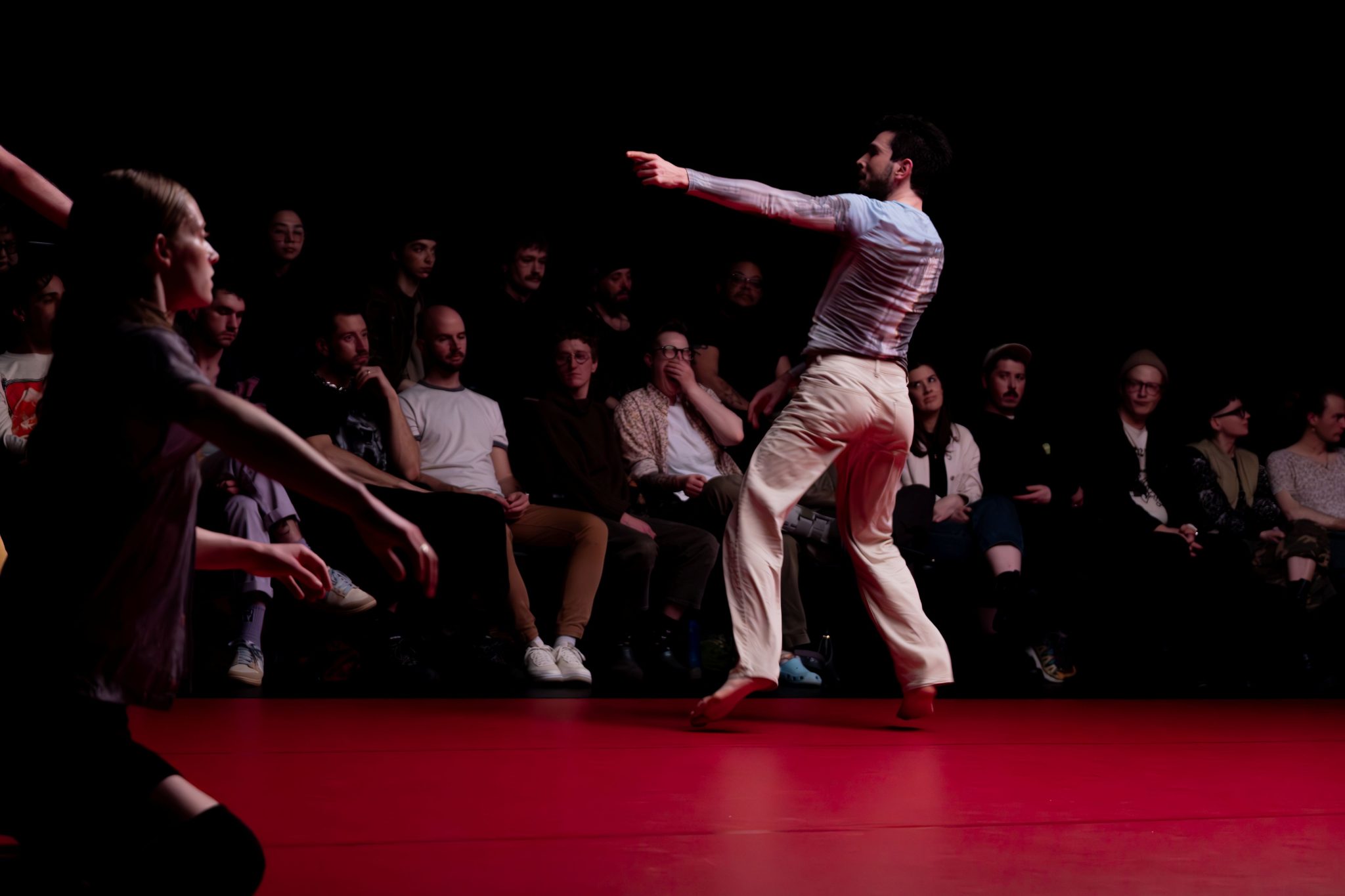 Photo by Erin O’Reilly
The energy of the piece fluctuated between a chaotic party and an isolated void. The dancers spiraled continuously around the perimeter of the dance floor engaging in movements that ranged from balletic leaps and extensions to deep lizard-like lunging and spine-centric turning that occasionally had the dancers merging with the floor, relentlessly maintaining a counterclockwise pathway the entire time. The dancers, at moments, broke from the movement and chatted casually with people they seemed to know in the audience. For those not in on the conversation, this made for a strange sense of exclusion—a kind of performative intimacy that felt slightly off. Were we meant to feel like interlopers? And then, without warning, they would slip back into the unending spiral, as if nothing had happened. Overhead, a strange, bright, low-hanging light fixture loomed over the red floor, casting its impersonal glow like the eerie lighting in an abandoned office space. Set in a rectangular “round” the audience witnessed from all four sides, the band taking up the corner farthest from the entryway into the theater.
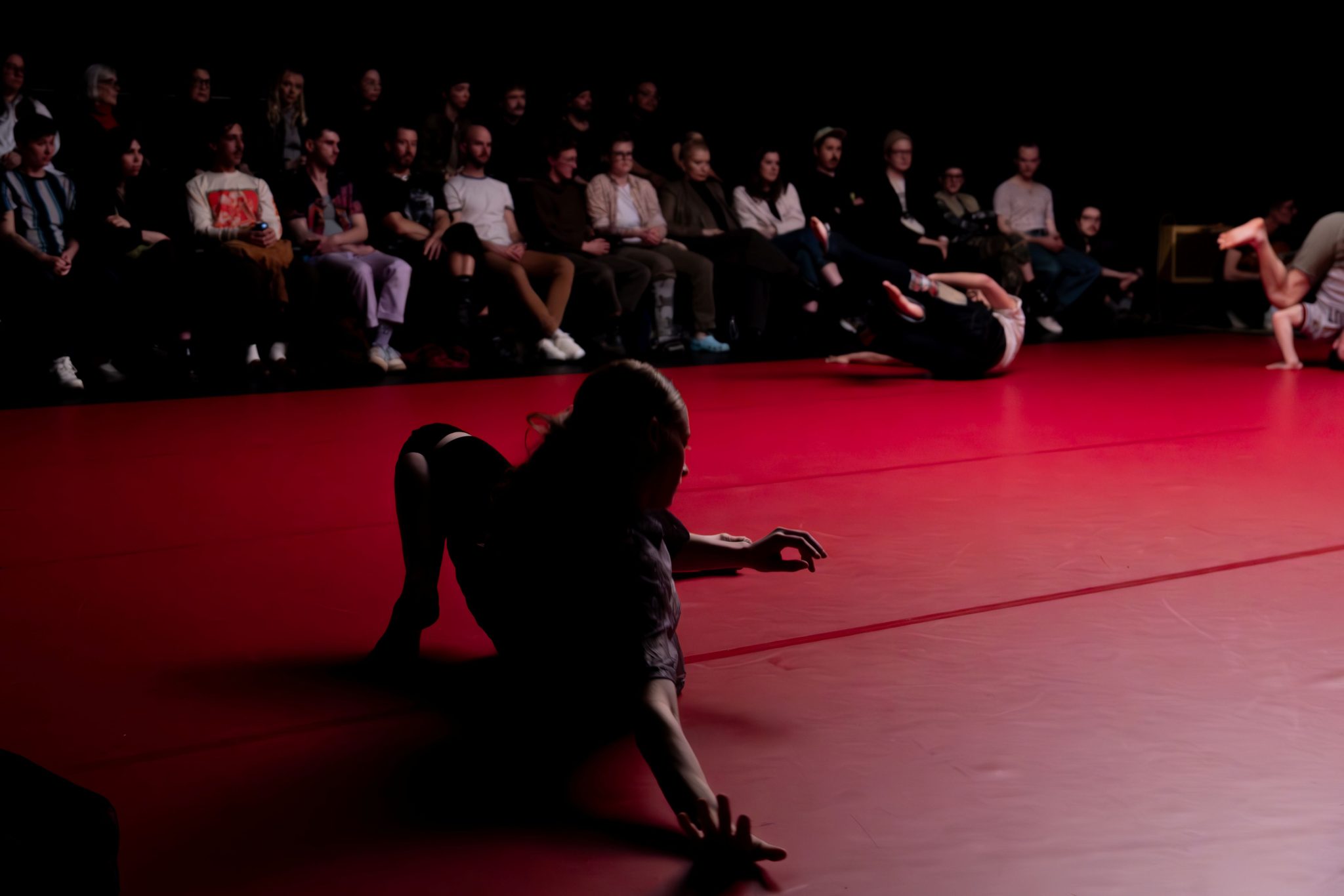 Photo by Erin O’Reilly
The music that was played during the entire performance? An extended and transformed arrangement of the song “Tomorrow Belongs to Me.” An infamous tune with a complicated history, It’s been embraced as a neo-nazi anthem despite being written by two Jewish songwriters (Kander and Ebb, Kander is also gay) for the musical Cabaret (1966). A gorgeous, nihilistic mix of eerie strings, buzzy guitars, room noise, and vocals, the music was a dissociative sigh from the depths of post-millennial angst. The way Coral Grief’s sonic landscape grounded the dancers’ spiraling movements in their own kind of melancholic momentum was hypnotic.
After witnessing the endlessly circling pathway that made up the whole movement score, I couldn’t help but think of time-traveling and unravelling—an embodiment of the past creeping into the present or the present unwinding into the past. I was reminded how the directionality of a dancer’s pathway might symbolize history itself. Moving counterclockwise rewinds the clock taking us into the past, moving clockwise turns us toward the future. But this dance? It seemed caught in the churn, neither decisively plunging into the future nor nostalgically dragging us into the past. It felt like a searching—an attempt to dance through an idea just for the sake of doing something, anything, to keep moving, refusing to freeze in the face of overwhelming oppression and hopelessness.
Speaking of relentless spirals, dancer Tariq Mitri was caught in one that differed from the others. His movement quality was sensual and playful, but there was a tension to this charisma—an unspoken divide between his body and those of the other dancers. His head gently grazing another dancer’s thigh as he lunges between their legs, his arms lifting in a seductive, welcoming gesture—it was like a tender embrace amid the otherwise self focused and somewhat impersonal cyclone of movement when most dancers were present on the floor. Shane Donohue, on the other hand, felt like the dance’s curious reckoner, someone willing to lean into the score’s awkwardness. Something about the movement—the score seemed to prompt dancers to treat the limbs in unexpected ways—wasn’t quite clicking for everyone. It felt as though some were lost in what I understood to be a complex improvisational invitation, unable to fully sink their teeth into its possibilities.
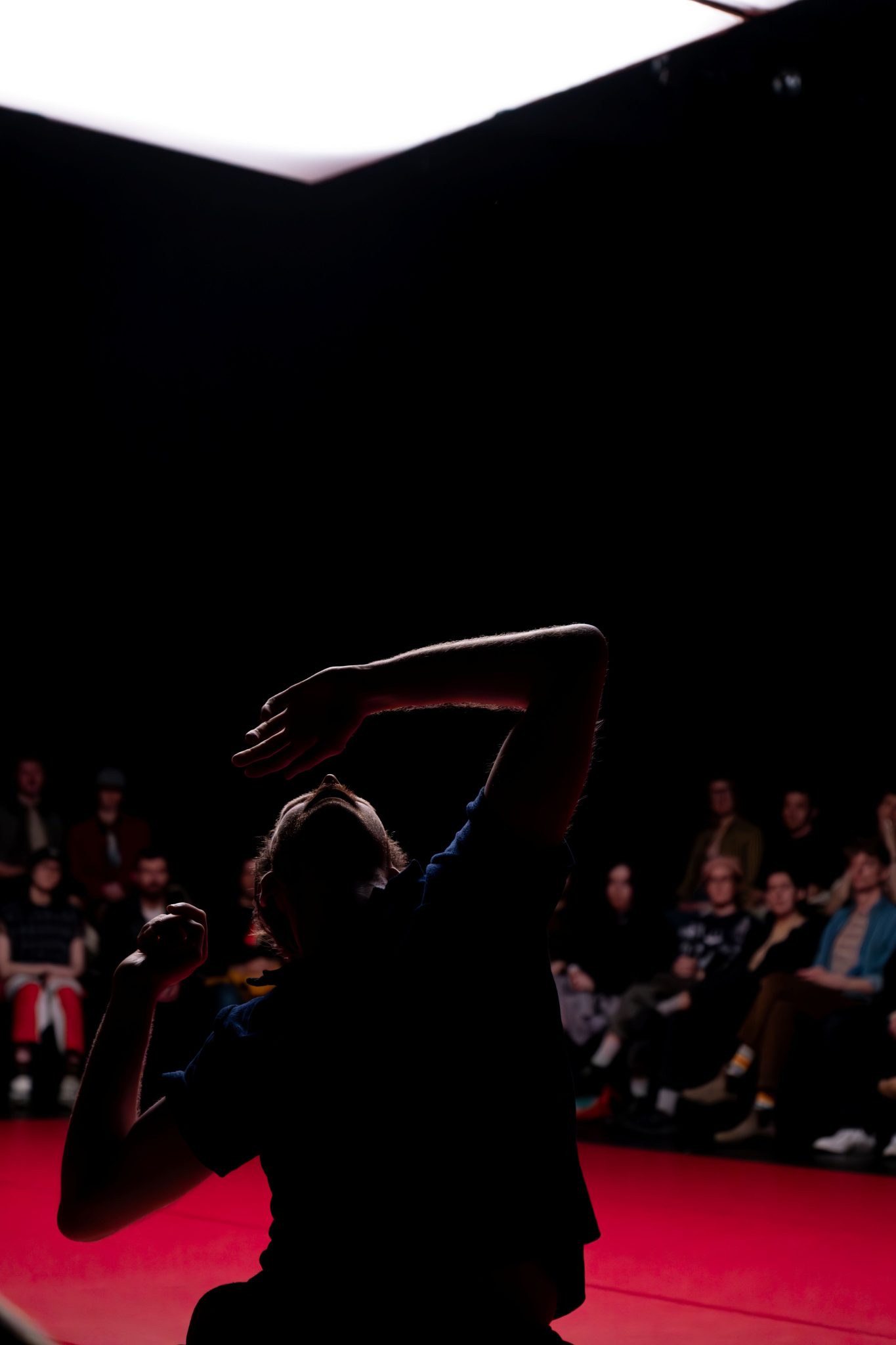 Photo by Erin O’Reilly
And then there was the red Marley floor. It reminded me of choreographer Barbara Dilley’s red square practice, where dancers enter and exit a square outlined with red rope with deliberate intention. Here, though, there was no such reverence—no delineation between inside and outside, just perpetual motion, bodies endlessly caught in a slow moving counterclockwise whirlpool, coming in and out of the dance as though crossing an invisible threshold without recognition. Was this intentional? A rejection of sacred spaces? A rejection of bureaucracy? It left me wondering whether the design team was even aware of Dilley’s work or if this was simply an accidental resonance.
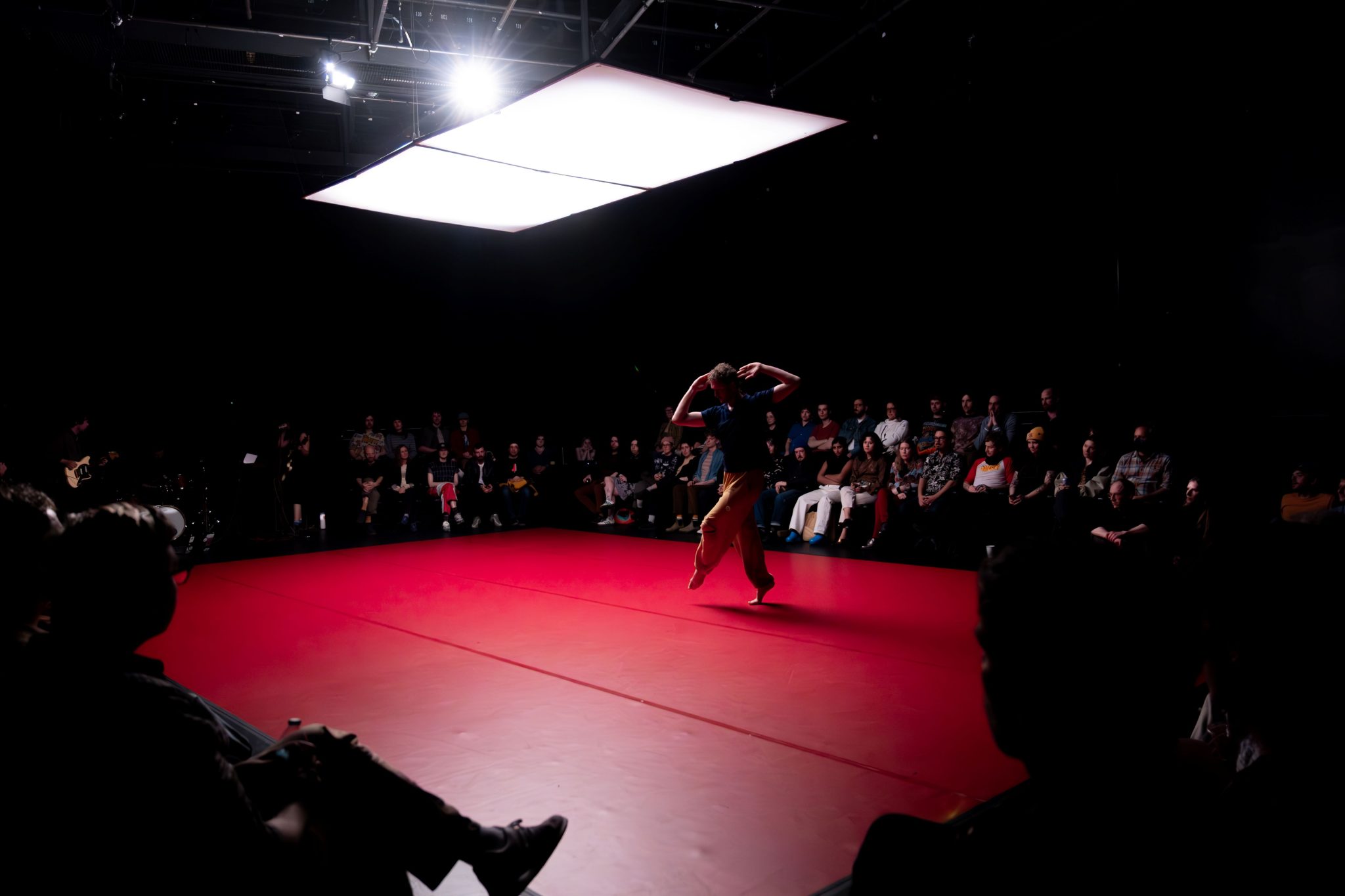 Photo by Erin O’Reilly
Physical contact amongst the dancers was rare—just the occasional resting of a head on a thigh, a fleeting touch that barely registered before it was gone. It all felt unresolved, as though the dance was circling something it could never quite reach. And then, just as we were grasping for some form of climax, out came the kazoos. Handed out like Rice Crispy treats from a crumpled aluminum foil wrapping, distributed by one of the musicians, each dancer shyly waiting their turn to choose their instrument, a moment of communal breath before—
Blackout.
No climactic cacophony of kazoo noise. Just absence. A gesture toward something that never came.
So what did I take away from Good Boy: Tomorrow Belongs to Me? It was queer in the way a whisper can be queer—subtle, coded, suggestive. It was anti-fascist in a way that never outright declared itself, but hovered like an unanswered question. It was brave in its aimlessness, in its refusal to solidify into something easily digestible. And maybe that’s the point. Maybe, in an era of increasingly policed and political hyper-legibility, refusing to be easily named is its own kind of resistance.
BLUE SCREEN’S Good Boy- Tomorrow Belongs to Me: an antifascist opera ran February 28-March 1 2025 at 12 Ave Arts Mainstage.


