 Photo courtesy of Ballet Rituals
Dear reader,
I bestow upon you an unsolicited recommendation (a love letter) born solely from my personal appreciation for and addiction to a dance class called Ballet Rituals. Founded by Hannah Simmons, Maya Tacon, and Alethea Alexander, three working dancers and artists in Seattle, the class offers a new ballet-centered landscape that I can never get enough of. Ballet Rituals began offering classes in September of 2022 and I have been attending consistently since September of 2023. That’s two years of eager and willing ballet-class-taking! A calculation my younger self would gawk at.
I grew up in a competition dance setting. Here’s the hierarchy of what’s valued:
- Turns
- Leaps/Jumps
- Kicks (get that leg up.)
- Facial expressions (picture grotesque smiles painted with bright red lipstick, on 12 year olds… disturbing)
- Cleanliness
- Musicality (this one I can get behind)
I took two ballet classes a week, barely. I skipped all the time. I hated my ballet class. I hated the leotards and the shoes and the fucking tights, good lord. The female anatomy is not meant to be squeezed into tights and a leotard, at least mine isn’t. Ballet was not treated seriously in my dance training. It was a loathed requirement, with most young competition dancers I knew gravitating either towards lyrical or jazz. Basically, you either liked to do the sad dances or the happy dances (I liked both). Up until college, the metric for success, for improvement, for quality, for your social life was gold, diamond, platinum, or double platinum. That’s right, double platinum. I never even competed in ballet, no one I knew did, so why should I give a damn about it if I can’t get that sweet sweet double platinum?
 Photo courtesy of Ballet Rituals
The most valuable thing I got from my one year at Cornish College of the Arts was connections to dancers and teachers here in Seattle. I first took Alethea Alexander’s ballet class at Cornish sort of by accident because my class had been cancelled and holy shit, it was hard! Alethea’s verbose explanations and physical executions of freedom, strength, levity, roundness, and autonomy shocked and invigorated me. I’d never heard anyone speak so poetically about a form I’d grown to associate with strict rigidity. I remember not picking up a single combination, not at the barre, in center, or going across the floor. Even though I floundered and struggled, my desire for more was slick with sweat and obvious. A profound shift in perspective surrounding ballet had been initiated.
My second semester at Cornish was spent desperately wishing I could be across the hall in the other studio where I’d watch students glide past the two tiny windows in the doors, mocking me with the distance between us. My ballet professor at the time let me leave her class every once in a while to go to Alethea’s, saying, “I know that’s where you want to be.”
I ended up dropping out of school and Ballet Rituals cradled me. The community class meant I could still take class with Alethea, along with Hannah Simmons and Maya Tacon, all three of whom enchanted me. I used to find watching ballet horribly boring. But these three…I felt like a new man, I could watch them dance forever. Each of them, poised with muscularity, lifting their limbs with ease and joy! Joy flows from their bodies, they love this form, they love the community this form has provided. They’re wildly intelligent, they move with knowledge and maturity and care and individual whimsy. And they’re fucking humble. It’s not just the undeniable beauty of three professionally trained dancers that got me hooked, but their sweet and sticky approach to teaching too. They encourage wonder and inquiry within the body. What new things can you access with what you already have access to? Do you want to unlock something new, or do you want to stay in a place of ease and comfort? Either avenue is valuable. There’s a tangible sense of care for dancers’ bodies and minds; they’re not just teaching a class, they’re incubating joy. As a participant, you are in charge of yourself. Do what will make you happy, what will feel good. And I know this isn’t exclusively a trait of Ballet Rituals’ class structure, but it was my first experience of this concept. They never let you forget that the class is (in their words) a “scaffolding”: put into it what you want to get out of it.
I have found visceral somatic liberty in Ballet Rituals, I get to be a fully fleshed out person, not just a body. There’s not really a ‘leave your shit at the door’ message. You’re allowed to bring your shit with you to class and class can probably help with some of that shit, at least it does for me. The humanity of dance, of getting to class at 9:30 in the morning on a Tuesday, of being cold, of being hot, of feeling sad, feeling the weight of political climate, feeling the gift of life and community, it’s all splayed out in a refreshingly honest way.
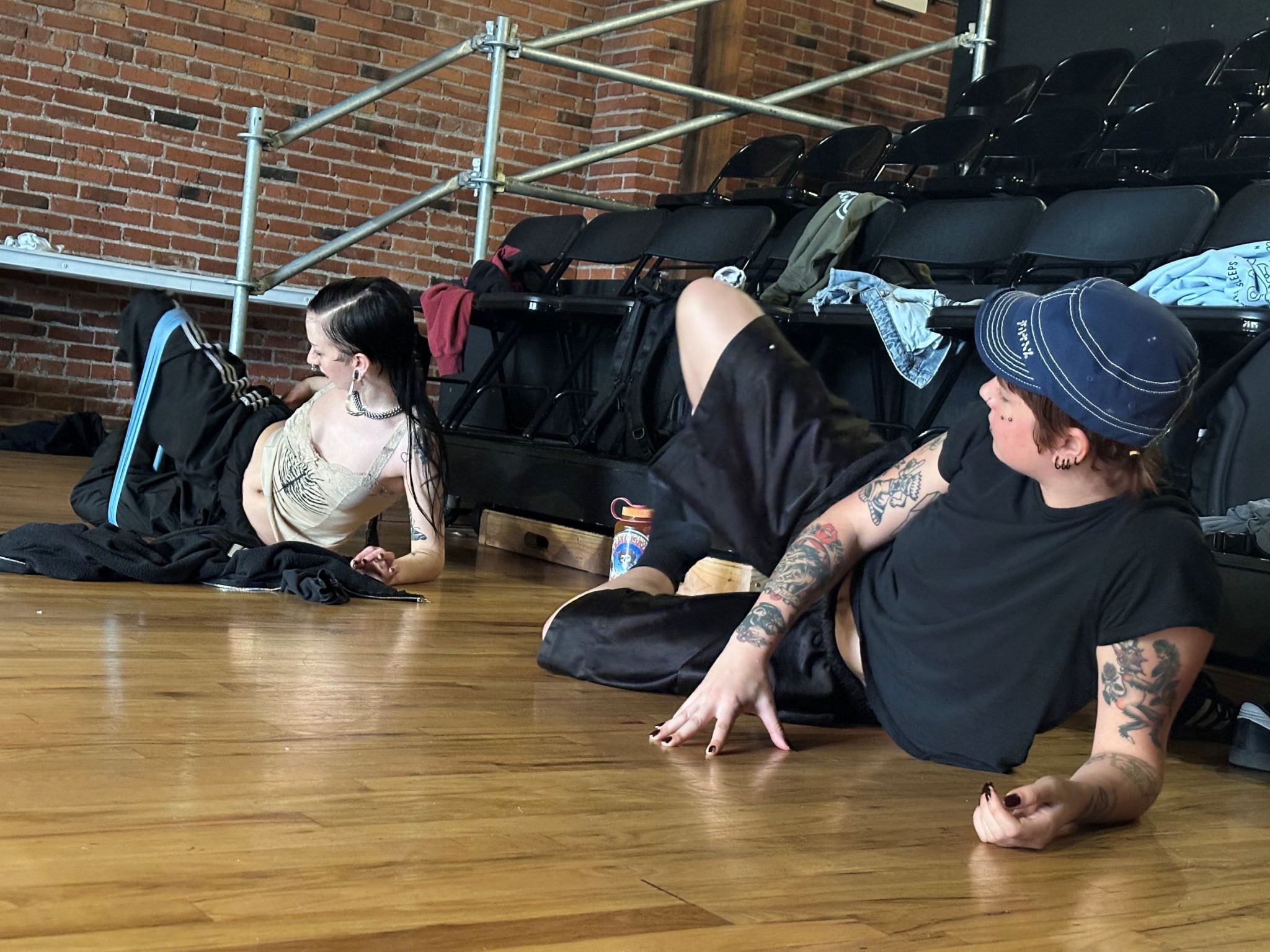 “Kai and Syl participating in class to their ability and desire.” Photo courtesy of Ballet Rituals
“This is not a silent space,” they remind us at the beginning of every class. They invite us to laugh, cry, yell, breathe, and chat our hearts away. And they do a great job exemplifying this as well. As teachers, they are constantly showing their hands. Laughing at each other, talking over each other, forgetting what combination they were about to teach, and swearing like charming, graceful sailors. I say all this not to paint them in an unprofessional light, but to highlight the frankness, the lack of facade. These are real people, real dancers with real, full lives, teaching other real people, real dancers with real, full lives. It is an exchange of palpable authenticity. It’s what makes their class so addicting. Be present with the people you’re dancing with, be present with yourself. People who care about people are the best kinds of people.
Ballet Rituals is returning this fall after a summer break. Alethea and Hannah teach on Friday mornings. Tuesdays are now dedicated to hosting contemporary classes taught by local dance artists, a shift in programming they implemented a year ago. And while I do miss getting to do ballet twice a week, I cherish the opportunity to work with people I’ve seen all over the Seattle dance scene: danced with in class, seen on stage, and admired from afar. This September the guest artist is Natalie Grant, a dancer I’ve had the pleasure of being in process with for the past couple of months. She’s strong and fiery and silly and I can’t wait to swing my body around in her class. It’s a special kind of community expansion that they’re offering. This is generosity: choosing to extend their resources to many working artists, giving their highly curated, highly tender space to others, allowing diverse dance forms to flourish and find homes in new bodies.
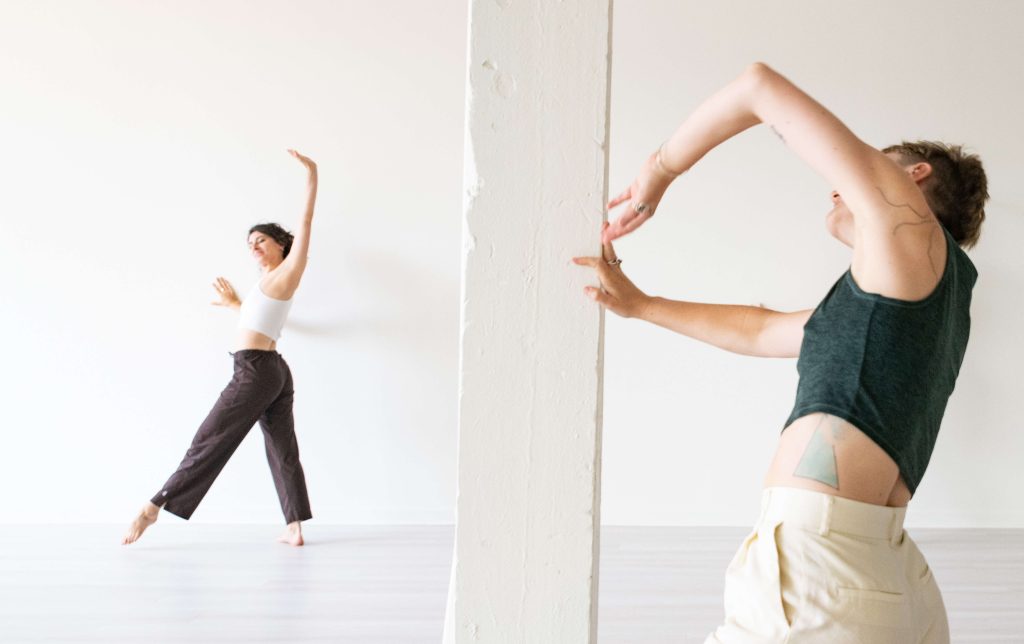 Photo courtesy of Ballet Rituals
I’m not sure how much more I can say without risk of repeating myself. This class has (with complete comprehension of the sound of my own melodrama) saved me many times, I could not recommend it more. I want to thank Alethea and Hannah and Maya for being the entirely wonderful and loving humans they are. Since becoming entangled in Ballet Rituals’ extensive network, they have, collectively and individually, given me nothing but affection, respect, and unparalleled guidance. I truly don’t know where I’d be without them. Probably still hating ballet.
Submitted by Kai Leigh Roach
Ballet Rituals regular classes happen Fridays from 9:30-11:30am at NOD Theater: 1621 12th Ave in Seattle’s Capitol Hill neighborhood. Rituals’ contemporary practice class happens Tuesdays 9:30-11:30am in the same space. Class payment is sliding scale and can be done through cash or Venmo at the door. Regular programming and special pop up classes can be learned about by following @balletrituals on instagram.


