 Photo by Don Smith
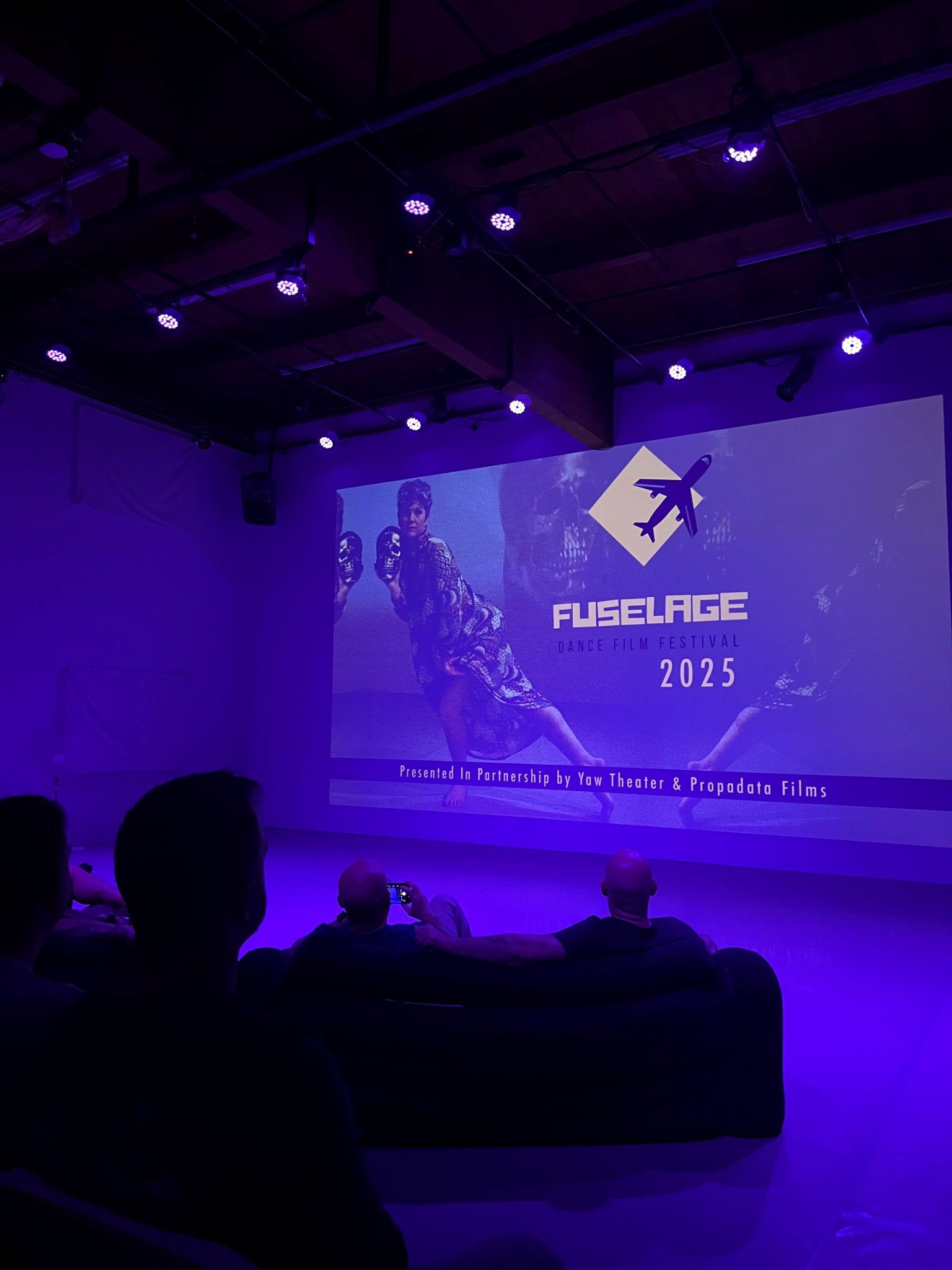
A film maker and a dancer met at Franklin High School in the 90s. Three decades of friendship later, Will Lemke and Stella Kutz are producing their 8th annual Fuselage Dance Film Festival. Co-produced by Kutz’s Yaw Theatre and Lemke’s Propadata Films, Fuselage presented twelve films centered around dance and movement, all the way from Egypt, Japan, as well as local artists from the Pacific Northwest.
Many of the films highlight dancers in the outdoors, with coastal beaches, wooded groves, sunlit fields, luscious waterfalls, and creviced rockfaces. Kiley Dolaway’s Directions To The Other Side Of The World features a stunning moment where Dolaway tumbles down a grassy hill with abandon, spilling backwards into snapshots of suspended momentum, rolling with and seemingly without gravity. Noel Kayser’s dust contains breathtaking shots of the Oregon Coast. The film starts with Bree Kostelnik carrying Audrey Wells as they stand in the middle of rapidly rolling waves of the ocean. Their bodies fold into one another with agility and the comfort of a long-woven relationship, hands firm and tender in their holding. The occasional rush of ocean sounds keeps us sensorially immersed in the environment. Sometimes the dancers are in focus, and sometimes they hover blurred in the foreground. In their sand-colored costumes, their bodies move as a part of the natural landscape.
Duets continue as a trend throughout the films, exploring the relationships that two bodies hold, in movement and the interpersonal. In I See Tyler Chang and Emmy Cheung move beautifully together in segmented, serpentine undulations, flowing through winding caresses, finding moments of regal lifted stillness. In I Love ABC, dancers Gwendolyn Benitez and Samantha Matsumoto embody the voices of two young sisters in a childish manner as they frolic through rooms in a house, while animated origami horse shapes plop along. Bri Wilson’s unfelt features local dancers Nicole Flores and Hayley Keller in the forest, their characters grappling with the heavy weight of letting go. While many of these duets hinted at the struggles of intimate relationships, Zero Sum Game, choreographed by Liz Dibble offers the most overt portrayal, as a couple points and gestures at each other, observed by a filled university lecture hall, while listening to advice about how to win an argument.
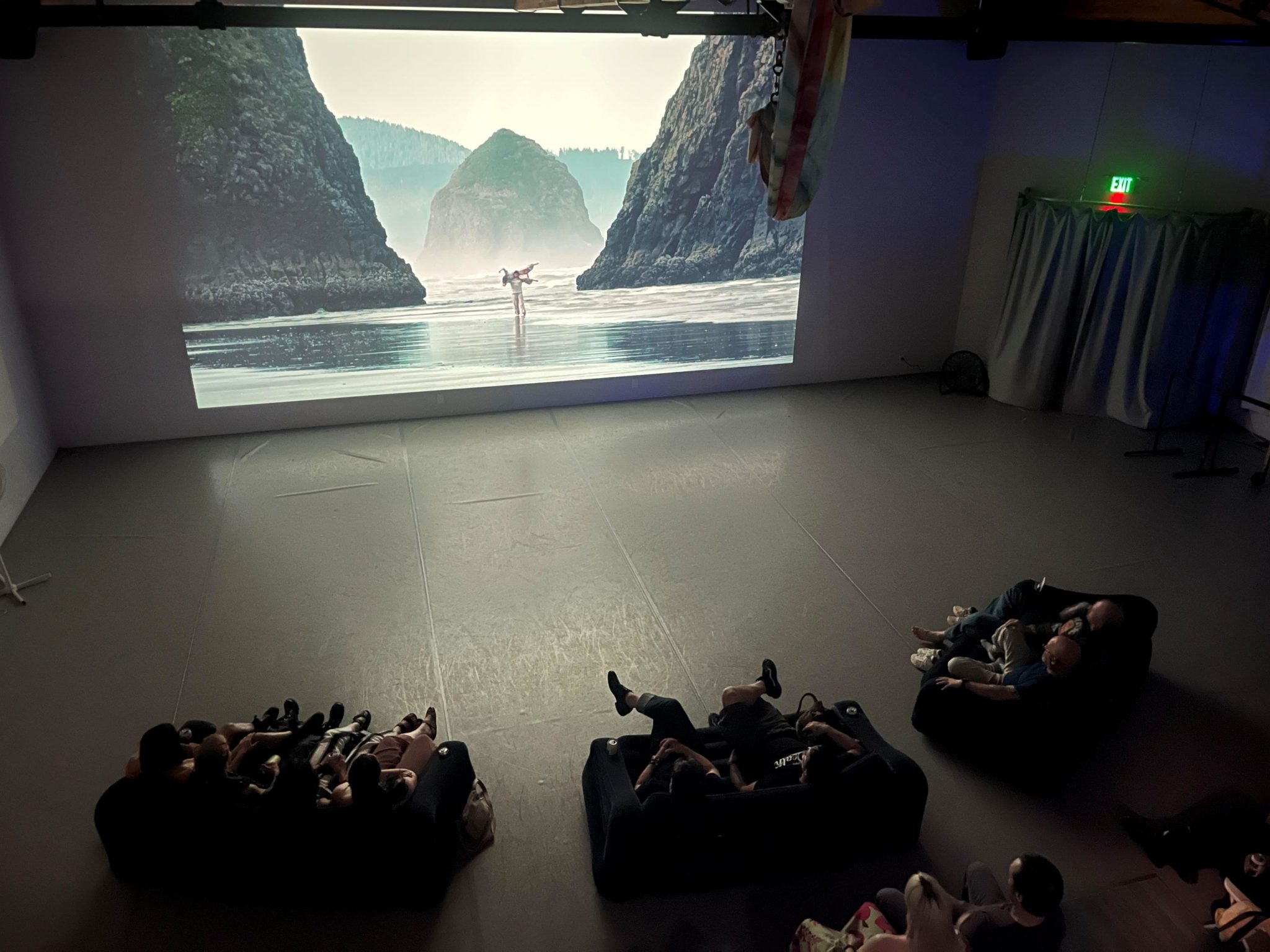 Photo by Don Smith
Whether it was curation or culture zeitgeist, there were some lovely moments where the films talked to one another. From the vivid red costumes in I SEE and einmin to the drone aerial shots in dust and Directions to the Other Side, pieces hold echoes of the other films. During unfelt, Flores opens their mouth to scream releasing the roar of the ocean waves, and in the second to last film I am Going Home, we see Emanuel Malak fully submerged in water, open their mouth to let out a noiseless scream, the ocean holding the sound back.
Two notable pieces caught my attention with their senses of presence and play.
In Anime Libere, eight young dancers, bundled in sweaters and scarves, shift and wiggle in an empty plaza. Choreographed by Suzanne Meyer with the children, the film balances compositional dance gestures with glimpses of unfiltered natural movement impulses. The piece ends with everyone clad in ruffly frocks and paper crowns running down the stairs in a raucous parade. As dancing adults, I find that we are often trying to find or replicate these childlike states of movement and play, and it was so refreshing to see such an honest experience of those states, up close on film.
In einmin Vár Bech Árling was able to find a similar state while incorporating their fluent and agile dancing. Set in a deserted building, the entire piece is an obstacle course for embodied play. As they swivel on an office chair, surprise handfuls of confetti are thrown in the air and balloons roll around under Árling’s shifting floorwork. The camera movement must be mentioned, because Rannvá Káradóttir filmed this 5 minute piece in a single shot, while the camera and dancer navigate moving through narrow corridors between different rooms, and interact with preset props in a smooth, active, exciting way.
I love to feel the choreography of the camera in dance films. When done well, we are invited to experience the movement with more of our senses, and we can increase the kinesthetic empathy that allows us to really come into the dance. Such is the case with Claire van Bever’s The road is still before us, a bright strip of dawn, with cinematography by Holly Roberts. Though shot entirely in one room, the constant circling and movement of the camera gives the space an aliveness. There was a particularly exciting moment when the camera zooms in as Rachel Thalman and Myles Tracy touch their foreheads together, their heads stay centered and tightly zoomed in the frame, so that when the camera pulls away revealing them now kneeling on the floor, we feel a satisfactory excitement about things that unknowingly change right before our eyes.
You Huo – Slow Living also highlights how dance films are the intersections of many disciplines, not just dancers and camera crew. At first seemingly a solo, it became a dialoguing duet with the pianist, then a trio with the camera person, and even a quartet when a second camera stepped back to reveal the first camera moving through the space as it filmed the dancer’s intricate arms tangling around themselves. Behind the scenes footage also wove into the film itself, showing crew steaming the fabric, and setting up the ladders, and editing the footage.
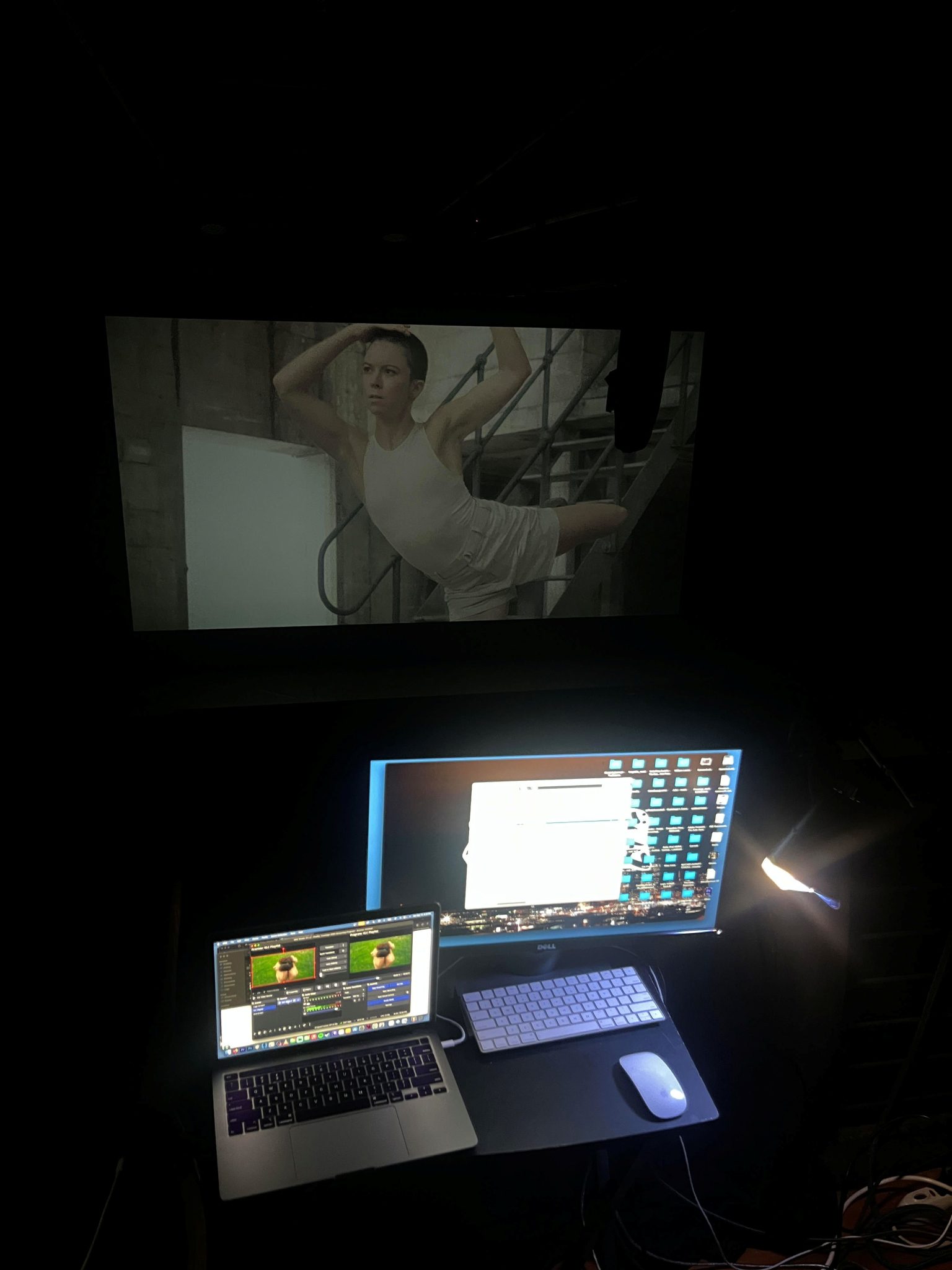 Photo by Don Smith
Much like how Fuselage is the overlap of Kutz’s choreography and of Lemke’s videography, dance films bring artists of many different forms together to create ideas. The storyboarding, prepping for the shot, the choreography, the costumes, the weather and unknowns of site-specific work, the spontaneity, the PA’s who dab the sweat, the editing, and the prep for the screenings. The convergence of meticulous planning and virtuosic improvisation is where the magic happens. There is only a brief moment each shot can occur–the fleeting warm glow of the golden hour pours in through the windows and the dancers jeté across the room. Leaning their head backward into the sand, a crashing wave narrowly misses them. The balloon falls in just the right way. While some things can be artificially added and we can sometimes “fix it in post,” dance films create long-lasting capsules of wonderful ephemeral moments, brought on by many collaborators, allowing us to breathe with the movement on screen as a hand cradles a loved one’s head, an air bubble is released into the ocean, a swaying arm billows the fabric in the wind.
Fuselage Dance Film Festival was presented at Yaw Theatre on Saturday September 13, 2025.


