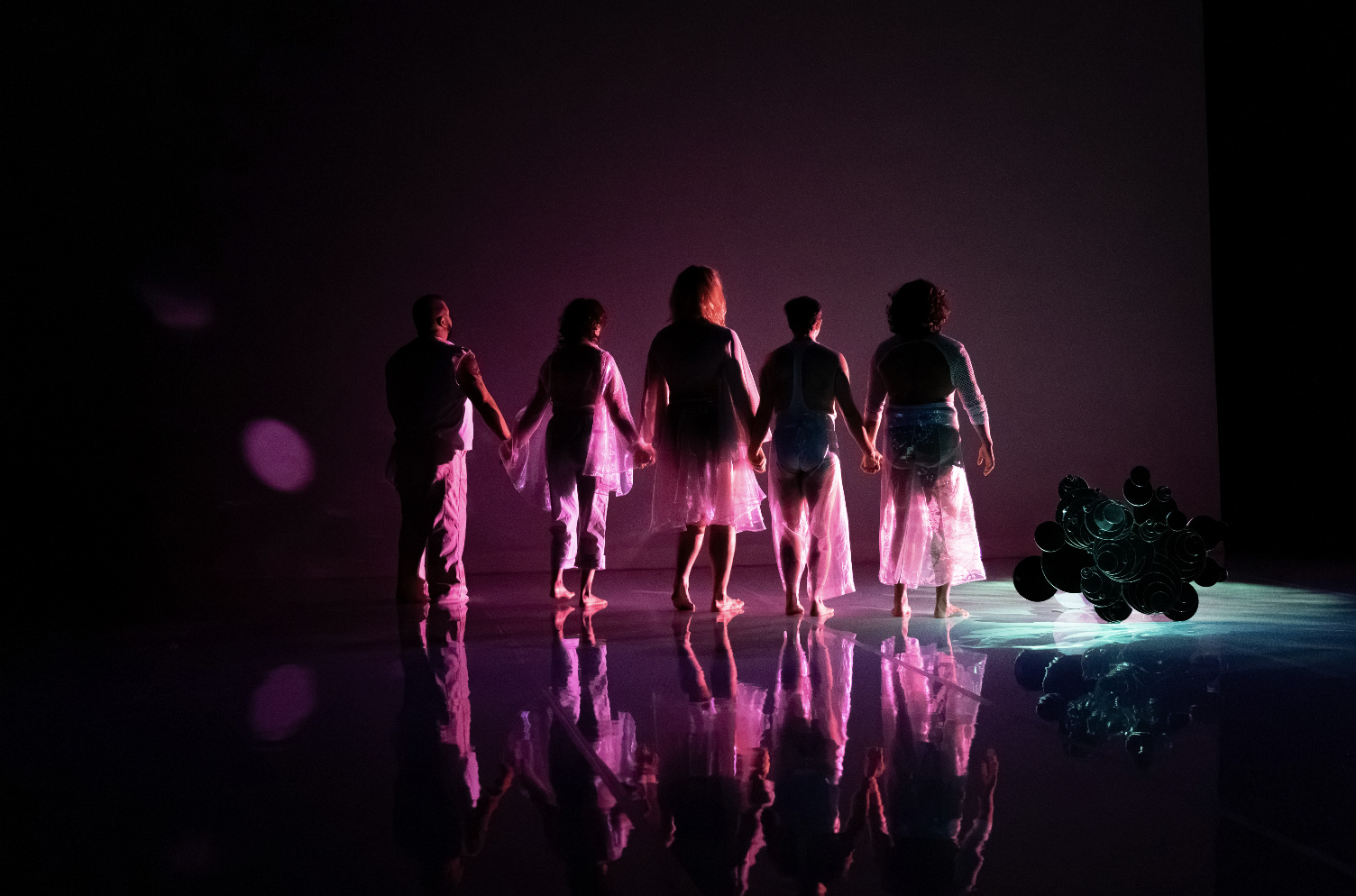
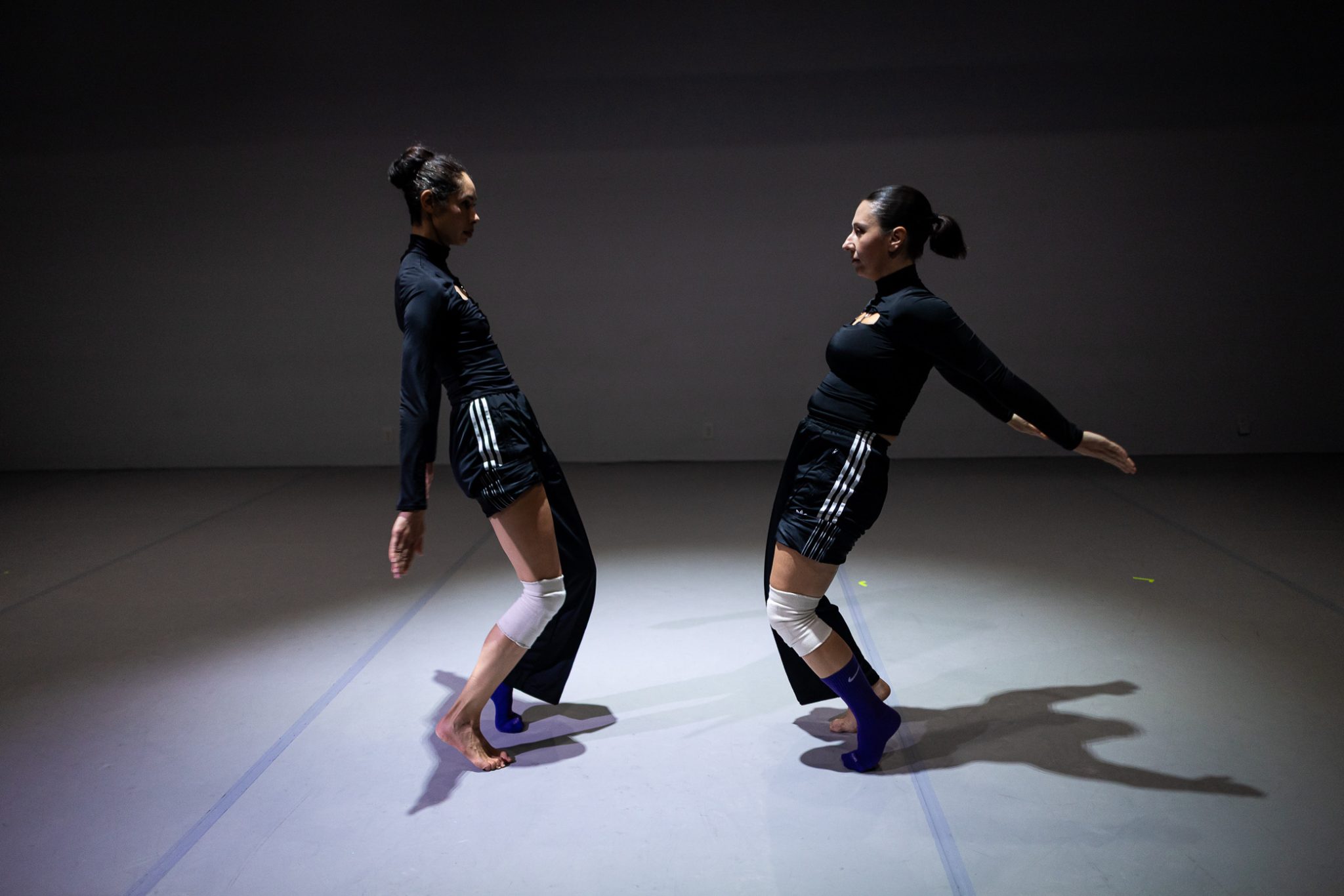
Clowning. Chimes. Cinematography. Three colorful works from local and touring artists featured in Odds and Ends at Nod Theater at the end of August. The lineup, originally a split bill between Grace Yi-Li Tong and Heather Dutton, had a last minute switch due to covid, replacing Dutton’s work with a short film by Colby Lamson-Gordon and premiere solo work from Giordana Falzone.
Falzone appears in A Third Red with bells tied to her wrists, backlit and luming. The bells roll softly, creating a symphony of gentle chimes like a cat sneaking into a room. As Falzone flings limbs, crawls, and reverberates, the chimes create a soft cacophony. Twisting and turning, joints mimic the way the balls roll inside the bells. Suddenly, the string of the bells is between teeth, then drops from the mouth. Getting right up to the edge of the stage, she makes curious eye contact with the audience. She adjusts the straps of her camisole preparing for a swirling frenzy of jumping and turning. Finishing on one leg posed like a flamingo, she looks back at the audience. A Third Red is a mischievous exploration of sound and audience gaze.
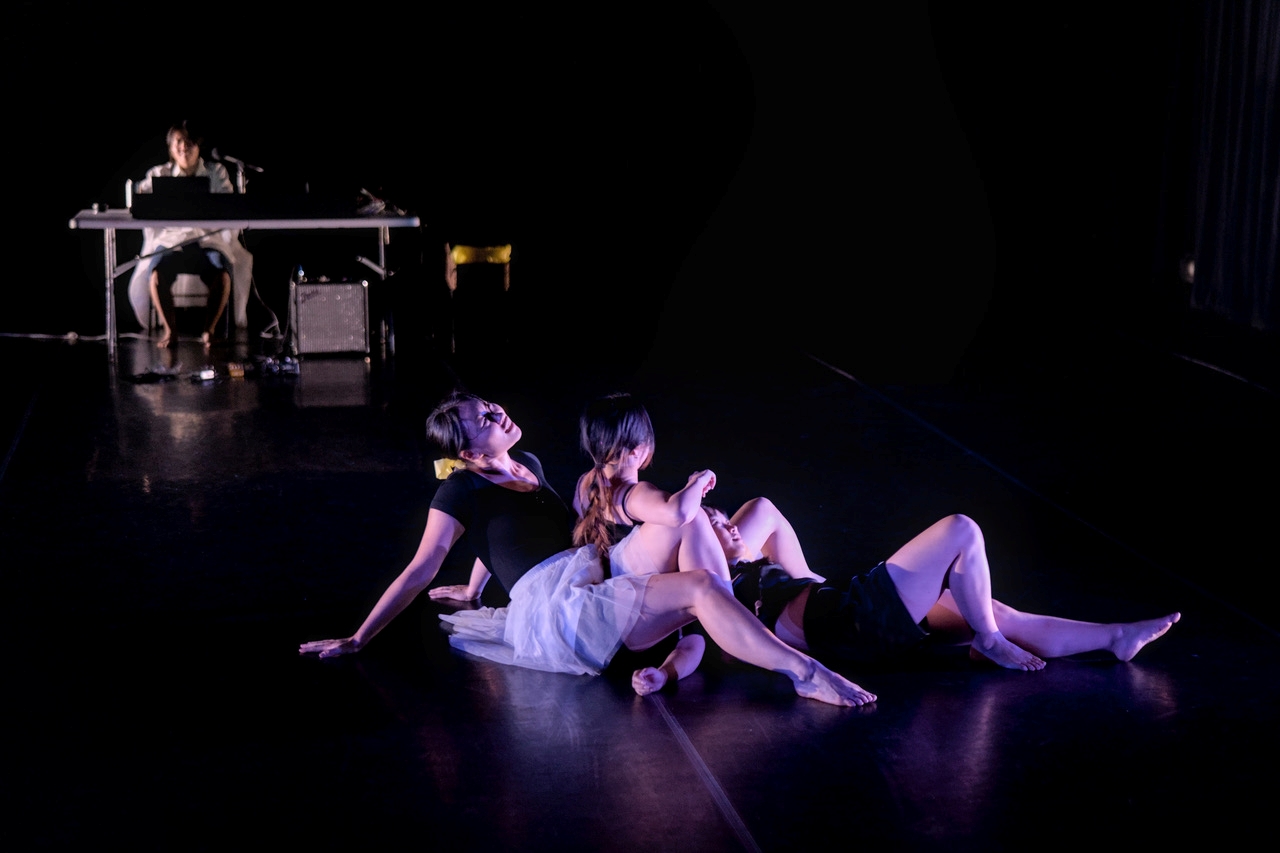 Photo by Rich Tong
Grace Yi-Li Tong, originally born and raised in Seattle, returns from New York where she currently resides to show MAYDAY MAYDAY MAYDAY, a work in-progress exploring forces of assimilation and kinship in Asian Diasporic communities. Featuring a referee’s whistle, extensive protective gear, and a bright yellow rain poncho, New York artists Rachel Ha-Eun Lee and Hiroka Mori Nagai join Tong to make a dynamic trio that frequently resembles ducklings in a row. The three play on stage like children moving in synchronized rhythms and teasing each other with exaggerated facial expressions. Also on stage is collaborating musician Lamson-Gordon, who creates a vibrant live soundscore: snapping a tape measure into an echoing microphone and operating a soundboard to create ambient noise at various tempos. One dancer poses another upright, but as they walk away, the dancer falls out of the pose. Their peers run to frantically prop them up over and over again in an increasingly traumatic fashion. It’s an animated comedic gag riddled with tenderness. What appears to be a bit for the audience has a softness and urgency to keep the dancer presentable. This made me think of the way sometimes it can be our own communities facilitating the process of assimilation to ensure collective survival.
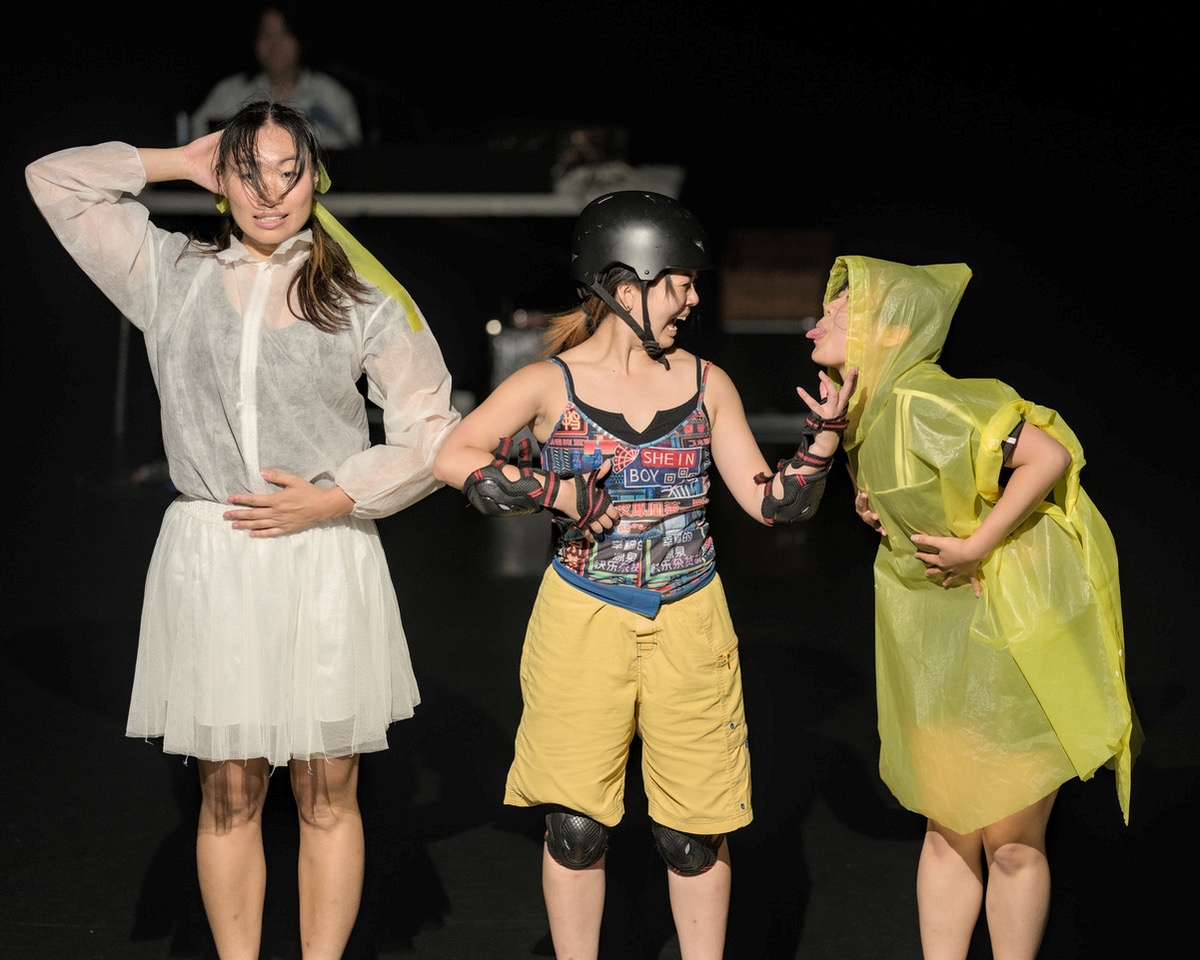 Photo by Rich Tong
In another section the trio faces the audience brightly, front lit like a stand-up show. Sitting in a line, they pantomime gathering bubbles from a bath to create foam shapes on their bodies. They mimic hats, biceps, and breasts, just to burst each other’s bubbles and cackle at one another. This playfulness is cut off by the dancers evoking abrupt high pitched screams in unison and falling backwards rolling on their tails. Two of the dancers emerge out of this cycle, then proceed to pose and make fun of the last dancer still yelling and falling. This section plays with the model minority trope, as the two dancers lean over each other and sarcastically pantomime at the odd one out to the audience, demonstrating the harmful impacts of both fitting a stereotype or falling out of it. Though they continuously make fun of each other, the trio still looks after one another.
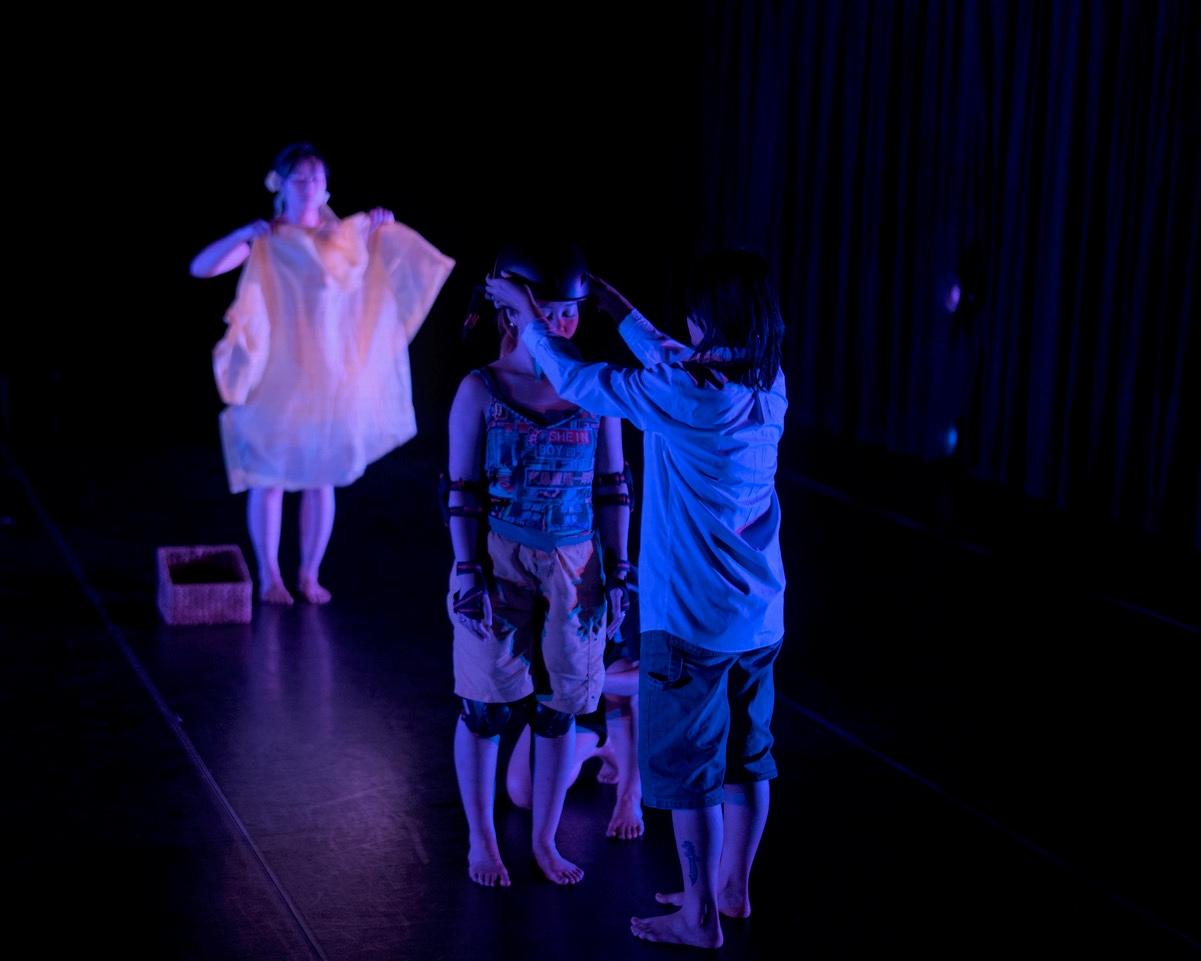 Photo by Rich Tong
The care continues as they put safety gear on each other: elbow and knee pads, a bright yellow rain poncho, a helmet. As warmly as a mother would. They explore their new worlds in their new gear: hopping, stepping, and framing the face like the sun. The dancers all come together in unison, as the music and phrase speed up and escalate cartoonishly like a children’s TV show at four times the speed. Eventually the dancers explode into a frenzy of disjointed sporadic movement. These sections of unison, ecstatic breakouts, and tender protective moments convey the complexities of community dynamics. The dancers navigate their individuality and conformity with one another, at times aiding in the collective process of assimilation or actively resisting it. But the sweet moments of play, teasing, and helping one another remind us that love is at the center of their actions.
Lamson-Gordon’s I can see the moon, and sometimes I wonder, is a poetic short film addressed to the artist’s unknown birth mother. The work is embedded with history and includes spliced images of landscapes and people, as Lamson-Gordon tells their story. The film’s depiction of transnational Chinese adoption and questions of identity pair well with the themes of assimilation in Tong’s work. Seeing the film provides a cultural context and richness to Lamson-Gordon’s performance in MAYDAY MAYDAY MAYDAY, where in addition to creating the soundscore, Lamson-Gordon is fully a part of the world. At times, hiding under the desk with the rest of the cast or leaving the sound table to deliver protective equipment.
Through zany worldbuilding and continuous care the dancers show for each other, the performers leave me questioning the role community plays in our assimilation, how we navigate agency, balancing individualism and collectivism, and how we show up for each other in the process.
Odds and Ends ran August 28-29, 2025 at NOD Theater. A link to the program can be viewed HERE.