 Photo by Christine Mitchell, House Tornado Multimedia
The red monorail train glints against a cerulean September sky. Today, as it rebounds between the Seattle Center and Westlake Station, it is a stage for four dance icons. Mark Haim, Tonya Lockyer, Wade Madsen, and Bebe Miller, each of whom have shaped the dance world in their own way. Their aggregate wisdom permeates their performance of MALACARNE’s chapter 2: psychogeographic drifts. As the title implies, for me, the liminal state of traveling stirs daydreams and poetic musings. The performance amplifies this effect for the audience who are literally lifted from the rut of routine, hovering above 5th Avenue in Seattle’s emblematic elevated train.
We become aware of the equally legendary Wade Madsen as we glide by the luscious metallic folds of the Museum of Pop Culture. His tomato-red jean jacket, T-shirt, and jeans are precisely the same color as the seats. His laser-blue eyes break the camouflage. Blinking, he turns his head robotically. Parking lots and anonymous buildings blur by in the background. Madsen watches with slack hanging arms that turn to tense fists. He talks silently and laughs to himself. I’m caught between feeling uncomfortable, like when encountering a person having a mental health crisis, or like I missed the joke. His hands turn to bird claws pulled in a taut V behind his shoulders. This becomes a signature motion for Madsen throughout the performance. When his mouth, with his trademark curly-tipped mustache and goatee, articulately morphs from cheesy grin to silent scream, I am reminded of the Hunger Games for some reason. Perhaps it is because we are watching a very personal experience of thoughts and emotions shaking and rippling through his body, as if it’s reality TV. Normally, we avert our eyes from truly witnessing and accepting our shared humanity.
I jump when the train doors blow open pneumatically at the Westlake Station. An unwitting passenger gets on the train and is tactfully ushered through the sold-out performance car. The fact that people can accidently wander through a MALACARNE show indicates how “All the world’s a stage” for choreographer Alice Gosti. She is skilled at integrating dancers, viewers, and urban environments that braid time, duration, and motion. Her selection of drift’s four seminal performers allows Gosti to showcase their adept movement capabilities like a caricature artist encouraging audiences to perceive their daily lives anew.
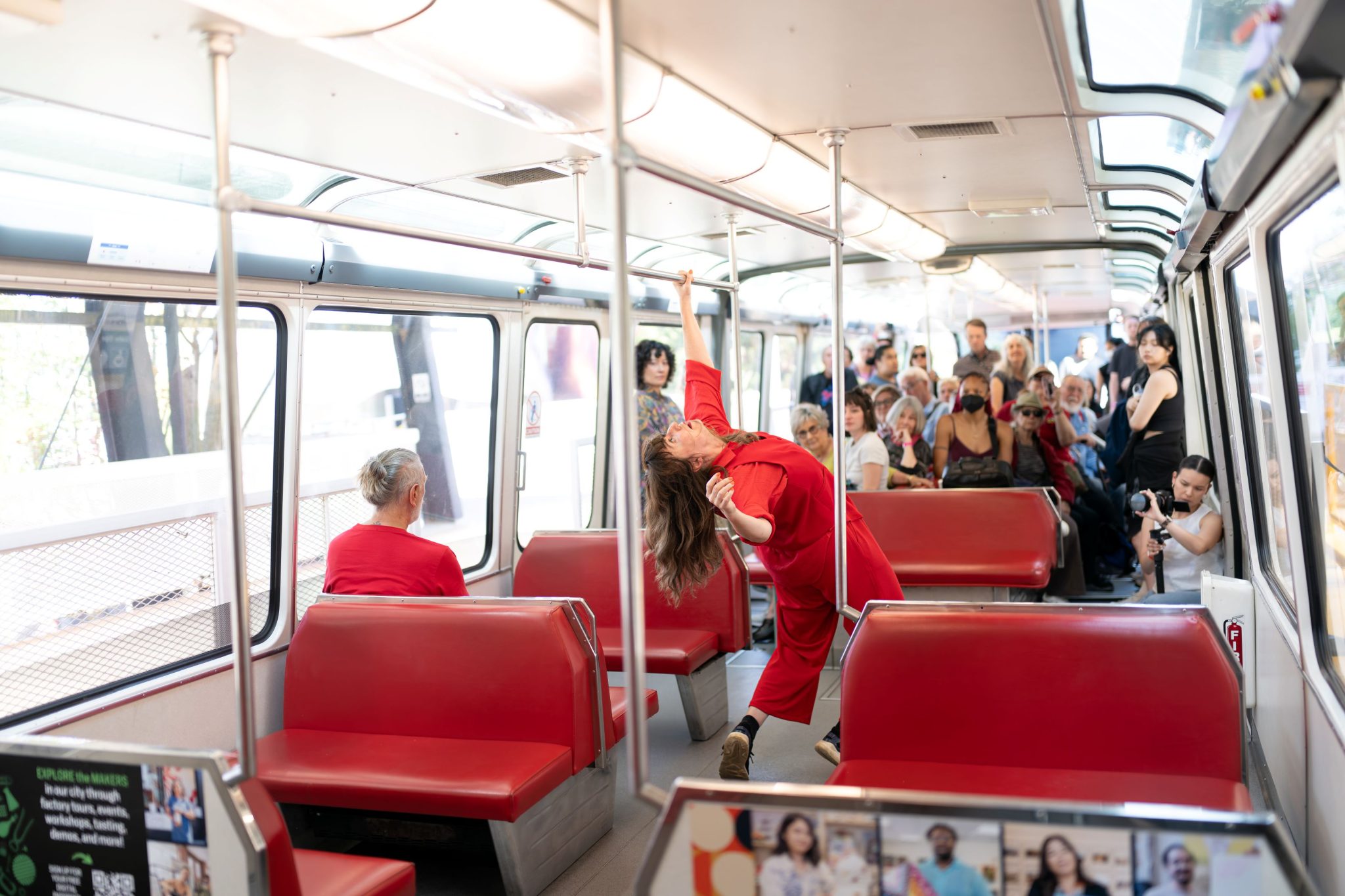 Photo by Jim Coleman
Like Gosti, the next canonical performer, Tonya Lockyer, is interested in dance that lives “…on the frontiers of life, where you feel alive and can be in conversation with the world,” her website bio says. Lockyer’s fingers twitch, picking at something invisible, and then make a motion like pulling a spider web. She collapses and Madsen, seated now, takes his jacket off. The monorail surges toward the Seattle Center, while Lockyer hunches, holding the seats against the momentum. As her body resists the direction the train is taking her, I think of how so much in life is outside our control. She relaxes and pinches near Madsen’s face, smiling big for no reason. An exaggerated embodiment of a cry to be seen in a river of fellow humans.
Pulling into the Seattle Center station, I feel the back-and-forth motion of the Monorail creating a micro-circadian rhythm, a tide of time. Like in a good sci-fi novel, we are in a space/time bubble buffered against the sounds of the street. Lockyer fan kicks into a penché, hair in her face. For what seems like a long time, her extended leg waves like a listless flag. I feel wistful noting that the music has morphed from frontier-hopeful harpsichord to the sad accordion sobbing. The drifts soundscape is scored by ings, who composed MALACARNE’s chapter 1 in 2023, and whose ears are highly attuned to the Monorail’s rhythms and moods. She scored Kraken-themed music for the fans’ ride to the stadium (also in 2023), and reworked the Monorail’s guest experience audio to better suit the speakers.
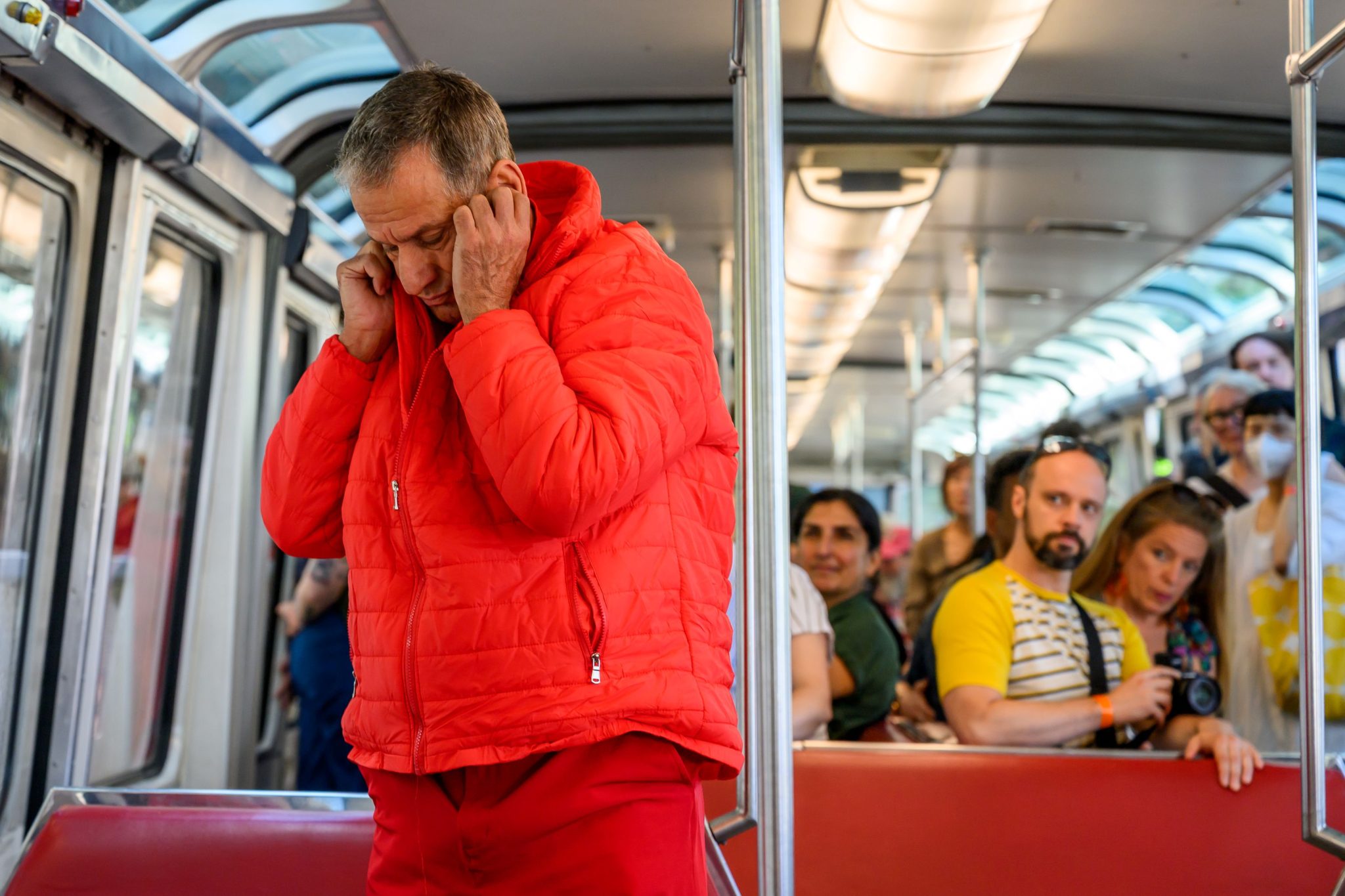 Photo by Christine Mitchell, House Tornado Multimedia
Some passengers disembark and Mark Haim sits on one seat in the performance area and then moves to sit next to Madsen. Haim, dressed in scarlet shorts and black socks and tennis shoes, looks like a boyish Dennis the Mennis. His costume belies the internationally acclaimed choreographer’s movement sophistication. All three performers, Haim, Lockyer, and Madsen switch seats while looking out the windows, avoiding each other’s gaze. To the strains of a desolate violin, Haim looks scared as his face tilts toward the skylights. He scoops something from the ether towards him, then makes a tie-straightening motion like it’s time to adult. Suddenly he contracts, arms rounded like he’s holding the weight of the world.
The music changes, we reach the station, and Haim, his elbow bent at 90 degrees, yanks twice like pulling a train whistle—an inner child emerging. He falls face forward to the floor. Madsen and Lockyer look worried.
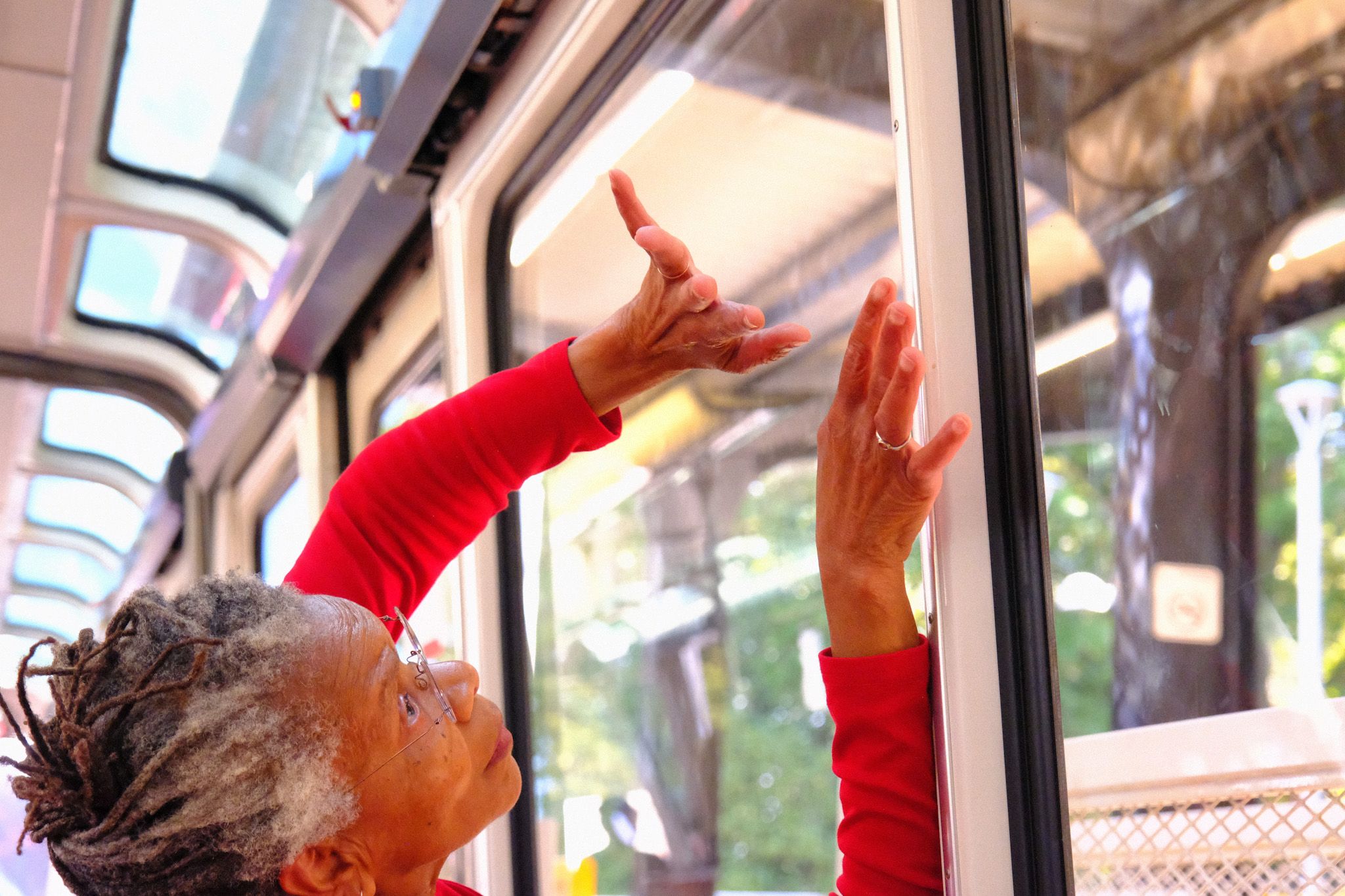 Photo by Cameron Day O’Connell
Enter illustrious Bebe Miller all hallmark braids and bracelets. She sits sounding “Oo, oo, oo,” balling her fists in front of her face, alarmed. She grabs the handrail, looks out the window and snakes to her feet. Miller stands with her hands on her hips, then sits pushing against Madsen, eyes scanning the view out the window. Around her, periodically the other three dancers move as if activated and unsettled by Miller’s presence. They switch seats. Haim’s head bobbles. Miller launches urgently, hanging by her belly over a seat back, arms reaching into the audience area.
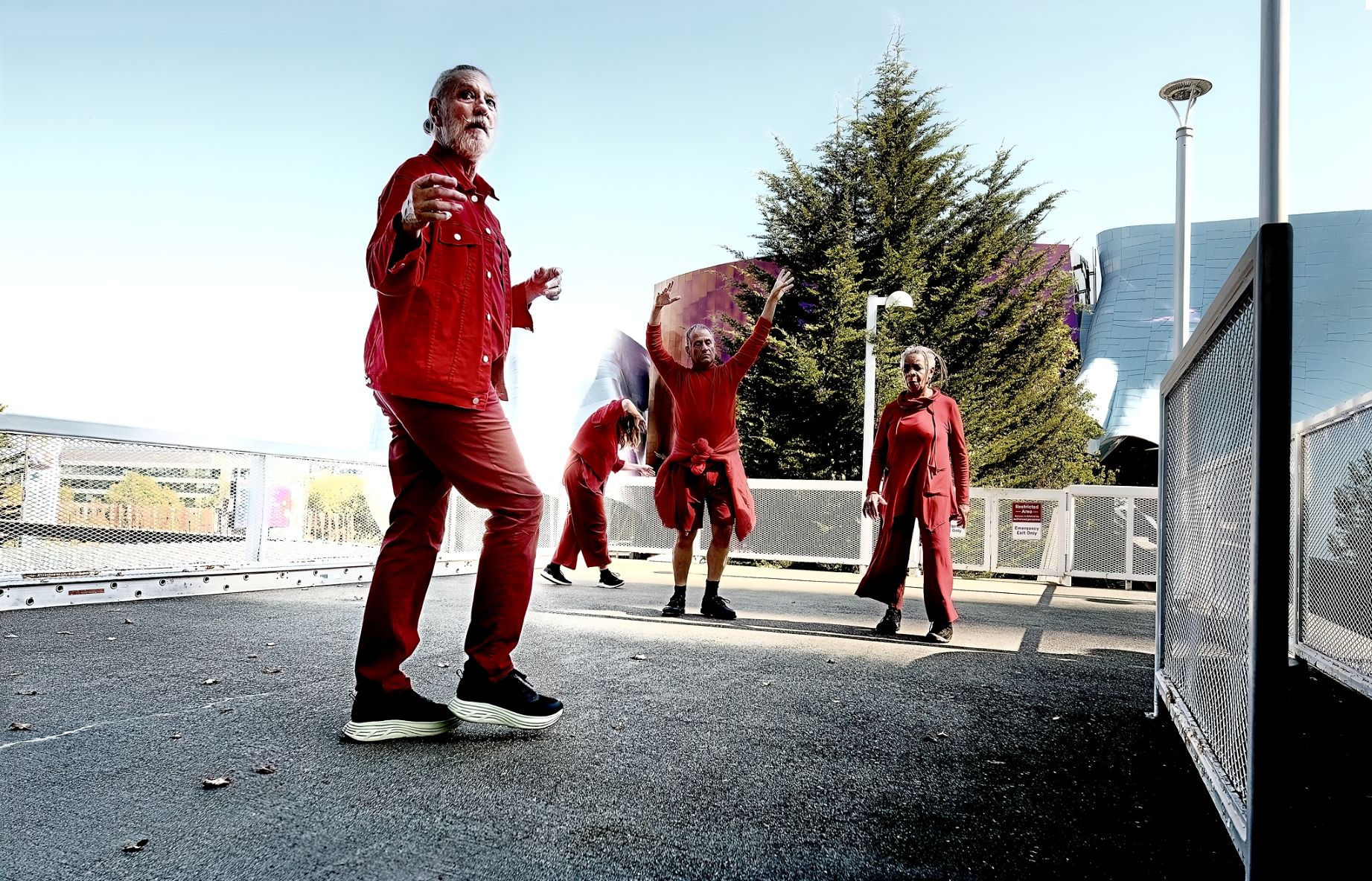 Photo by Joe Iano
Watching the four be influenced by and move around each other is reminiscent of how people dance to unspoken social cues like in an elevator. The performers collaborated with Gosti to create the choreography. Reading Miller’s website bio, I feel like I can see how this section demonstrates how she is “…interested in the space between people: how telling, how specific, and how dynamic it can be…reveal the subtext of our interactions. Our bodies, focus, intention and awkward grace hold all the evidence we need.”
The dancers move off the train onto the Seattle Center platform performing some of their motif motions. Madsen’s hands and arms plucking bird wings, Haim pulls a train whistle and holds the heavy world, Lockyer’s breastbone vulnerable for the thrumming, Miller chews and points. Their vermillion figures vibrant against the impossibly blue sky, they file off the platform, trailing their collective wisdom like the green streaks when you look at the sun too long.
chapter 2: psychogeographic drifts was performed on the Seattle Center Monorail, September 17, 2025, at 12 p.m. and 2 p.m. The program can be viewed HERE.
It is part of the Artists At the Center project—a multi-year collaboration between the Seattle Office of Arts & Culture and the Seattle Center. The project is made possible by a 10-year grant from Climate Pledge Arena and Seattle Kraken.


