The pewter water of the Salish Sea riffles just beyond the orange arcs of Alexander Calder’s sculpture The Eagle. Pearlescent clouds pregnant with vapor scud and swirl in breathy wind. For the audience inside the glass-walled Paccar Pavillion, atop the Seattle Art Museum’s Sculpture Garden, the water cycle outside is almost palpable. In this way, the venue itself introduces the core precept of Karin Stevens Dance’s Sea Change Within Us—that the health of Earth’s water is inseparable from our own survival, physically and spiritually.
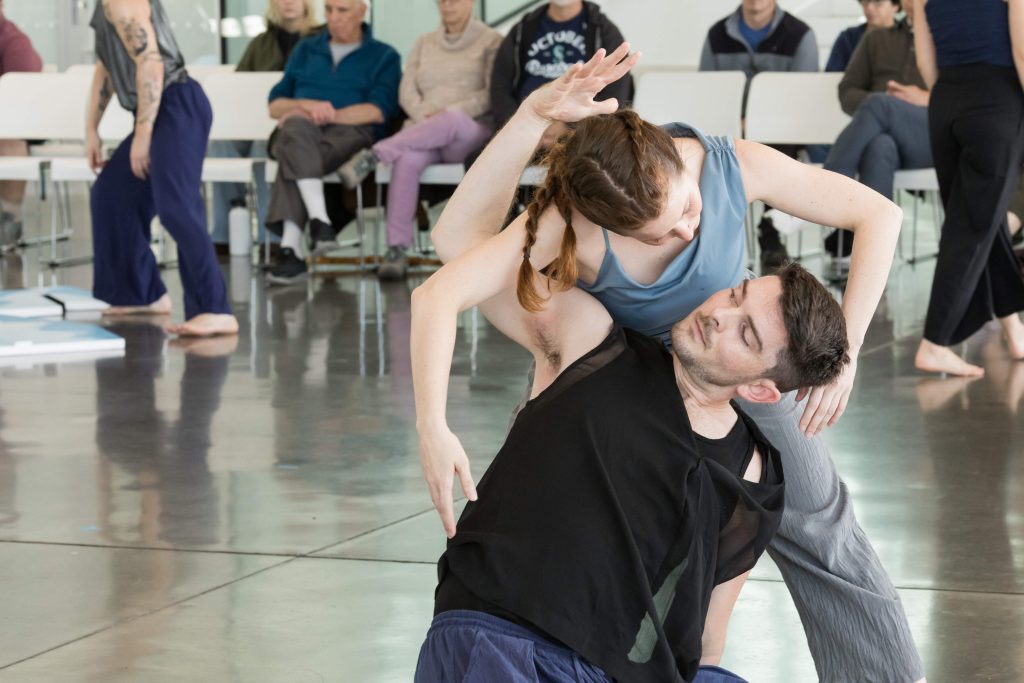 Madeleine Gregor & Michael Walton in “Ice” section. Photo by Michelle Smith Lewis.
Publicity materials about the dance describe ambitious goals: “Eight dancers…express concerns about rivers and dams, endangered species, ice, ocean and sea-level rise, flooding, migration, Indigenous fishing rights injustice, divisive politics, and human dis/re/connection.”
Normally the stuff of overwhelming headlines, I wonder how KSD will filter the complexities of these heady topics somatically. In her pre-performance talk, Stevens introduces some key collaborators involved in the creative process—marine scientist Gerald Erickson, visual artist Roger Feldman, and artist activist Lucy Larkin. They are just a few of an impressive diversity of scientists, policy advisors, Duwamish Tribal leaders, and more who were instrumental to the eight-year creative process detailed on KSD’s website. Interview clips with these collaborators weave throughout the soundtrack in the coming performance.
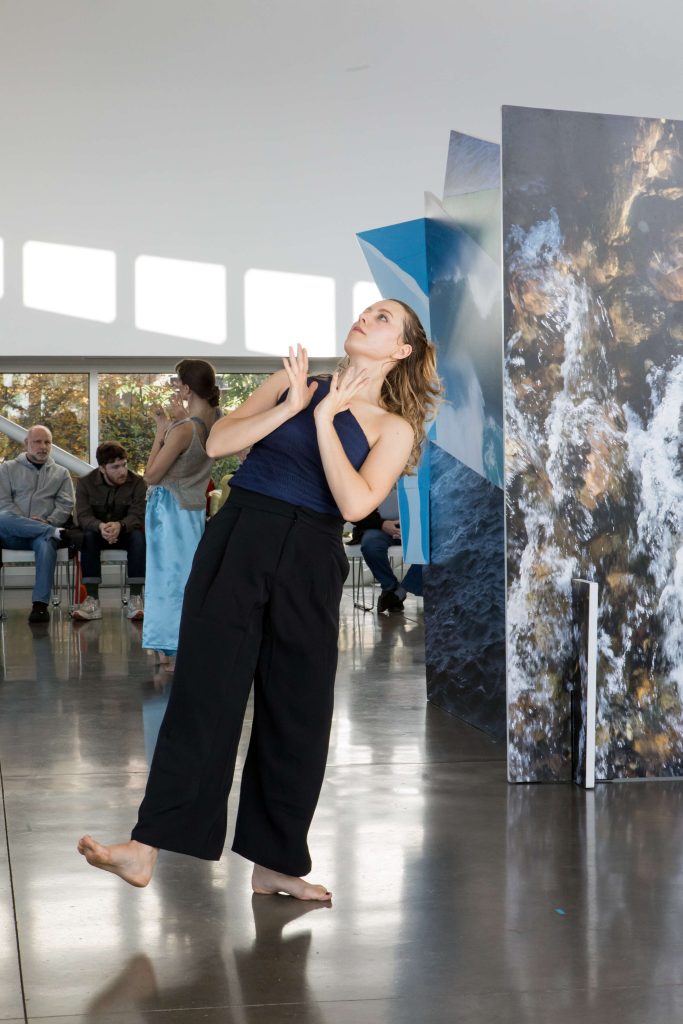 Ellie Van Bever as Salmon. Photo by Michelle Smith Lewis.
The grave urgency of the climate crisis makes me queasy. Stevens, as a movement-based artist, believes the keys to change and hope lie in visceral responses like mine. As she continues her introduction to the work, Stevens describes the special emotional, cultural, and spiritual attunement we have with water, the main element composing our bodies. In Sufism, Stevens tells us, the word “compassion” is linked to “womb” where we all begin life in water. Stevens sees water as an interfaith element, one that unifies us all. Stevens’ goal for the performance is to corporeally connect the audience with our environment. In that spirit, Stevens asks us to shift side to side in our seats like salmon and to bow our heads to our hearts like orca.
As our movement subsides, the dancers trickle into the performance space. One hovers her hand, like a qigong energy caress, over one of Feldman’s four irregularly shaped foam art panels depicting various stages and forms of water. The panels lie flat on the floor in the corners of the space. Wearing drapey tunics and wide-legged pants, the dancers’ costumes—most in soft grays and sky blues—echo the color palette of the panels.
Suddenly the dancers rush to the center like a crash of waves against a barrier. Then they lunge away like the ebbing tide, hands gentle like kelp, heads arcing like orcas surfacing and diving. Like flotsam and jetsam, bits of spoken word from the soundscore collect in my consciousness, “Midnight of survival…salmon, salt in the air…my body is a song, each note different, every tide a nocturne…”
As a dancer exhales like a whale surfacing, I hear, “Is there a way we can redefine ourselves as a species?” The question hangs like ocean spray in the air of the light-filled room. The audience forms a shoreline of sorts, surrounding the performance area on four sides. We see each other just beyond the dancers and thus become part of the conversation. I feel accountable to my fellow viewers in a way I wouldn’t in a dark theater.
The text and the movement echo and amplify each other, modeling the equanimity of the watery world. “Ultimately the water moves to the ocean, regardless of boundaries. Humble yourself.” The dancers flatten to the floor as if under the rolling force of surf. Underscoring the self-effacing properties of water, I note an egalitarian quality of the choreography. There are no solos or duets. The dancers move around space in the sophisticated synchronization of schooling. A violin keens like a whale crying. They support each other as they move. I think of the way the orca mother, Tahlequah, famously carried her dead calf for 17 days. The score urges us to act on the empathy stirred by this undeniable display of grief, “We have to come together if we want to make a change.”
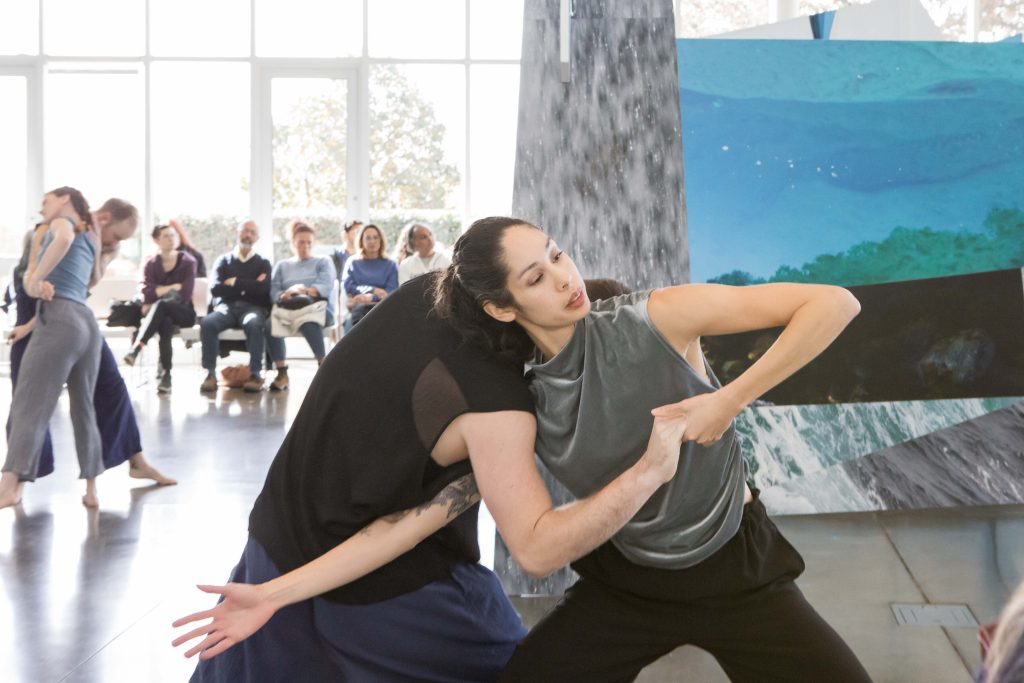 Michael Walton & Sara Caplan in “Tides” section. Photo by Michelle Smith Lewis.
In contrast, I squirm when the performance distills current cultural and political realities. The soundtrack says, “Silos. I am not in that camp.” The dancers plug their ears, look at each other in angry confrontation while walking listlessly. Mouths open and close like fish out of water. The performers block one another’s path like a dam—human self-destructiveness made manifest. Frantically slapping themselves, the dancers push the art panels up, walling each other off. Greedily, a dancer mimes picking an apple, taking a huge bite, and throwing it away. We hear, “At one point, ideology doesn’t matter. Comes down to survival.” But clearly our current trajectory will not lead us to survival. The dancers appear to struggle to hold up the panels. Slowly the dancers get pushed to the floor, trapped underneith—as if the weight of human impact on the environment is squeezing us out of our own world.
The soundtrack warns “Does despair actually move people to action?” As the dancers help each other up, we hear, “The antidote to despair is agency. Our bodies are full of wisdom. If always in our mind, we can get lost.” The dancers pick up the panels and connect them to form a four-sided structure. “Circumstances you must shatter. Pick up the pieces. Put them back together and behold the beauty.” Sea Change ends as the dancers disappear into the embrace of Feldman’s aqueous art, finally integrating their water bodies with bodies of water.
Sea Change Within Us was performed October 19th at 12 and 4:30 p.m. in SAM’s Olympic Sculpture Park PACCAR Pavilion. Read the program here. Sea Change is a revival and recreation of a 2019 collaborative work.


