Five queens. Performing the same five tracks. At the same time.
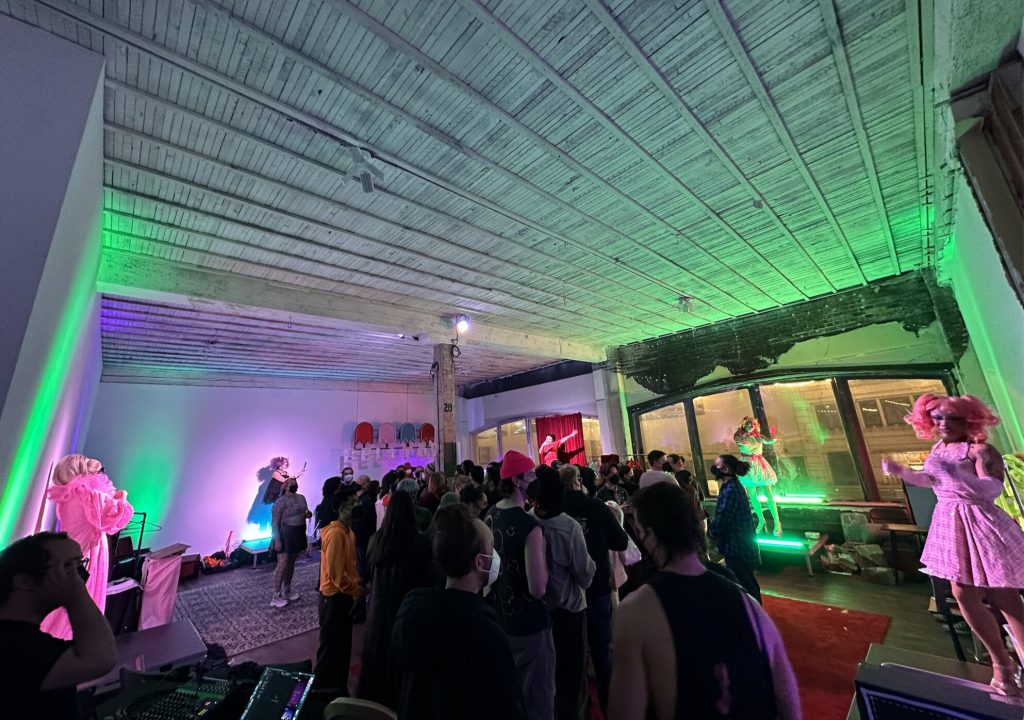 Left to right: Stasia Coup, Angel Baby Kill Kill Kill, Clara Voyance, Miss Texas 1988, Beau Degas. Photo by Alyza DelPan-Monley.
This past weekend, Base Camp Studios 2 hosted Glory Hole: Clone, an experimental and immersive drag show that invites you to stay on your toes and try not to miss a thing! As the queens interpret the same song five different ways, you are transported into different worlds, with the agency to bounce between them as you wish. Beau Degas, Clara Voyance, Stasia Coup, Miss Texas 1988, and Angel Baby Kill Kill Kill compete for your attention through endless eccentric endeavors.
The space is open with five platform stages scattered around the perimeter, with each queen’s clothing racks and prop station on display beside their stage. The queens emerge into the space, circling the audience, spread out but keeping an eye on each other. They weave through the crowd to maintain proximity to one another. Almost flocking, they work to copy each other’s movements, unclear who is leading. An alarm blares overhead, and the queens rush to their stages. A western showdown unfolds as they take turns miming finger guns and reactionary chest shimmies at one another. This playful showdown and copy cat behavior introduces us to what is about to unfold.
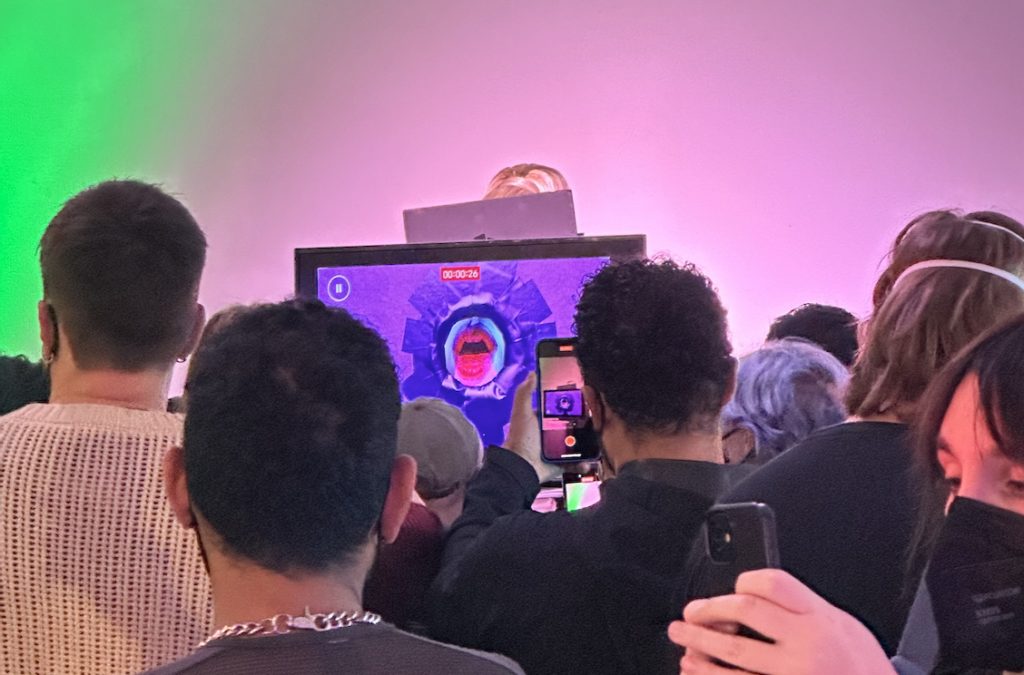 Stasia Coup. Photo by Alyza DelPan-Monley.
The show takes off with “From the Air” by Laurie Anderson playing overhead as the queens begin simultaneous solo acts. Part of the show’s excitement is the air of competition. As an audience member, you can only watch one or two queens at a time and are free to move about the space during the performance. You may be watching one person when something suddenly catches your eye across the room! Angel Baby Kill Kill Kill starts by lying in a cardboard box space craft, while Beau Degas is serving ginger ale and Biscoff cookies with a searing smile, from a custom “Bodega Budget Airlines” snack cart. Beside them, Clara Voyance delivers a sharp robotic interpretation in a pastel pink and blue dress with a cone bra, while Miss Texas 1988 is balancing on a folding chair in heels. While all are playing off the same brassy song about taking flight, it is reimagined five different ways. In between each song, the queens have the length of one “Macarena” to get ready for the next performance. The siren plays again to signal that intermission is over, and it’s time for the next number.
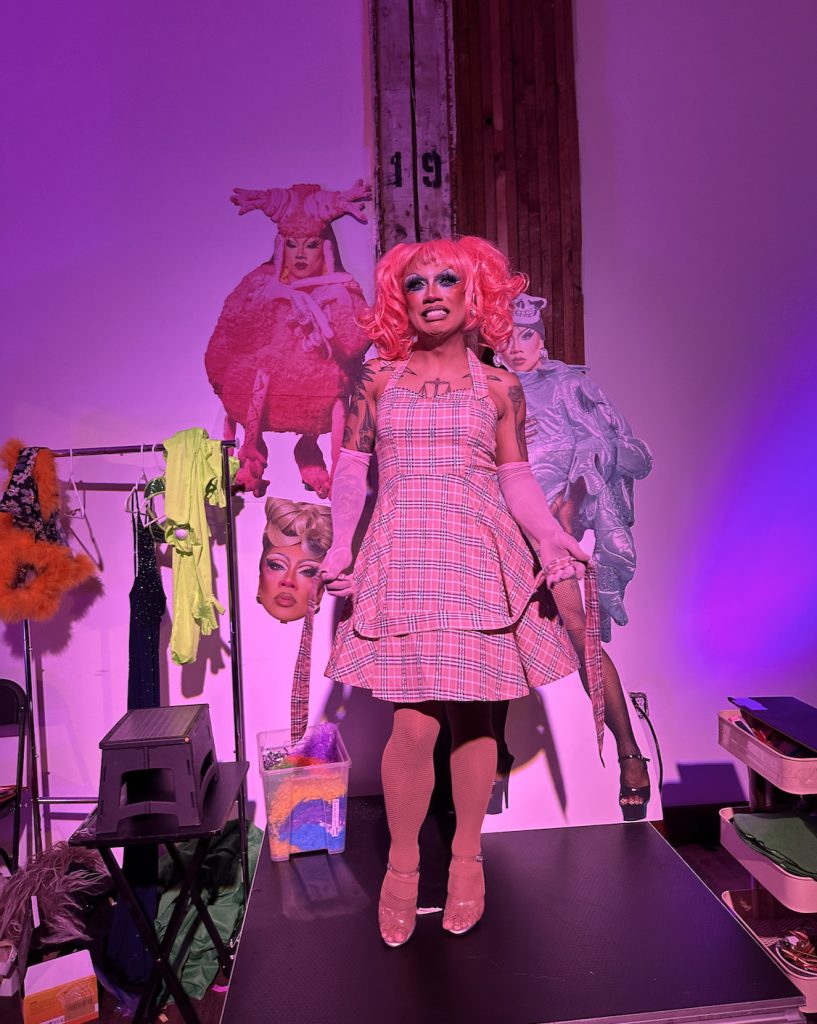 Beau Degas. Photo by Alyza DelPan-Monley.
Overlapping themes occur when playing off the same lyrics, what happens when they interpret an instrumental song? The third act is set to Johann Strauss II’s “The Blue Danube Waltz.” Each queen takes on vastly different interpretations, creating mismatched and colliding worlds in the space. Beau Degas crafts balloon animals with a cardboard sign that reads “Lower your expectations” on display. To the left, Miss Texas 1988 is cooking up a horrific and sinister stew with guts and intestines. Stirring cartoonishly and full bodied like a witch, an open brain peaks out from beneath her chef’s hat. Creeping throughout the space is Angel Baby Kill Kill Kill. In a draping white cape and alien mask, they are frisky and loaded with silly string. Amongst the chaos, Stasia Coup is icing a cake in an apron and fishnets. She pulls out a photo of Bruce Harrell, climbs a stool, and prepares to sit atop her frosted creation, and the photo. Simultaneously at the crescendo of the waltz, Angel Baby Kill Kill Kill erupts with silly string stretching in ribbons reaching for the sky. Chaotic, messy, and sweet, each queen creates mischief in their own way.
The varying interpretations often find natural moments of connection and contrast. In the fourth act, Clara Voyance pays tribute to Ti West’s slasher film Pearl, dancing and clicking heels with a cutting gaze to West Side Story’s “I Feel Pretty.” In a similar fashion, Miss Texas 1988 is dolled up in a filly pink and white dress, fixing the audience with a viscous stare, poised while she pulls out her hair. The song switches to No Doubt’s “Just a Girl” as Miss Texas 1988 and Beau simultaneously rip off literal pink ribbons from their eyes, corresponding with the lyrics of the song. Across the room, Angel Baby Kill Kill Kill swings a hot pink baseball bat around in circles, while Stasia Coup swings a plush vulva on a rope like a lasso above her head. Stasia Coup’s rope begins to wrap around her neck like a tether ball, causing an exhausted collapse. Each queen contributes complex commentary on gendered expectations, vanity, and anger in their own campy way. The unifying song creates a structure that organically creates parallels with enough space to still find uniqueness and juxtaposition.
The final performance is explosive, soft, and delightfully bizarre. As Aerosmith’s “I Don’t Wanna Miss a Thing” plays overhead, Angel Baby Kill Kill Kill takes a tender approach, soothing a baby doll in punk alien drag. Miss Texas 1988 rests on a pillow, wearing an eye mask in a sleepy number. Stasia Coup begins hoisting a rectangular piñata that bluntly states “THING” in bold letters across the side. Tying a blindfold on and picking up a plastic red bat, they begin swinging and swatting towards the crowd as an audience member jerks the piñata up and down. After searching, arms stretched out to feel for the swinging “THING,” Stasia Coup finally strikes the piñata! It bursts open with confetti and printed out photos of Steven Tyler fluttering through the air.
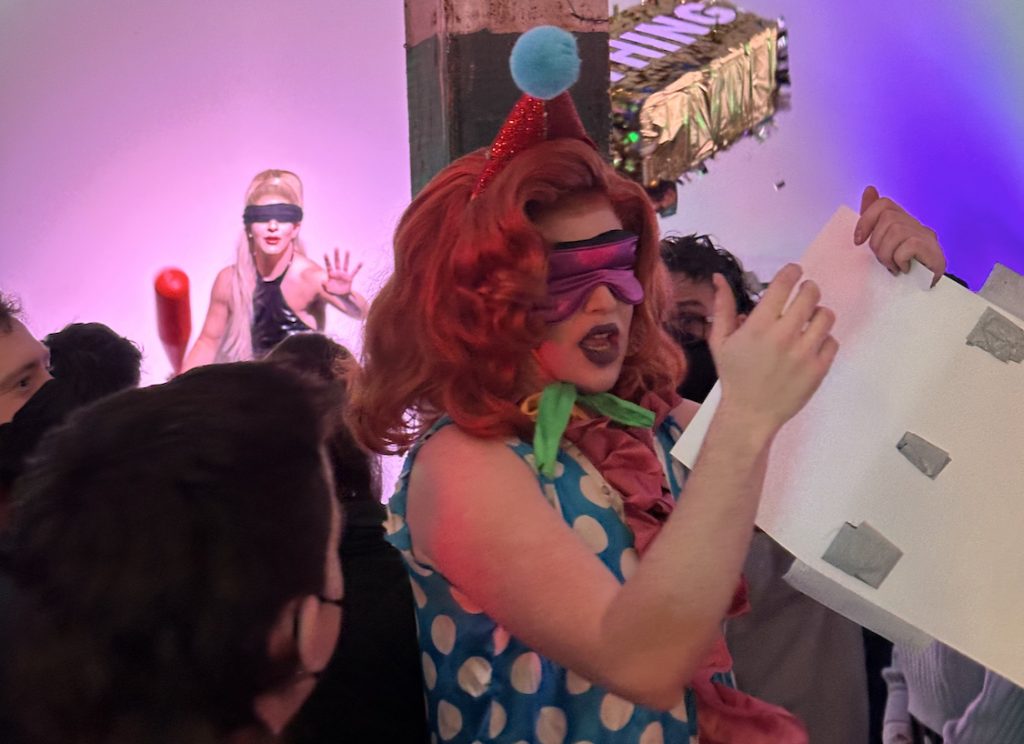 Miss Texas (foreground), Stasia Coup (background). Photo by Alyza DelPan-Monley.
The various takes on each song are literal, unexpected, amusing, and witty. Showcasing different stylistic choices, each individual performance demonstrates the ways drag can take on adaptations from satirical to sensual. The unique format is excessive and immersive. Navigating the show is like riding a carousel with windows into different zany and crafty worlds. The structure prompts expressive and imaginative ideas, allowing artists to make things that generate social and political discussion, alongside oddities, laughter and joy. Creating endless juxtapositions and mirrorings in the process. Glory Hole: Clone is campy, post-modern, and brilliantly facetious.
About Glory Hole Drag Collective
Glory Hole is an experimental drag and performance art showcase that seeks to create unique, immersive drag experiences. Originating as a one-off basement show where five performers were invited to forgo the typical four-minute lip sync, Glory Hole grew into an award-winning show where audiences might see and interact with truly anything—from durational character work improvisations, to interactive visual art installations, and pop-up performances which spontaneously occur over the course of a night. The glory is in the unexpected. What’s inside the hole?


