What happens when everything falls apart and we come together to build something new? Cornish Dance Theater presented their Fall showcase featuring new works from Keyes Wiley and Joseph Hernandez. These works both question how we move forward through difficult times. Using both displays of vulnerability and whimsicality, these pieces tackle hardship, finding commonality in the power of community care. Inviting laughter, tears, confusion, and connection, Cornish Dance Theater takes audiences on a tumultuous and tender ride.
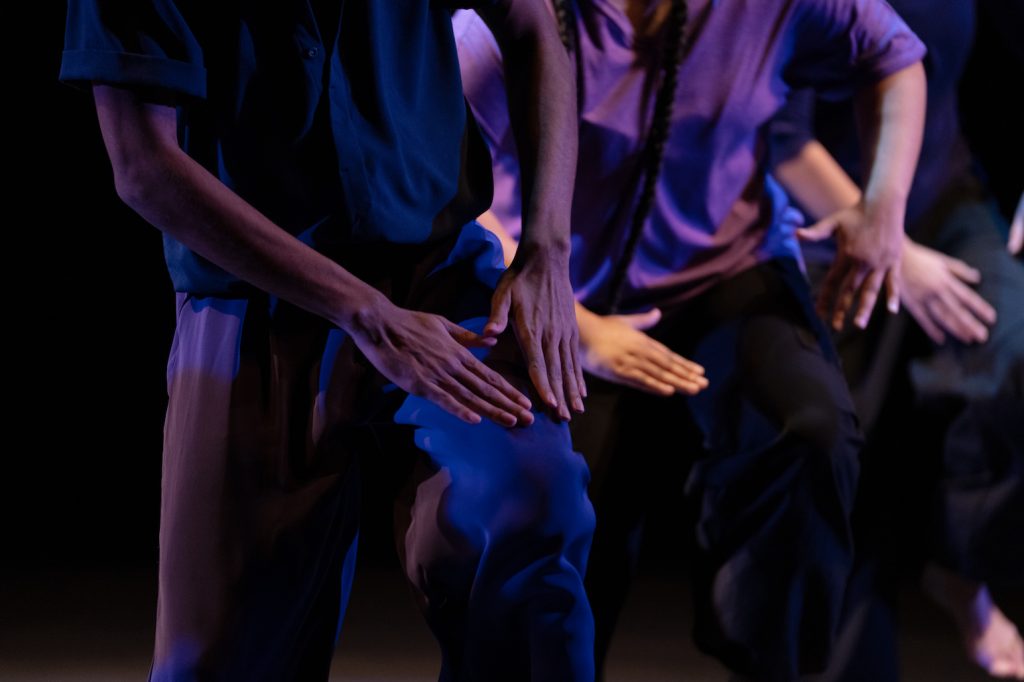 Photo by Jazzy Photos.
(Future) Ancestors, choreographed by Keyes Wiley with associate choreographer Olivia Anderson, is a moving piece about loss, life, and finding your way swimming through grief. Performed by Bri Holmes, Bryce Elazier, Gabi St. Luce, Leila Estrada, Lucy Blair, Marlo Nettel, and Maya Hernandez, the dancers come together to create a community on stage, supporting each other through waves of grief, leaving not a dry eye in the house.
Movement becomes a method of holding memory. The dancers emerge into shadows and begin following one arm, longingly, searching for someone in their movement. An eerie and looming sound covers them as they wander. Movement grows as a beat kicks in, the fluid exploration becomes more grounded and finds moments of unison. As the dancers come together and groove, emulating nightlife, the somber sound from before still lingers on top of the new music, replicating the feeling of remembering and celebrating loved ones in moments of joy while navigating grieving them. This section moves me, as the performers find their way moving together still holding heartache.
Throughout the piece, the dancers have solo moments from the group emphasizing the way we all grieve differently. As dancers float searching in a trance, St. Luce breaks out loudly and emotionally. Strongly stomping and whipping hair around, the movement is explosive before returning to the group’s softness like a wave getting pulled back in. Building upon the recurring motif of following one arm, Blair under a spotlight fights this urge by pulling extended hands back towards the center, trying to contain something escaping.
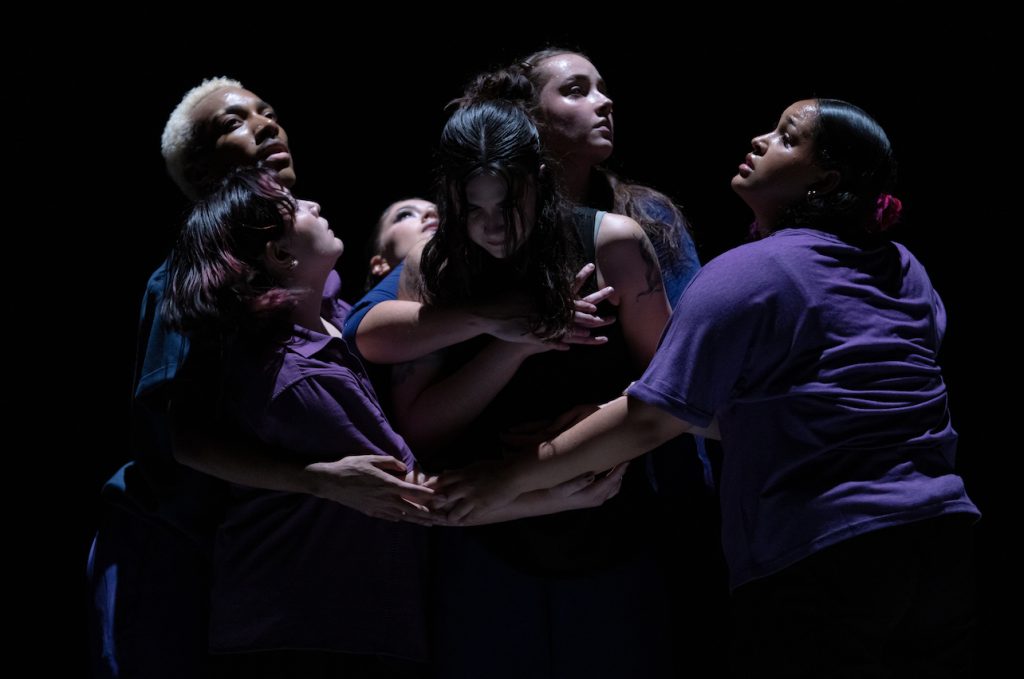 Photo by Jazzy Photos.
Though sections often start as solos, the community quickly comes to support the lone dancer. Center stage, Nettel stretches with arms that perch like a heron, then reach like an alligator. Dancers join in one by one and repeat the phrase alongside Nettel. Elazier comes downstage introducing a percussive and satisfying section of rhythmic stomping and clapping. As the group joins, the dancers take breaths and moments of pause, arching their arms like wings. The solos hold space for the wide array of emotions felt while grieving. The unison sections remind us to lean on one another, remembering joy and collective power.
The piece ends with the dancers hugging and swaying in pairs, Showing up for one another means holding each other as each learns to hold up themselves again. (Future) Ancestors is a touching piece, reminding viewers to lean on their community, hold your loved ones, and celebrate life to the fullest.
Joseph Hernandez’s new work Rhinoceros, is a bizarre and timely piece interrogating conformity and culture through constant absurdity. This work features dancers Maya Gonzalez, Glen Norris, and Estelle Bolier, as well as two commentators played by Bri Holmes and Becca Plummer. The two commentators sit downstage right behind a small white scrim. Plummer in a hot pink blazer with spikey shoulder pads and cowboy boots, Holmes in a bright blue suit. They sit in front of music stands and microphones, addressing the audience with a creepy synchronized echoing voice reminiscent of Mars Argo’s “Computer show.” The dancers emerge one at a time in colorful zany outfits, at times having their faces partially covered by fabric tubes. Music comes in and out, switching frequently and abruptly like someone flipping through radio stations in a tunnel.
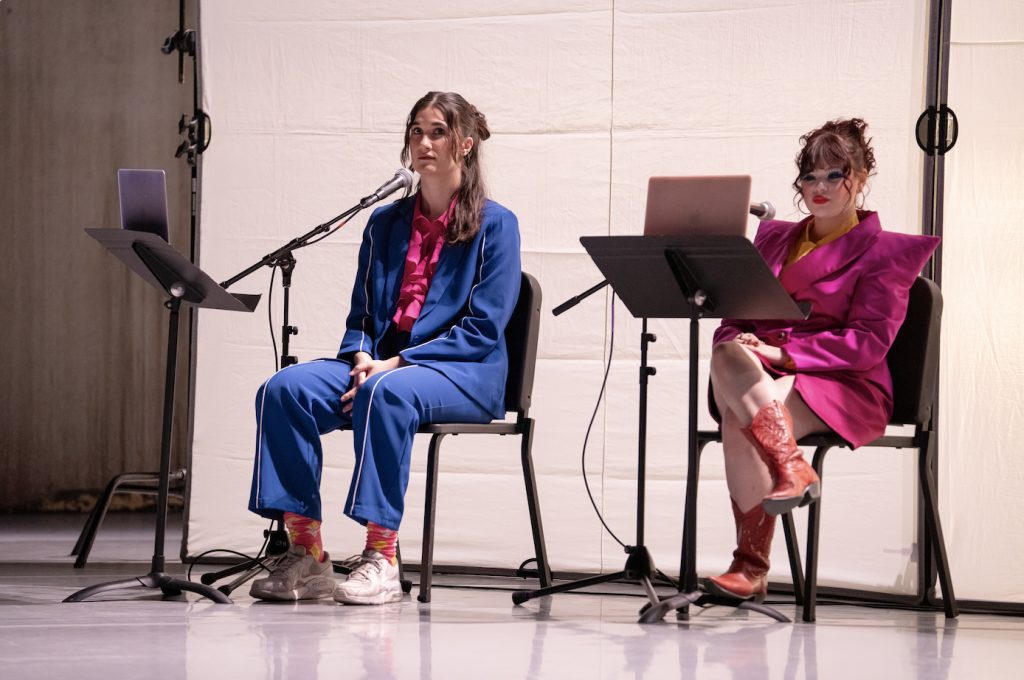 Photo by Jazzy Photos.
What is the meaning behind all this absurdity? The program reveals that the title Rhinoceros refers to Ionesco’s play of the same name from 1959, an absurdist response to fascism. In the same absurdist vein, you never know the performers’ next move. The dancers take turns tossing their shoes onto an empty stage, someone does a handstand with their hands planted in shoes, and the commentators address audience members directly by name, breaking the fourth wall. These acts create an elusive and perplexing scene. Trying to figure out what is happening on stage emulates the deep confusion and chaos of existing in the world today. Sometimes scenes come off as satirical and sometimes very human. The experimentation creates room to question what you are presented with. Absurdity highlights the limitations of logic. When we have space to let go of the rational possibility, we begin the ability to dream radically.
The piece ends with a synchronous jumping and gyrating. Dancers break out into unison bell hopping from side to side as if they are playing Dance Dance Revolution. Sentimental and spontaneous, the commentators begin searching for meaning as the dancers run in circles around them like goldfish swimming in a bowl. As the spiral, they take turns collapsing to rest then getting back up. Holmes and Plummer in unison state: “This is all about the time we share. Sometimes you fall in love. Sometimes you fall apart. Sometimes everything falls apart. Sometimes magic happens. Magic happens when there is help.” All the dancers collapse and the curtain falls. It immediately bounces back up to reveal a red light across the entire stage and everyone gyrating and thrusting the air and floor. For the first time, we see the dancers unified, working towards something, finding pleasure and exhaustion in the process. Embracing the illogical, this ending searches for meaning and ecstasy, as they find their collective groove.
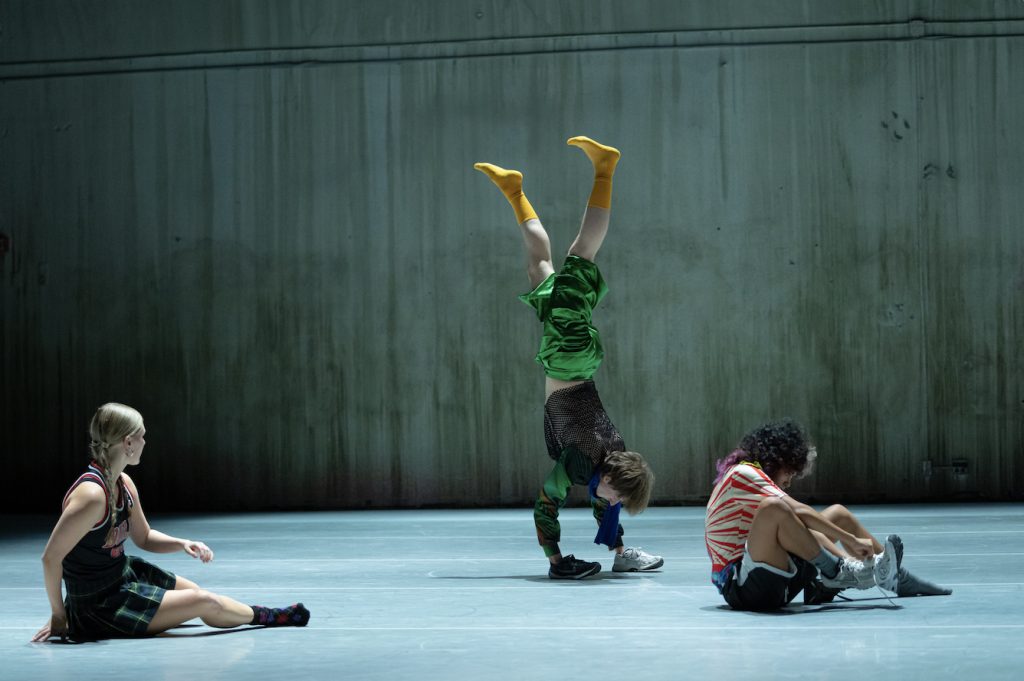 Photo by Jazzy Photos.
The two works use the stage to process heavy emotions. While (Future) Ancestors looks inward navigating intense emotions and community support. Rhinoceros focuses on the external world, moving with curiosity and suspending disbelief. Performance becomes a means of expressing our grief, as we try to let go of our loved ones. It also allows us to try and parse out what a more liberated future could look like through on-stage experimentation. Allowing audiences to feel seen in a work or envision a different future for themselves. Cornish Dance Theater takes audiences through love and loss, showing us the magic of people coming together to help one another.
Cornish Dance Theater’s Fall 2025 Showcase ran November 21-22, 2025 at Cornish Playhouse. The program can be viewed HERE. Featured photo by Jazzy Photo.


