**CW: mentions of suicide and self-harm**
There are ten or so of us in the accessory kitchen/storage building tucked behind the gallery space at Mini Mart City Park’s campus in Georgetown. We stand, and we sit. We are waiting for the last audience member to show up. Performer/choreographer kelly langeslay is sitting on the floor with us.
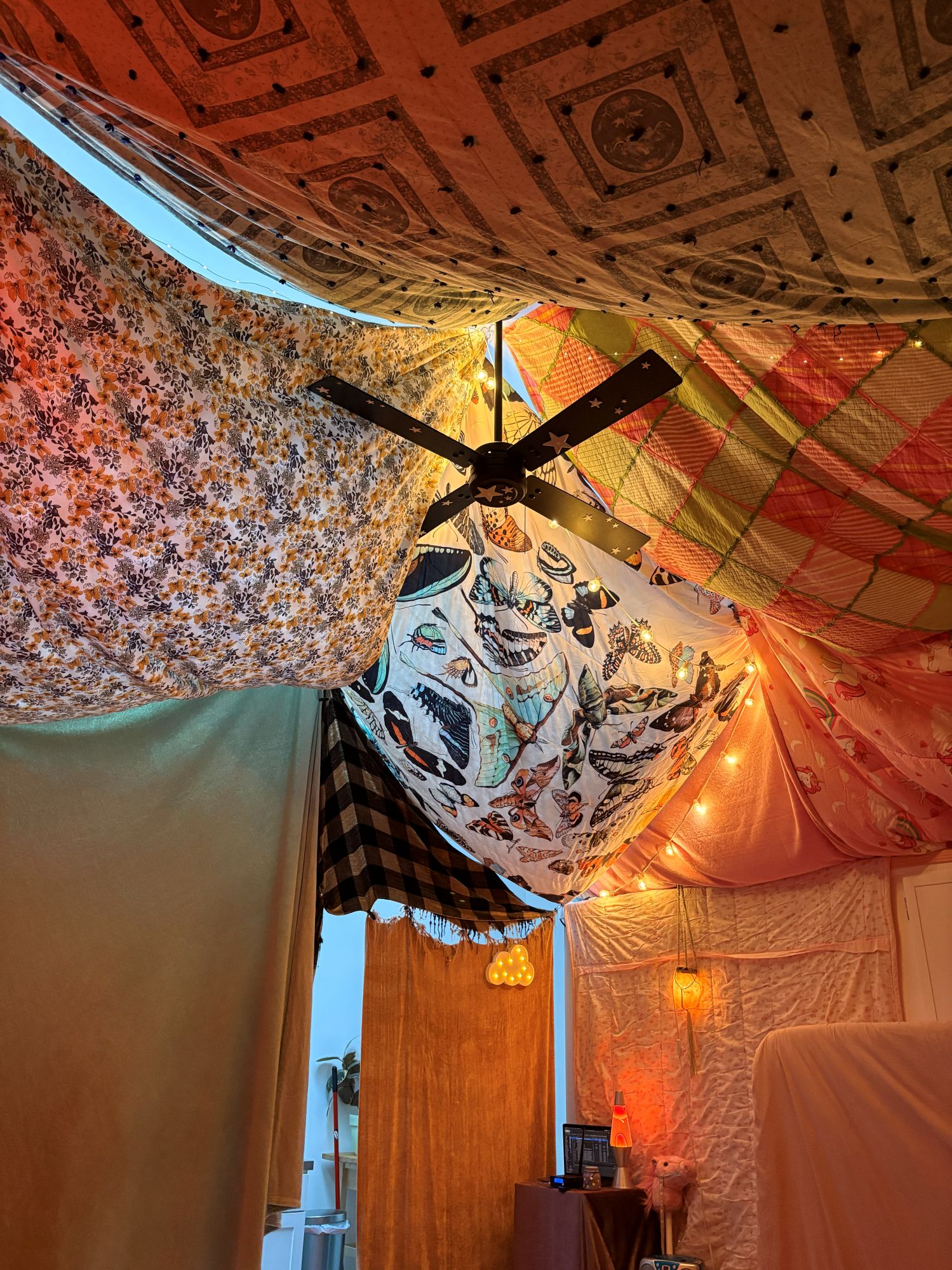 Photo Courtesy of Mini Mart City Park
The slow, kitchen beginning of crush 58 sets up a blurred and porous fourth wall for the piece, which has an overall feel of a slumber-party that is also a lecture, a confessional, a fairy tale, and a dance performance. langeslay’s relationship with the audience is one where langeslay is at the center, but we are all on the same level together. They are not doing audience participation anymore, they assure us, they think it is manipulative and cruel.
“So…”
they ask us, scooting up onto the kitchen counter, next to the sink,
“…how did we get here?”
crush 58, we learn, is the sixth performance work langeslay has made in the crush body of work, not the 58th. The structure and content of this crush live in the same family as the other crushes, all of which circle around similar questions about queer ghosts, masochism, repetition, feeding, and early 2000s nostalgia. There are movement motifs, lines of spoken text, and musings that are recognizable as continued explorations of elements in previous crushes. These are the questions that, it seems, never leave langeslay alone, and merit further research.
There is a reason for the repetition. In the program description langeslay quotes independent scholar Paisid Aramphongphan’s book Horizontal Together: Art, dance, and queer embodiment in 1960s New York:
“Neither moving forward or backward, it is through repetition that space and time for thinking sideways occurs.”
This “thinking sideways” is visible in how crush 58 unfurls and spools around itself in run-on sentences, repeated citations, thought spirals, and read-aloud text messages. Each time we rehear a familiar phrase, langeslay gives us another opportunity to hear it differently.
langeslay speaks continuously through almost the entire piece with an affect that is difficult to describe: not theatrical, but decidedly scripted. Not deadpan, but also not conversational. Words tumble out quickly to form long sentences while langeslay maintains audience eye contact. Sometimes the meaning of phrases is only just landing and langeslay has already moved on to a completely new topic, or has followed the one we are still deciphering farther down the rabbit hole.
After the kitchen intro, we follow langeslay up a set of stairs to a storage space that has been transformed into a softly glowing, cocoon-like, pillow fort. The walls and ceiling are hung with safety-pinned unicorn sheets and pink comforters that drape like a tent. We sit on air mattresses, and couches, and the pink-and-white-checkered shag carpeted floor.
How did we get here?
They tell us, at intervals, that they have a chronic condition that causes them to want terrible things to happen. We learn of the many and specific ways they are going to die. They spin love stories about cockroach roommates. We hear about a bloodred suicide dahlia, over and over again. langeslay expands on the quietly subversive politics of Shrek 2, the way that instead of killing the dragon, they seduce the dragon, eat romantic dinners of spit-roasted wood rats, and when they kiss, they stay the same.
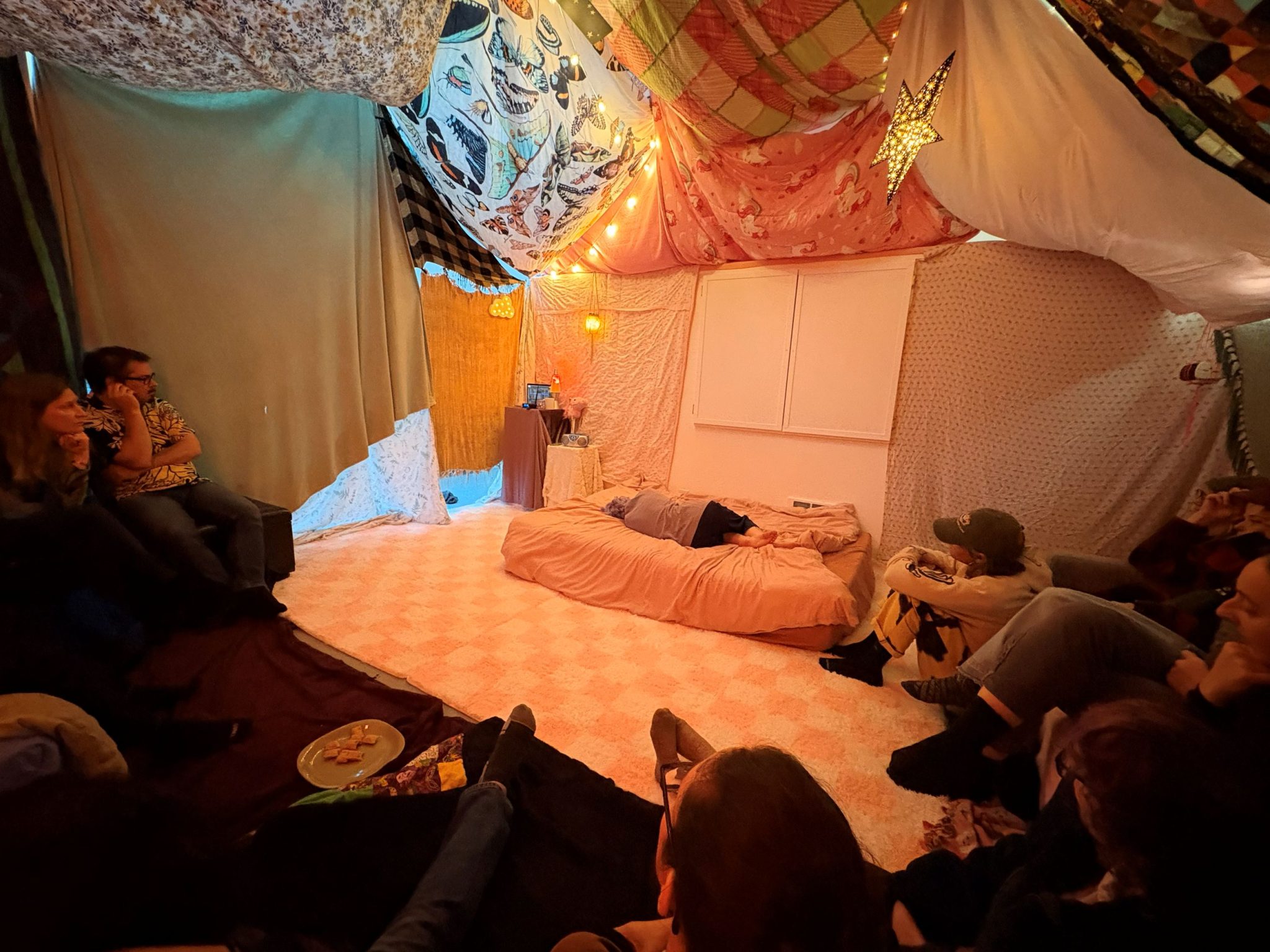 Photo Courtesy of Mini Mart City Park
The circularity of the show makes time stretch in strange ways. langeslay runs their own sound and lights, has to pause to air-fry Totinos Pizza Rolls for us, and needs to look for the pile of safety pins they can’t find. They let us wait. It is in these “dead” moments when we have a second to breathe and let the weight of certain spoken lines and forceful movements land. The structure of the work is in conversation with Sarah Kane’s play 4.48 Psychosis, which is often interpreted as her expression of clinical depression, for which she was hospitalized. Shortly after finishing the play, she died by suicide. The play has 24 sections with no characters or stage directions, motifs are repeated many times. By crafting the circuitous nature of crush 58, langeslay situates their ruminatory work within a history of queer depression, obsession, and especially revolution—a word meaning here to circle around itself.
The constant blurring of the real/not real keeps us curious about what is about to be revealed. Did they really send that unhinged audio message to the person with two rattails who becomes a symbol for the archetypal queer tattoo artist/performer/musician of all of our fever dreams? We start to believe they really did consume the body of their landlord with their thousands of cockroach roommates who descended from the black plastic ceiling.
In the final chapters of the show, langeslay lies on a mattress in a relaxed fetal position, with their back toward us, unmoving, for the length of Atomic Kitten’s version of “The Tide is High.” The music is played on synchronized low-quality boomboxes that look and sound to be sourced from the back shelves of Value Village. langeslay is eventually slowly swallowed by the mattress and moves underneath the comforter, making it undulate like an ocean. They peel themself out from under the heavy blanket and pull themself up and through a slit in the sheets to wait on a hidden platform six feet in the air.
To the tune of Neil Diamond’s “Sweet Caroline,” langeslay emerges, lying at the edge of the platform, dressed as a cockroach. They fling their body off the edge and land, hard, on the mattress below. They rise, spin and fall, then get back up again, throwing their body off the ledge over and over again, just to get up, spin, fall, and rise—almost in a state of euphoria—in an unending cycle that ends the piece.
Earlier in the performance, langeslay challenges Artaud’s Theater of Cruelty, and the futility in the modern era of exposing audiences to brutality in order to shock them into an awakening. All we have to do, they remind us, is open Instagram to be shocked and horrified. I wonder then, what the point of langeslay’s self flagellation is and how it is different from Artaud’s or Kane’s. Violent, repetitive self-injury emerges in the majority of langeslay’s recent work. The performances are mostly spoken word, that become fully embodied only in these moments of intense, drawn out pain. They ask us to watch. As an audience member, this is extremely challenging. I find myself wishing I knew that my viewing was in service of my enlightenment, or langeslay’s catharsis, or the synthesis of larger ideas, but langeslay does not offer us that clarity. At times, it seems the pain is not for us, it is for langeslay, seeking sensation somehow through the sense-deadening of depression. I will bear witness to that, and will also keep asking, how did we get here?
crush 58 was performed at Mini Mart City Park, January 14-Jan 18, 2026


