A man rushes through the audience, clambers up the orchestra pit, and springs onto the stage—the first Little mortal jump of Alejandro Cerrudo’s work that opens PNB’s Firebird program. The oxymoron of the work’s title amuses me. How many tiny deathly jumps can a person make? Within seconds, I get one answer to my question. Silhouetted against blinding light high on a platform, a dancer launches into some unknown abyss exactly as the stage lights cut. Simultaneously plunged into sudden complete darkness, audience members gasp at the urgent leap of faith.
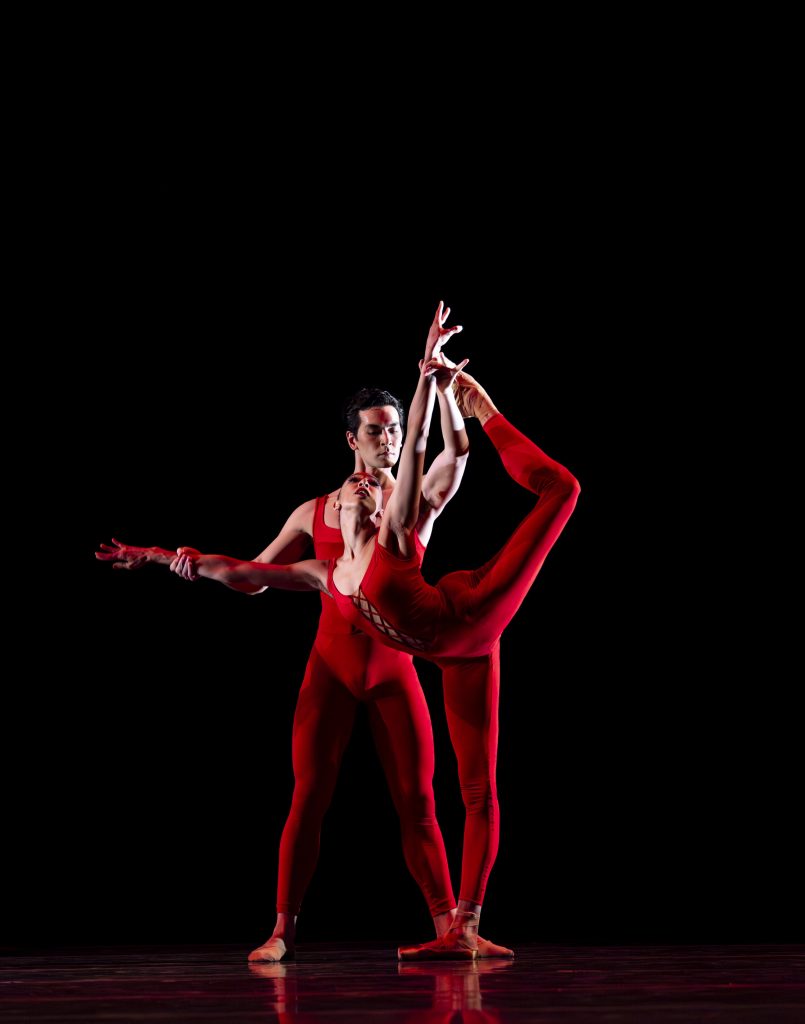 Pacific Northwest Ballet soloist Amanda Morgan and principal dancer Christopher D’Ariano in Ulysses Dove’s Red Angels. Photo © Angela Sterling.
When stage lights return muted and dim, the dancers push aside wheeled walls, sending them spinning as if ridding themselves of roadblocks. The costumes—suspendered pants, negligee-style black lace shifts—create an early American, Mark Twain vibe. The movement surges smoothly, mesmerizing like a river punctuated with occasional quirky movements like off-axis tilts and splayed hands. Analogous to going through life mostly in a steady state, but every once in a while something throws you off your game. There are also Charley Chaplin-like, silly penguin walks that remind us that humor is a survival skill and foreshadows the most iconic leap of the work.
Two cavorting dancers land stuck, Velcroed to two different walls. Their limbs glued, the dancers reach for each other across the divide, fingers twitching unable to embrace—an impossible situation. Then epiphany strikes. They undo the fronts of their suits and simply step out. The imprisoning garments left adhered to the walls are lined with red satin, like magicians’ capes. I think about how many problems in life can be illusions of our own making.
I saw mortal jump when PNB premiered it ten years ago and fondly remember the wall-stuck dancers. But tonight, I find myself overwhelmed with emotions watching the buttery smooth synchronous movement that characterizes the rest of the piece. Rippling and sinuous like sea creatures, every movement connects to the next. The women in socks, the men in slippers, they quietly interweave and move through each other like thread through needles. The harmony feels meditative, spiritual—a tender reminder of being human. Elizabeth Murphy (retiring at the end of this season) epitomizes the choreography’s underlying intensity. I love how that quality is written all over her face in the photo of the piece in the program.
When the curtain rises for Ulysses Dove’s Red Angels, next on the evening’s lineup, it’s clear we are no longer witnessing mere mortals. The four dancers’ vermillion superhero-like unitards thrum athleticism. Ignited by the electric violin, the dancers move lightning-fast through Balanchine-esque choreography. A suspended arabesque clear as a laser pointer amid the frenetic frenzy allows my brain to absorb what I am seeing. I realize I’m holding my breath. Amanda Morgan is made for this. Her never-ending legs fold like a praying mantis in forced arch second position on pointe. They exit with backs to the audience, arms held high in victory Vs, and quickly glance over their shoulders at us as if to say, How do you like them apples?
I’ve never seen the evening’s titular ballet, Firebird, but have fantasized about it since I was a sixteen-year-old student at Chicago City Ballet. Maria Tallchief, the nation’s first Indigenous prima ballerina, founded Chicago City Ballet, and became famous for her electric performance of the technically challenging lead role in Firebird.
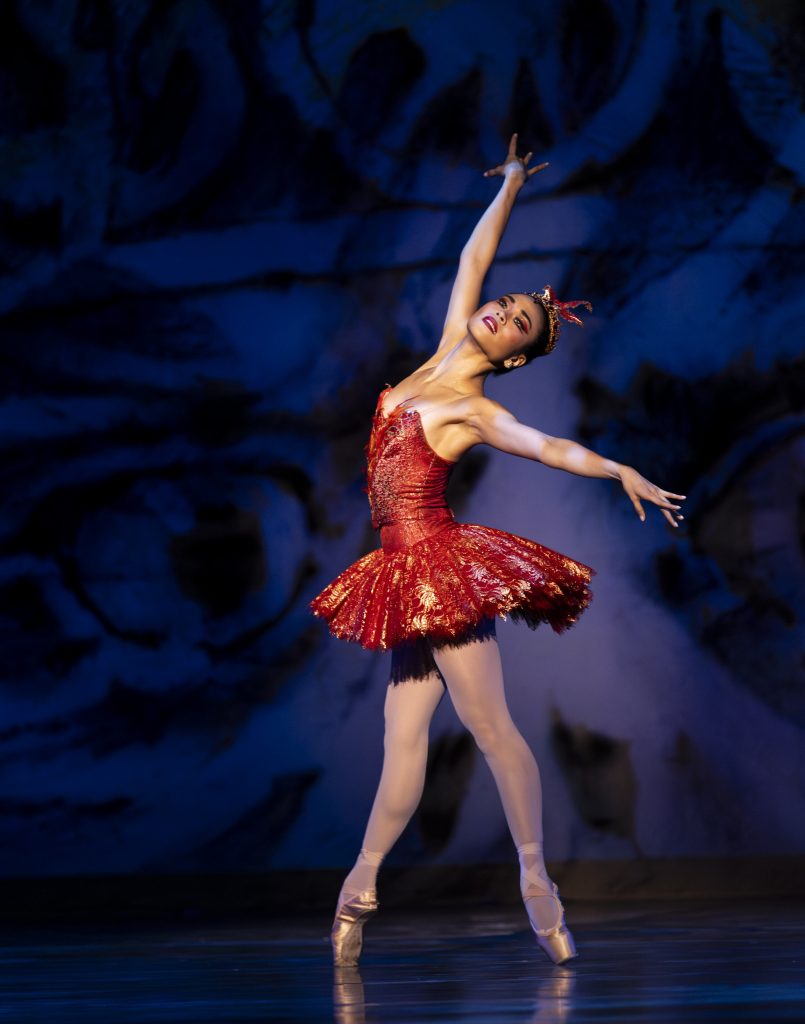 Pacific Northwest Ballet principal dancer Angelica Generosa in the title role of Kent Stowell’s Firebird. Photo © Angela Sterling.
I was thus primed when the curtain whisked up and am momentarily stunned by designer Ming Cho Lee’s set. Beautiful pastel mosaic-like lily pads hang in the sky around a crisp full moon. But since story ballets rarely resonate with me, the magic dissipates quickly as Michel Fokine’s 1910 Ballet Russe fantasy trope unfolds. Man hunts Firebird in an enchanted sorcerer’s realm. Man spares Firebird. She offers him protection should he need it. Man falls for princess who is also ensnared by the sorcerer. Firebird helps the man destroy the sorcerer’s soul and free the lovers to marry.
Kent Stowell choreographed PNB’s production in 1989 tweaking what he saw as a flaw in the storyline. Stowell felt that Fokine’s choreography focused the audience on the Firebird and the man rather than on the dynamics of the man and the princess’ love. In Stowell’s version, he centers the tenderness between the man and the princess (danced tonight by Jonathan Batista and Leah Terada) early on so that when the Firebird (Angelica Generosa) helps the lovers overcome the sorcerer, the Firebird acts more as a source of inspiration than as an independent supernatural savior. Generosa flits and skims quick as a hummingbird through parallel passés pausing briefly en pointe in lunges and bent supporting-leg extensions–technically tight as I have come to expect from PNB dancers.
Again, the set and costumes for the second act are pretty phenomenal. I love the long, gnarled fingernails of the sorcerer. Fabric arches step down seven-gates-of-hell style to a massive demon face with long flowing locks, a sort of Pirates of the Caribbean look. There’s something about the symbolism of a fiery bird freeing love from soulless evil that reminds me of the phoenix-from-the-ashes metaphor that recurs in countless stories dating back to its Greek mythology origins.
When the curtain falls, I know Firebird has filled a gap in my dance history knowledge. I search for its modern-day, personal relevancy. The Firebird symbolizes summoning the strength to resist overwhelming oppression. I think about how I wore feather earrings as I worked to extract myself from an unhealthy relationship–a constant encouragement to fly free from a spirit-dampening situation. The inspiration to fight repression is one we can all use as real forces threaten our collective liberties. May we all be firebirds for each other.
PNB’s Firebird performed at McCaw Hall March 13-22, 2026. This review is of the March 13, 7:30 p.m. performance. Program details here. For tickets and info, contact the PNB Box Office, 206.441.2424 or PNB.org. Featured photo: Pacific Northwest Ballet soloists Kuu Sakuragi and Yuki Takahashi in Alejandro Cerrudo’s Little mortal jump. PNB presents Little mortal jump on a Photo © Angela Sterling.


