A queen sized bed, bedside table, and lamp wait quietly atop a milk-white dance floor. A nearly identical version of the colorful bedroom scene hangs, upside down, from the ceiling above, creating a reflected double image of pinks, oranges, teals, and yellows. A third ghost-image of the beds and their bedclothes is reflected in the smoothness of the floor. The striking set (a collaboration between Teia O’Malley and Kaitlin McCarthy) is our first visual evidence that in the world of I’m on Fire, You’re on Fire, We’re on Fire, the normal rules do not apply.
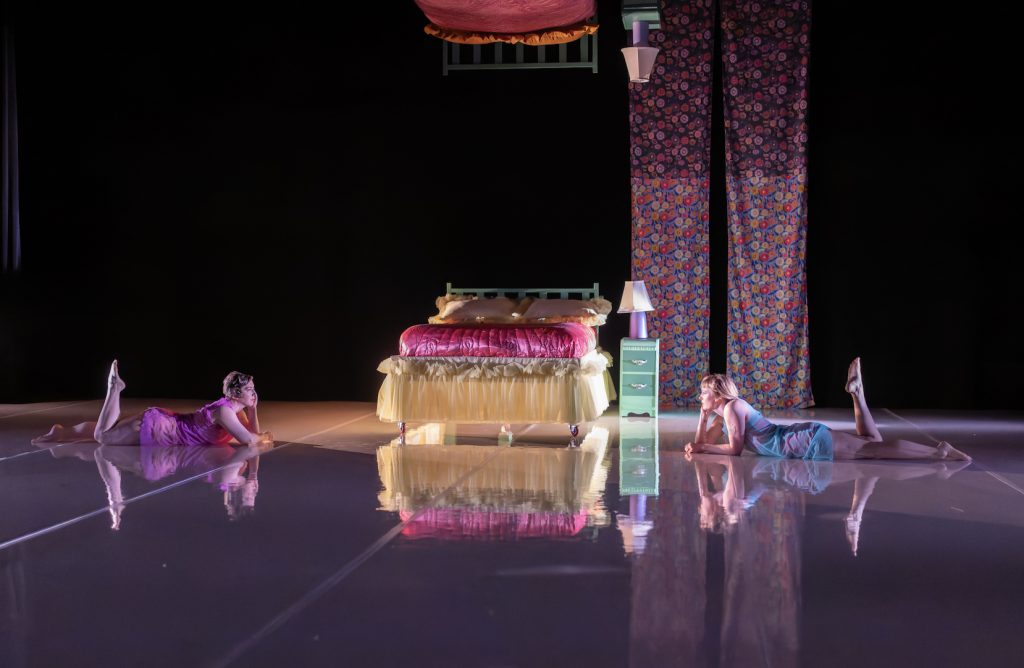 Photo by Allina Yang
Lights reveal performers/choreographers Jenny Peterson and Kaitlin McCarthy, lying on their bellies—twin images of one other framing the twin images of the beds. Each of the performers wears colorful bikini-like underwear underneath short-skirted mesh dresses in bright hues. They lie with one leg bent at the knee, chins resting on fists in iconic teenagers-watching-TV poses. They languidly roll downstage, gazing into each others’ eyes. When they reach the front, they slowly turn their focus to look at us, the audience, flirtily daring us to look back.
Peterson and McCarthy maintain this audience/performer dynamic throughout the piece. It becomes clear in these early gestures that they will do exactly what they want, when they want, and we are allowed to watch. They don’t need our attention, they are just allowing it. Our watching does not make them filter their desires, compromise their total self absorption, or threaten their obsession with each other.
I’m on Fire draws inspiration from Věra Chytilová’s 1966 film Sedmikrásky (Daisies), in which two young women revel in frivolity, indulgence, and small acts of naïve violence in communist Czechoslovakia. The characters (both named Marie), play a series of rule-breaking pranks that involve eating large quantities of phallic foods and behaving in gender nonnormative, childish ways. The film was so controversial at the time that it was banned in its home country. The two stars of Daisies bounce on beds, eat hungrily, and flop from stimulus to stimulus, a movement vocabulary that is mirrored, exaggerated, and expanded in the bodies of Peterson and McCarthy. The piece mirrors Daisies in structure as well—each is a series of loosely connected surreal vignettes that do not follow prescribed story-arc norms. Daisies as a structural and thematic inspiration for the piece is clear, but I’m on Fire builds its own very distinct world.
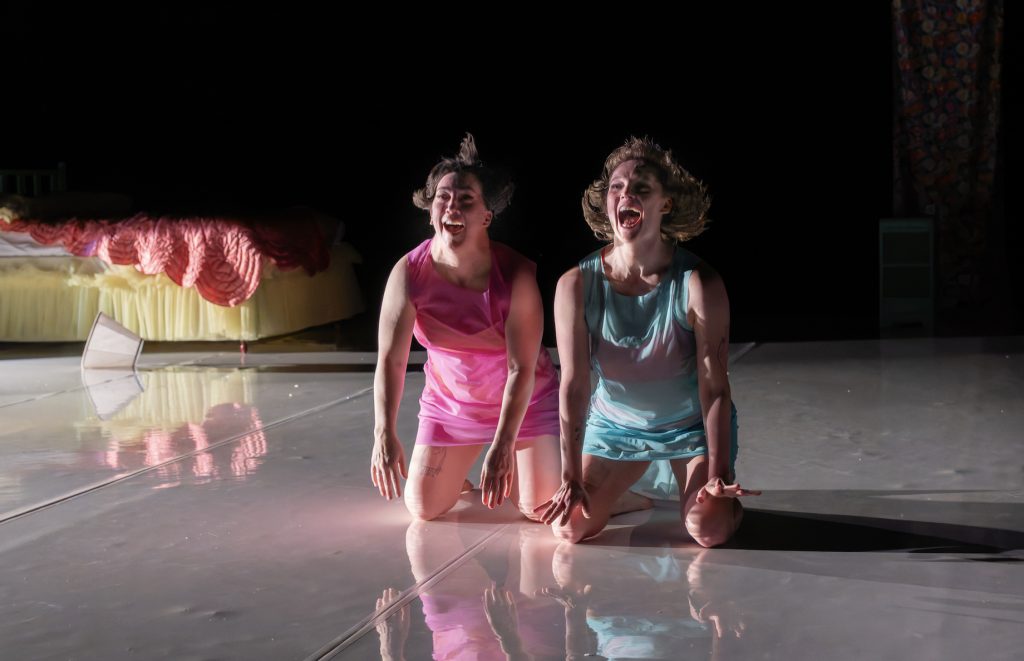 Photo by Jim Coleman
The musical score, composed and performed by Peterson, begins with a ballad to Peggy Jo Tallas, who, according to the program notes, robbed five Texas banks in a fake beard and 10-gallon-hat. Tallas, aka “Cowboy Bob” used the money she stole to pay her mother’s medical debt. As Peterson’s recorded voice sings, she and McCarthy flop, turn, and pivot on the bed in a series of repeated movements whose forcefulness shifts the bed around the stage. They punctuate each action with enthusiastic shouts of “NO!” before toppling onto the bed, jabbing an elbow to the side, and spinning recklessly.
Peterson and McCarthy manage to, through movement alone, convince us that at any point, they could and would do anything because they have decided that the rules do not apply to them; they follow their impulses as long as it takes for them to have a new impulse. Eyes bulge, tongues hang out, heads flop to the side, wrists flap, and bodies are thrown and bounced around. It is terrifying and hilarious to watch, and stirs something deep inside me: a kind of kinesthetic jealousy for a body I used to live in. Their chemistry with one another is reflective of their ten year creative partnership under the moniker “The Bonnies.” We see that this work is informed by the experimentation that can only happen within deeply trusting, time-tested relationships. So much of the immense emotional heft of I’m on Fire IS their relationship.
The Bonnies are joined onstage by a bright yellow, columnar puppet creature who emerges in an explosion of shimmering tulle and ruffled taffeta. The creature’s face looks like a cross between Beaker the Muppet, and a Lunar New Year Lion Dance costume, with bright, round, sequin-studded eyes and a huge gaping mouth. This “Sloth” creature poses seductively as McCarthy and Peterson bounce on the bed, licking their lips and rocking their pelvises. Another Sloth enters the stage, this one in blue, and joins their compatriot, grinding against the floor and bootie popping to riotous audience laughs. The Sloths, played by Jackson Knappen and Hendri Wa, reappear throughout the show as sassy assistants, placing props and removing sharp objects.
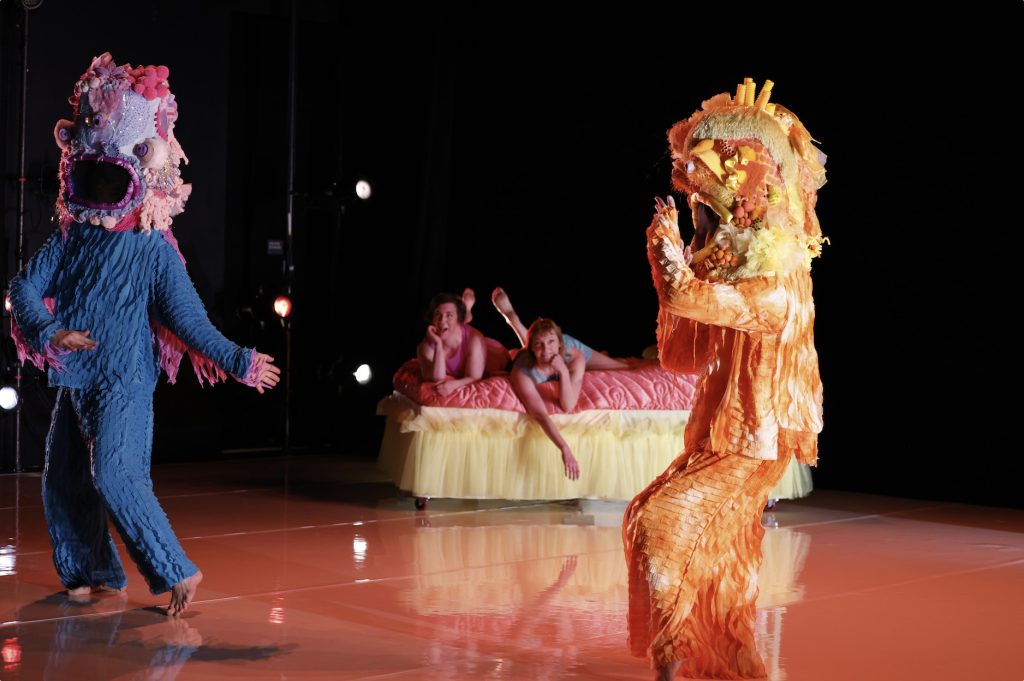 Photo by Allina Yang
The piece continues to flow from impulse to impulse, scene to scene. In one vignette, Peterson sits atop the bed and sings a karaoke version of Frankie Previe’s 1987 hit “Hungry Eyes” with her back to the audience. Occasionally her body contracts into the unselfconscious movements of private bedroom singing. She breaks with the original lyrics to desperately shout, “I’m so hungry!!” At the end of the song, her high notes become shrieks and screams, because it seems, she feels like singing very high and doesn’t hold herself back for our comfort.
In another vignette, The Bonnies move across the stage toward the bed, becoming a sort of feverish ball of worms; nuzzling, smothering, and surfacing, all the while muttering their desires to themselves and to one another. One of them wants to go to Costco and get a juicy rotisserie chicken. One of them wants to wear your skin on her face.
A Sloth tip toes in from stage right and slides a knife downstage where it spins to a stop right in front of audience members. Time stands still as McCarthy begins to move toward the knife slowly, somehow both directly and indirectly, drawn to the tool and its power. Though not privy to her internal dialogue, we witness her mental and physical processing through her movements and facial expressions. Once united with the knife, she revels in her newly realized potential for violence. The other Sloth hands Peterson a knife as well and The Bonnies wield, fellate, and practice joyful martial arts with their pointy knives. The ante is upped; movements get wilder. A knife is replaced with a pipe wrench. A chainsaw enters the mix, which is turned on and revved. McCarthy gleefully swings a baseball bat until with a terrifying crash, she whacks the bedside lamp and sends it flying across the stage, breaking it into pieces. At this moment, for the first time, The Bonnies come to grips with their power and its implications. They surprise themselves with their violence. And then they move on.
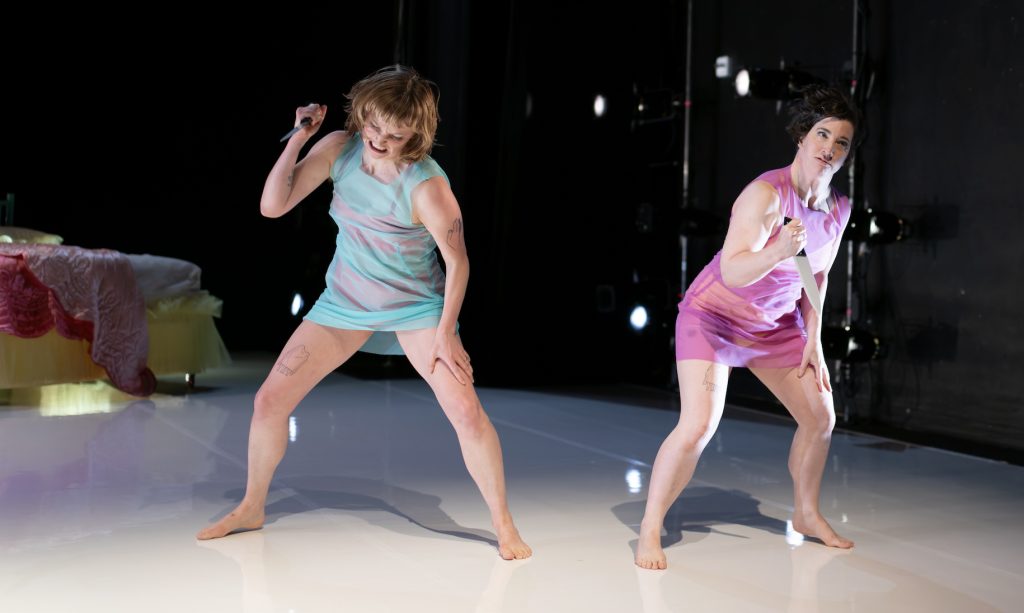 Photo by Jim Coleman
The piece continues in a multitude of scenes where the only constant is the knowledge that chaos could break out at any moment, and that The Bonnies are both in control of everything and are totally out of control—uninhibited and following their pleasure. They flop the mattress onto the floor and use it as a gymnastics mat to perform tricks for one another with varying degrees of seriousness and success. Like a scene straight out of so many of our childhoods, there are stunning backflips, and dramatically prepped-for belly flops. They show off for each other in ways adults don’t allow themselves to anymore out of politeness.
I recognize in their relationship, echoes of my own childhood obsession with my best friend. As an adult, I often mourn that it is no longer developmentally appropriate or logistically feasible to have the kinds of wild, chaotic, and delicious friendships that are possible only before your brains are developed enough to put limits on intimacy and conflict. I found myself missing my adolescent self-permission and endless free time to platonically and obsessively love my best friend so deeply while still being absolutely self-absorbed.
Nearing the end of the show, The Bonnies sit across from each other on the mattress on the floor downstage. They each take a microphone and announce, “so….this is how the piece ends.” They take turns verbally describing a myriad of delirious and increasingly impossible ways for the show to end. These descriptions morph slowly to become fever dream wishes each performer has for the other’s future. They begin referring to one another as Kaitlin and as Jenny. Jenny wishes for a cable to descend from the ceiling and pull her away like Mary Martin in Peter Pan. Jenny tells Kaitlin that she is sitting across from a hot babe in a red cowgirl outfit with thighs that could crush a beer can…but that the real secret is that the girl is actually Kaitlin. Their dreams get bigger and sweeter, and more unhinged. The way they deliver their lines makes me assume these are well practiced scores, not memorized lines—everything feels real and immediate with the rawness of improvisation, but the editing of extensive practice.
After describing all of the many ways the piece could end, this version of I’m on Fire ends with a quick succession of events.
The Bonnies discover a rotisserie chicken and throw it on the floor.
They tuck themselves into bed.
The mattress from the hovering bed falls from the sky and crushes them.
The lights go out.
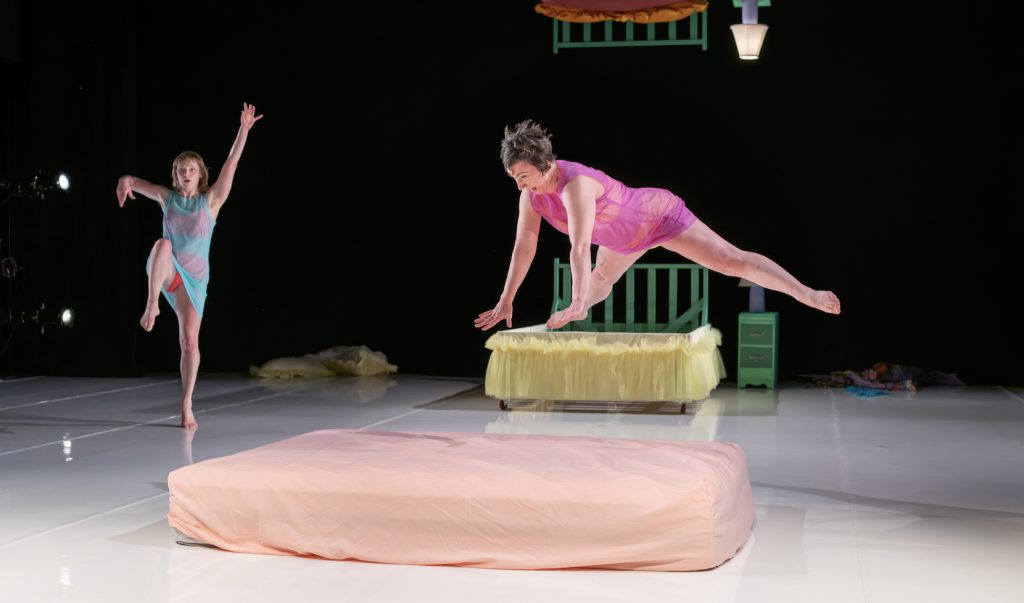 Photo by Jim Coleman
In a political climate that demands so much hardening of ourselves against cruelty, I read I’m on Fire as a commitment to breaking from self-censorship and engaging with pleasure and freedom as acts of power. Deciding to not follow the rules that do not suit us is one of the few ways to threaten oppressive forces. The piece also acknowledges the violence and chaos that comes from that kind of unbridled “authenticity.” It reminds us that queer friendship and female friendship can press against patriarchal norms of comportment and be tools for power and liberation.
I’m on Fire, You’re on Fire, We’re on Fire made me treasure my body and its hungers, its dark ghosts, foul lusts, and deep pleasures. In witnessing The Bonnies’ onstage relationship, I found myself honoring and mourning my own intimate friendships that have exploded, fizzled, or dimmed and ended. I found myself wanting feverishly, desperately, for us all to experience the fulfillment of having friends that see us, have wild dreams for us, play with us, and match our freak. I only speak for myself, but the shiny eyes I saw around the crowd are proof enough to me that I’m not the only one who was so moved by this work, and who wants so badly to break things and burn them down with my freaky friends. Let’s light it all on fire and jump on the bed.
I’m on Fire, You’re on Fire, We’re on Fire was performed at 12th Ave Arts Mainstage, March 4-7, 2026. Conceived, Created, and Performed by Jenny Peterson and Kaitlin McCarthy, co-produced by Velocity Dance Center. The program can be viewed here. Featured image by Jim Coleman.
***Disclosure: Kaitlin McCarthy is a staff member of SeattleDances. Kaitlin was not the editor assigned to this review and the opinions presented are entirely that of the writer***


