At the end of February, UW Dance Department presented seven new works choreographed by undergraduate dance majors. As we would hope from college students who are studying dance, the evening’s program was full of pieces discovering the different ways dance can tell a story, evoke a feeling, showcase techniques, or play with form.
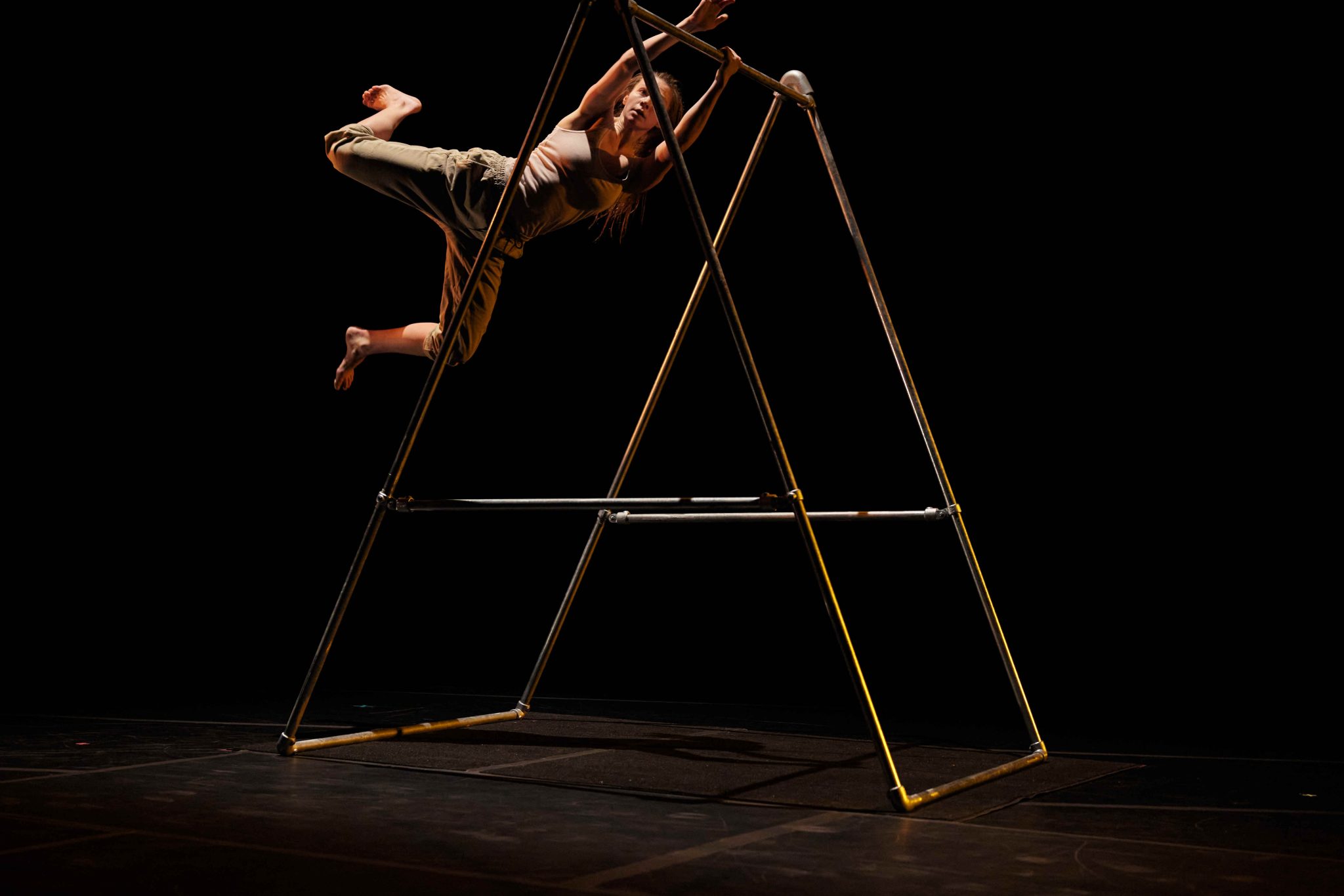 MC Womack in Working in Progress. Choreographed by MC Womack. Photo by Allina Yang.
The show begins with a metal scaffolding shaped like a park swing A-frame, which soon becomes the primary apparatus and site of Working in Progress, choreographed and performed by MC Womack. Womack effortlessly swivels around the structure, climbing and swinging through the empty spaces. Their playground-reminiscent movements reveal a practiced familiarity with their body and conversation with gravity, seamlessly lifting their body from the ground into the air, without the use of any momentum. Lovely details of composition elevate this piece beyond a showcase of prowess in a simple moment where their feet caress and circle each other. This small and tactile gesture magnifies a kinesthetic curiosity and embodiment that exists throughout all the intricate and athletic movement.
In within/without, choreographed by Amanda Winterbauer, the dancers move cohesively, nimbly articulating fast and specific gestural shapes, then melt into flowing and full bodied revolutions. The composition of the piece is symphonic, with dancers phasing in and out of pairs and quartets and solos. The dancers find each other intentionally through touch, sharing weight and twining limbs. There is something yearning in the movement, though it seems more to inform the general tone of the choreography rather than any particular dancer’s motivations. In the final moments two characters sit embracing as the lights fade, suggesting that the yearning was for connection.
home, choreographed by Sachiko Miyoshi in collaboration with the dancers, invites us into a springtime picnic with friends and a playful frolic in the rain. This piece was a simple exploration of easy going good times, through a lyrical movement style.
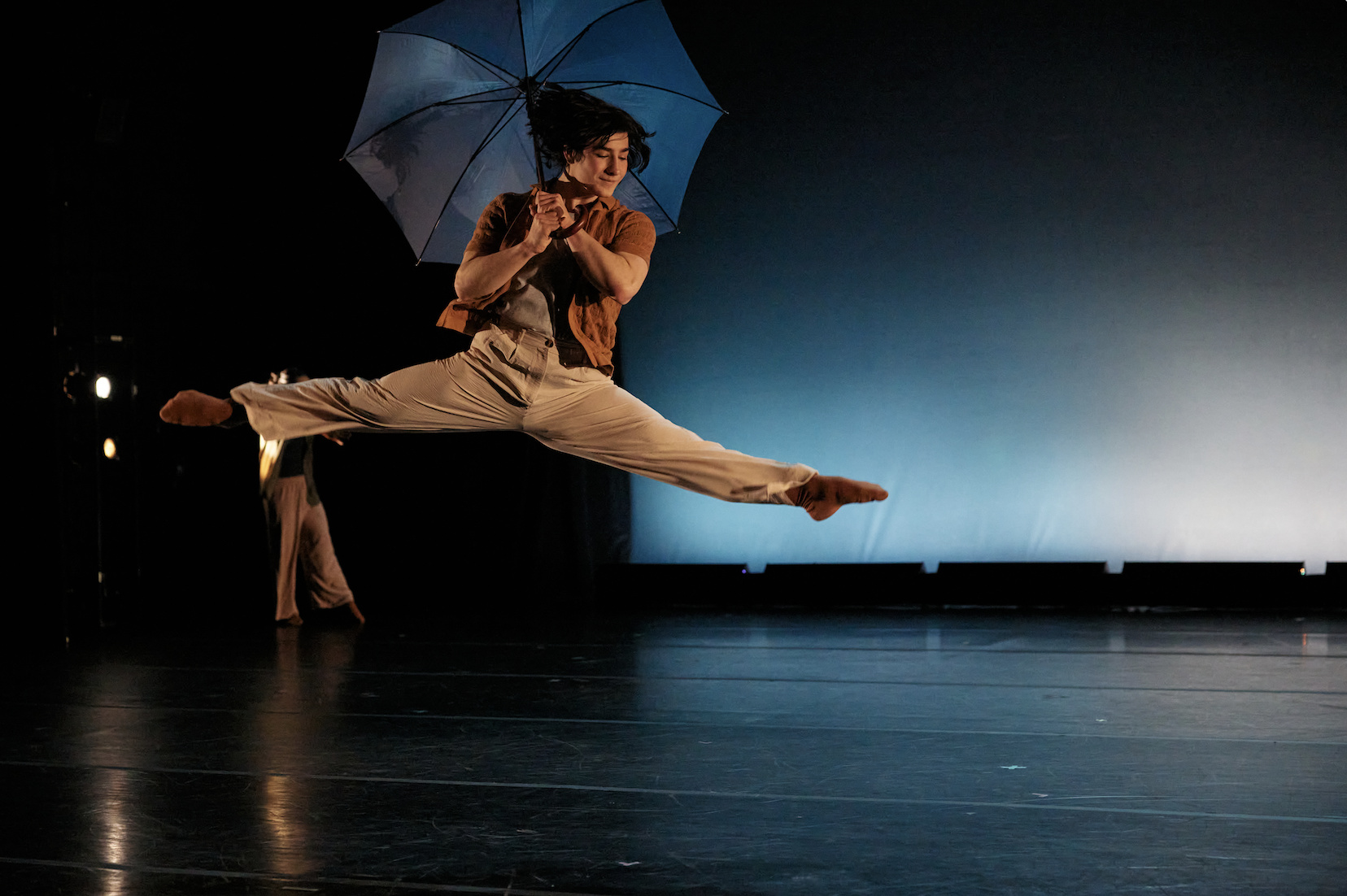 Eddie McClary in home, choreographed by Sachiko Miyoshi. Photo by Allina Yang.
a wind blows through me, choreographed by Kate Hancock in conversation with the dancers, opens with a large ensemble of blindfolded dancers, searching. The dancers are reminiscent of marble statues of a timeless or dystopian future, in draped button downs and translucent gauze covering their eyes. Viewed in snapshots, this piece creates a very storied editorial spread, one exploring the metaphor of sight: what we can and cannot see in our surroundings, what is limited when our vision is obscured, and how we can journey to seeing more clearly. The visual metaphor could be further explored throughout the choreography, especially with regards to the meaning of the blindfolds.
In split, choreographer Taylor Burbacher explores the physicality of emotional dysregulation, using two pairs of partners, each with one person acting as the controller and the other as the controlled. Pacing in long pathways around the stage, the controlled is closely followed by their partner, while the controller manipulates them with sharp and jagged motions, forcing the next movement. The program notes cite the “difficulty managing the intensity and duration of emotional responses,” which can be seen as the the two pairs converge into forced embraces, only to be torn apart from each other, again and again, oscillating rapidly between many different feelings.
In a more forthright and formulaic approach to narration, When We Listen choreographed by Natasha Crowley, explores opposing styles of dancers. The piece presents a balletic group, a street styles group, and a solo tap dancer stuck in between, unable to fit into either group. Eventually another tap dancer joins and the pair helps the groups find a shared language between the three contrasting styles of movement.
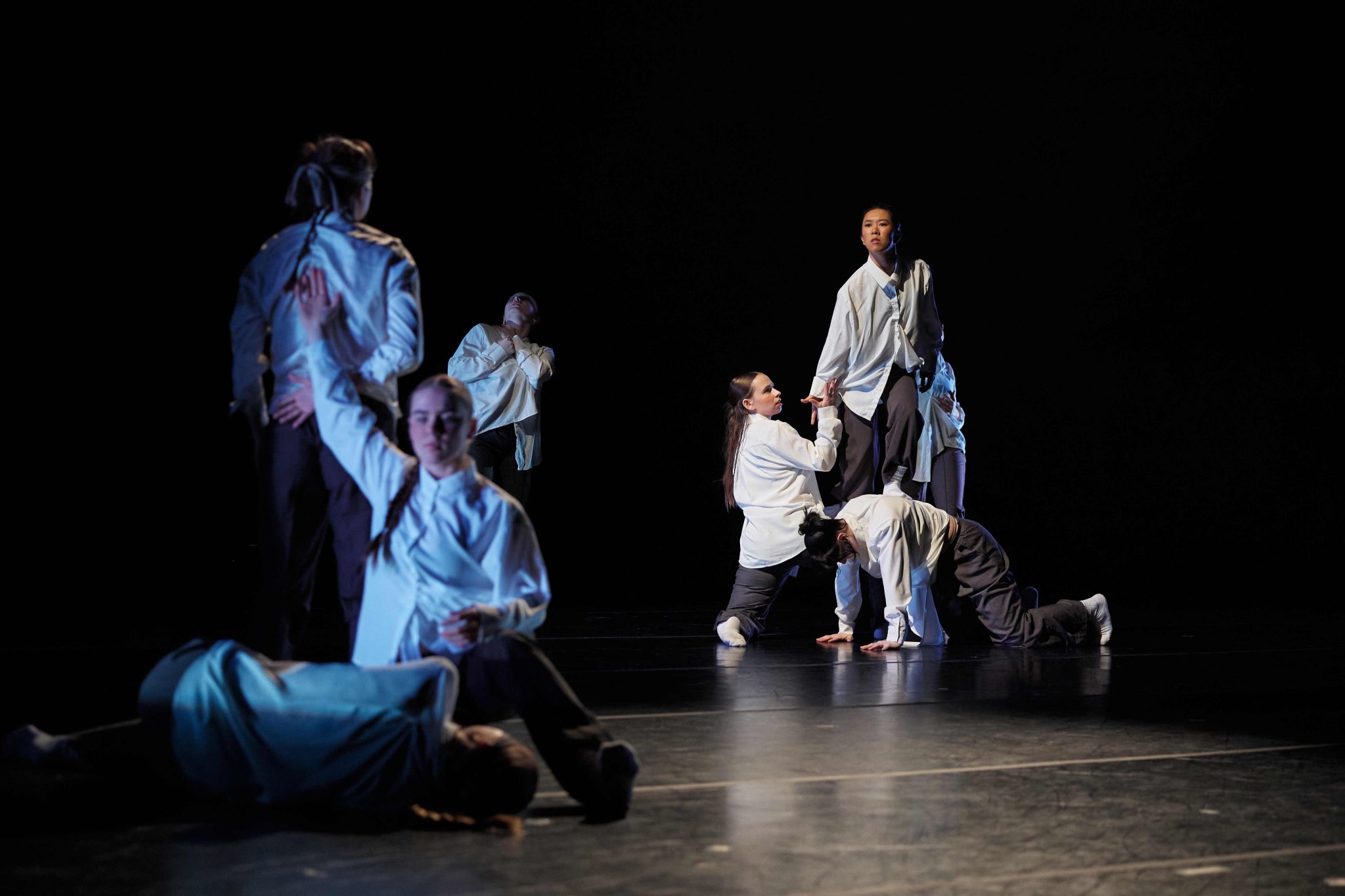 a wind blows through me. Choreographed by Kate Hacock. Lighting Design by Marley Keith. Photo by Allina Yang.
Closing the evening with a proper bedtime sendoff into your nightmares, Birthday Clowns in the Dark, choreographed by Sam Stratman, features eleven clowns twitching and bouncing in and out of an amorphous clump. Though the low-lit space was true to the title, I would have liked a little more light to see hollow-eyed smiles of the backbending clowns staring dead-straight ahead. The movement vocabulary was very true to the character choice, and while I do not fully grasp the point of dragging each other around by the ankles and playing dead, there is something delightful about ending the night with so much camp and theatrics.
The pieces were wonderfully cast, showcasing the dancers’ shared base techniques of dance training, allowing them to dance in the choreographing stylings of each piece, whether lyrical, theatrical or hard-hitting. It is exciting to see so many dancers and choreographers at this point in their careers, cultivating and discovering their aesthetics, movement styles and choreographic voice. As they continue to find the meaning in their movement and the potential of what their movement can say, we look forward to having them join the broader Seattle dance scene.
UW Dance Majors Concert ran Feb 26-Mar 1, 2026. The program is available HERE. Featured photo is Birthday Clowns in the Dark, Choreography by Sam Stratman, Lighting Design Gwen Cubbage, Photo by Allina Yang.


