eXit SPACE’s BOOST Dance Festival returns for its 12th iteration! Marlo Martin, the festival’s founder, shares a story before the show of moving to Seattle out of college, ambitious and ready to make work. When presented with numerous closed doors, Martin decided to make her own festival to create opportunities for dancers to express their art and extend the reach of their audiences. BOOST aims to feature artists across many stages in their career, curating a diverse spread of artists to bridge the dance community all across Seattle. BOOST 2026 was split into two program lineups due to a record breaking number of artist submissions. This year features new works from Amy J Lambert, Zihao Yuan, Rhea Keller, Ebb//Flow, Alana O Rogers, Ieva Bračiulytė, Elia Mrak, Sally Holloman, and host company badmarmarDANCE.
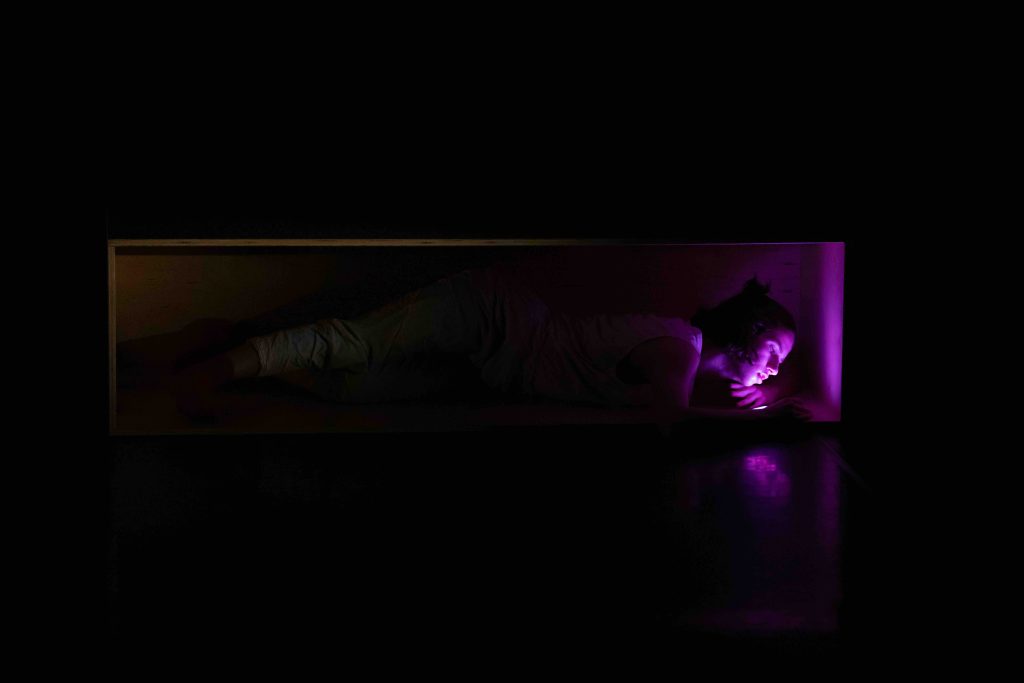 Maisy Neill in Alana O. Roger’s Fractured (an excerpt). Photo by Jazzy Photo | Joseph Lambert.
The show opens with a spiraling and starry quartet from ebb // flow. Intertwined begins with each dancer introducing themselves with gestural and sharp motions as the other three watch from the sidelines. The dancers (Rebecca Barney, Becca Blackwell, Kimberly Holloway, and Emma Hreljanovic) swirl and lift one another with extended limbs like shooting stars. The dancers get closer, balancing on top of one another like turtles and their shells.
Amy J Lambert and Rose Amlin perform i am more likely to wait than you are, a comedic and sweet duet. Amlin stands over a black tarp holding a bouquet of lilies, making melodramatic expressions as Ave Maria plays and placing flowers on the tarp, which mysteriously pop up into the air whenever Amlin’s back is turned. Lambert emerges from the tarp and the two begin synchronized walking and theatrics in their matching color-blocked and iridescent outfits. The twins push each other, oscillating between connection and competition. The two display a silly and sweet sibling-like rivalry that ends with them together, sharing a cigarette.
Zihao Yuan explores tradition and queerness in a solo performance, The Hidden Q.U.E.E.R. This piece draws inspiration from Chinese Opera performer Mei Lanfang, known for pushing gender boundaries. Yuan emerges, creating a train of flower petals as he glides across the stage. Blending traditional Chinese dance with contemporary forms, he moves with the grace and precision of a heron. Slipping on white water sleeves, they begin swirling and slicing the air. The sleeves retract and extend, creating rippling waves in the air. The spinning of the sleeves creates a windstorm for the petals to lift off the ground and swirl alongside.
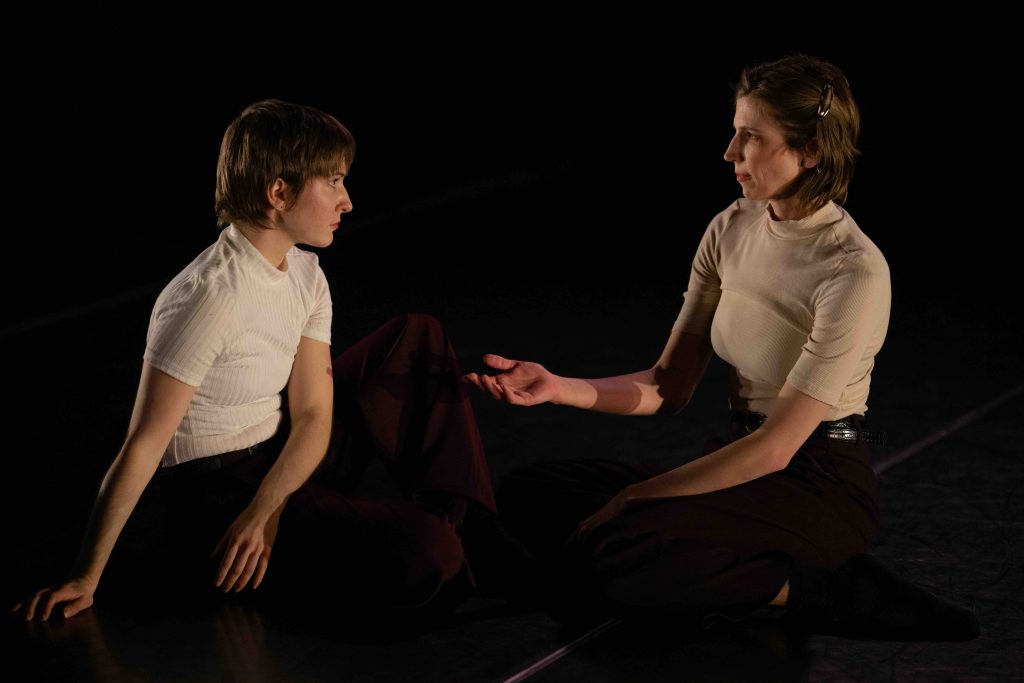 Rhea Keller and Alicia Pugh in from the ground. Photo by Jazzy Photo | Joseph Lambert.
Rhea Keller and Alicia Pugh perform from the ground, up a duet displaying the effort of standing. Keller traces and zippers points across their body as Pugh sways forward and back like they are on a boat. Grasping each other intensely, Keller drags Pugh across the stage until Keller descends and Pugh catches them like a seesaw. Durationally, the two take turns jumping into an airplane position, balancing on one leg with arms extended wide. Continuously leaping and balancing, they find moments of stillness and unison until the lights fall with them.
Program two begins with Fractured (an excerpt), a solo choreographed by Alana O. Rogers, performed by Maisy Neill. In a pre-show installation, Neill wiggles in and around a wooden box, holding a cellphone illuminating her face. She begins skittering across the stage and falling into a face palm of defeat, sequentially adding swooping sharp arms and turns to the sequence. The box becomes an anchor as Neill rushes towards it. Facing away, she sits on the box, uncomfortably shakes and twitches. Becoming tethered to the phone’s glow, still moments with the device contrast various efforts to part from it. This piece reminded me of early experimentations of playing in small, contained spaces like cabinets, cupboards, and cardboard boxes as a child, contrasted with the isolated and phone addicted present.
Ieva Bračiulytė’s The Waiting Room takes traditional sexy heel moves and spins them into the anxiety-inducing context of a healthcare waiting room. Hospital ambiance plays as a lone folding chair sits on stage. Six dancers (Jenna Batchelder, Ieva Bračiulytė, Miranda Deguzman, Audrey Gibson, Venise Lee, and Caitlynn Noltie) come out with folding chairs and matching outfits. A jazzy piano plays as dancers move frantically to express their unease. A dancer stops and splays open on their chair like a starfish. Everyone pauses to notice their vulnerability. The dancers create the illusion of free falling by lying on the chairs, floating their limbs, and performing a synchronized nose-dive on their chairs, planking as if they are plunging into the unknown. The piece ends with the dancers all stacking their folding chairs on top of each other to create a tangled, distressing Jenga-like sculpture. The last dancer on stage sits downstage of the sculpture, looking back at the tower before the lights go out.
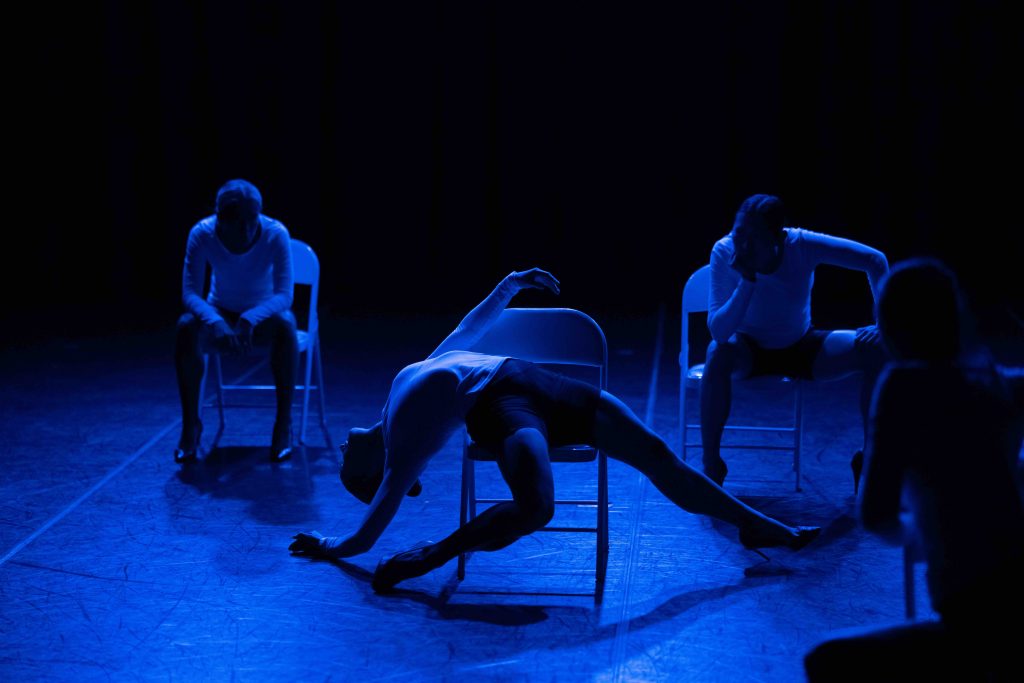 Ieva Bračiulytė’s The Waiting Room. Photo by Jazzy Photo | Joseph Lambert.
Sally Holloman’s Impozter Zyndrome Iteration 3 – The Antiheros navigates identity and competition through the fusion of various dance styles. Red and blue lights flash as police sirens sound. Dancers (Holloman, Sophie Martin Hurwitz, and Kaylyn Ready), are introduced through precise kicks and turns, juxtaposed by bold grooves. The dancers fight with each other, pushing, shoving, and even slapping one another to the ground. Two dancers hold up their hands as the lights flash, smiling with earnest embarrassment and fear. Holloman comes out and mocks the dancer’s expression before breaking into more dancing. This piece reflected to me how it feels to be a person of color brought up in predominantly white dance spaces, finding your identity as a dancer and as a person through shared notions of hybridity.
Elia Mrak’s Stay With the Trouble performed by maia melene d’urfé, is an urgent pressure cooker that spirals into softness. Bright lights flash on, thrusting the audience into intensity. d’urfé performs fast-paced rhythmic movement, meticulously placing hands over the body and face, reverberating the controlled, quick movements. The sharpness is blended with a fluid smoothness as the speed continues. The music cuts out and d’urfé continues moving with the memory of the rhythm before. A stillness is reached, then they begin moving quieter with a much needed relief to the efficiency of the earlier section. They look to the audience before spiraling off center and smoothly flipping low to the ground with legs gliding over head. The fast paced nature of the piece reflects the everpresent obsession with automation and productivity. Watching d’urfé find gentleness and warmth has the relief of watching brakes suddenly kick in on a runaway train.
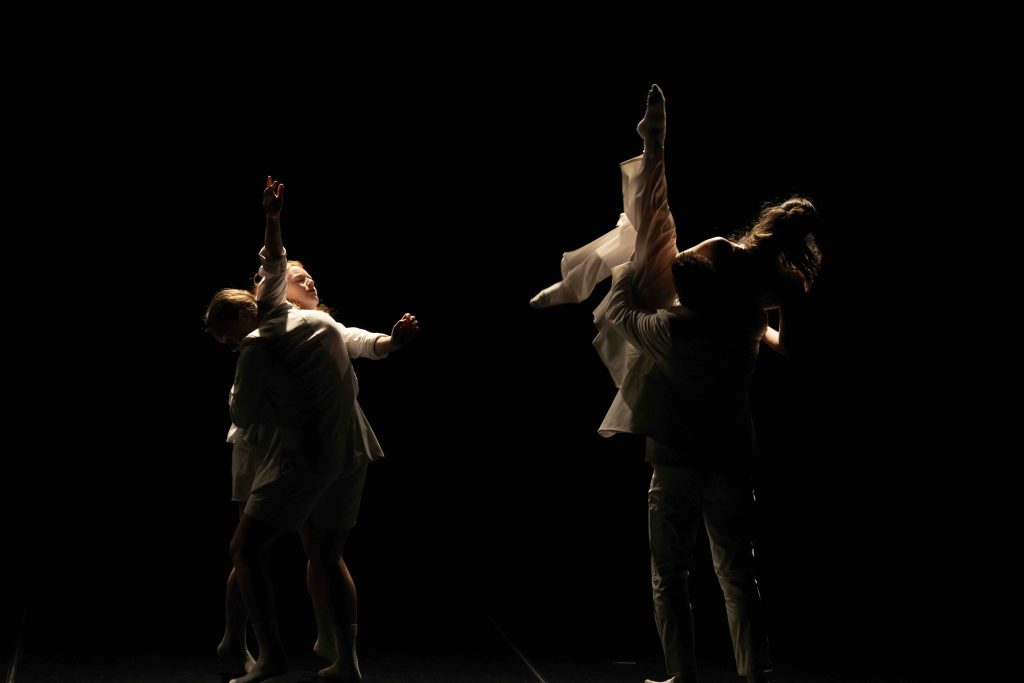 badmarmarDANCE in meet me h e r e, choreographed by Marlo Martin. Photo by Jazzy Photo | Joseph Lambert.
badmarmarDANCE closes the show with meet me h e r e. Miranda Chantelois and Sean O’Bryan begin, finding long-reaching limbs beneath a spotlight, while facing away from the audience. The rest of the cast (Carol Davis, Ally Elliott, Nicole Flores, Hayley Keller, Bri Wilson, and Roni Witbeck) trickles in and joins them one at a time. Otis Redding’s soulful “I’ve been loving you too long” fades in and out as the dancers travel through space. Lifting one another in the air as the brass of the song climaxes. In a line, the dancers slice, bend, and break to industrial hisses and puffs of air. The piece ends with the dancers coming together. Son Lux sings “We Are the Ones” as the dancers move in unison with expansive movement and extended legs.
BOOST offers a diverse array of dancers to showcase different styles, bringing various dance communities across Seattle together. Across the show, dancers navigate themes such as anxiety and identity, often finding comfort in community. This year’s performance was the last BOOST at NOD Theater; next year, the festival will continue at the Erickson Theater.
eXit SPACE’s BOOST Dance Festival ran Mar 27-29, 2026 at NOD Theater. Lighting design by Becca Blackwell. To see full program information, click here. Featured photo of Sally Holloman’s Impozter Zyndrome Iteration 3 – The Antiheros , photo by Joseph Lambert of Jazzy Photo. To learn more about eXitSPACE programs, visit their website.


