The kinesthetic communion central to Amy O’Neal’s work Again, There is No Other (The Remix) begins before entering the theater. Bass notes vibrate the sidewalk in front of On the Boards in rhythms that seep through shoe soles, vibrations that call us to the dance floor.
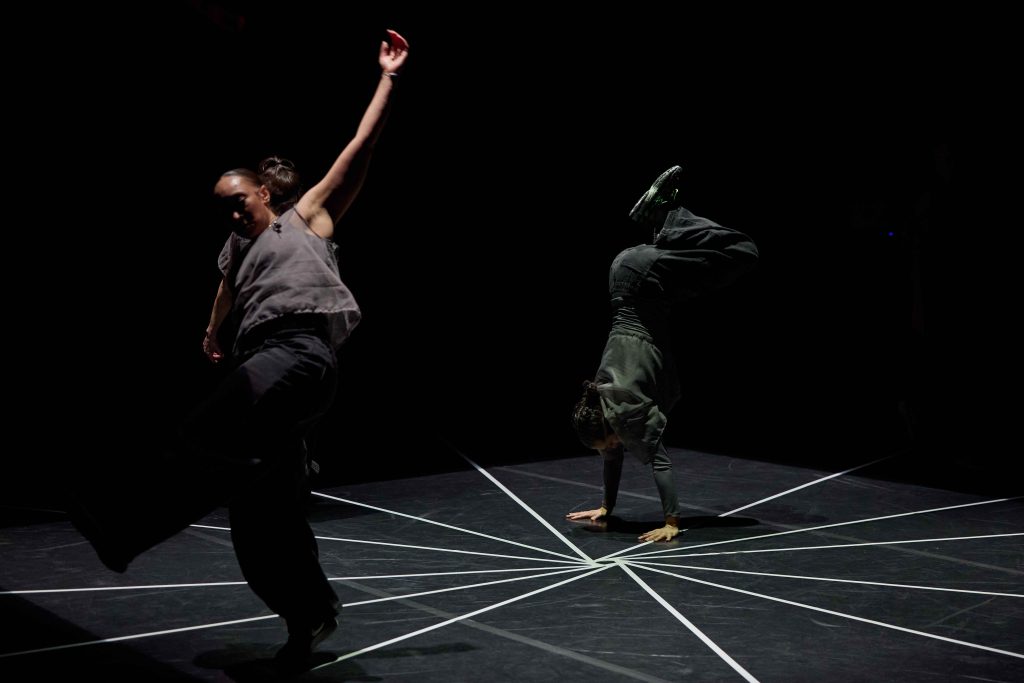 Photo by Allina Yang
The lobby doors to the house open early, slowly funneling guests onto the stage, into a dance party in full sway. Veterans of the Seattle house and hip hop scenes are in the building, making themselves known by casually top rocking with their friends amidst the audience dance party. In addition to the dancers, there are uncles in the mix who last danced at their daughter’s wedding, and other non-dancer-identified folks who move with the gentle ease of simply grooving to good music with infectious rhythms. The space is democratic, open, and buzzy with joy.
The audience is shooed off the stage to take their seats, which are arranged thrust-style on 3 sides with no wings for dancers to disappear into. Lines on the black floor converge like spokes on a wheel into a central circle, drawing our focus to a singular point, pulling us into the cypher of the stage. I can feel the sub bass of the original compositions by WD4D, Shabazz Palaces, Natasha Kmeto, and Moderat, mixed by WD4D, deep in my pelvis, through my rumbling theater seat. I know that the other bodies in this semicircle audience are vibrating with me as the show begins.
Five femme-identified performers get in formation in the upstage right corner of the theater. Their blue-lit bodies slowly walk forward together, panther-like, in an image of power and unity that returns as a visual touchstone throughout the hour-long performance. Their energy is all don’t-mess-with-me swagger. During their slow walk, we hear the only audible lyrics in the show; “she’s got that masculine thing down,” which repeats, mantra-like. While the dancers originally move as a pack, as they break out into trios, duets, and solos, they all stand out as individual experts of their own styles. We see house, hip hop, breaking, popping, waacking, contemporary, and the manifold hybridities between.
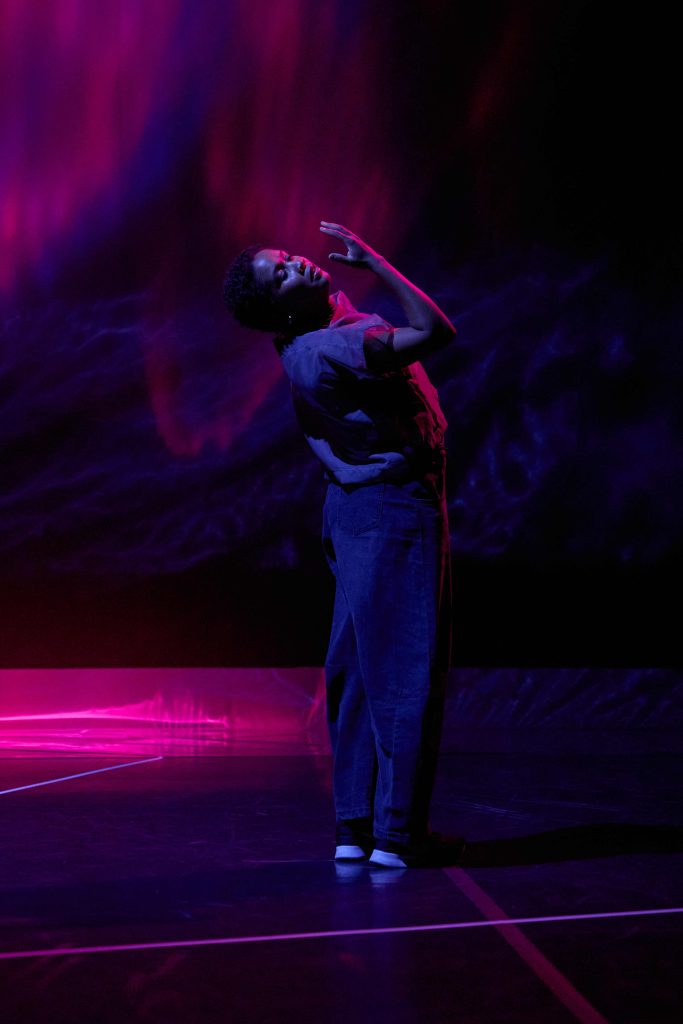 Photo by Allina Yang
The cast of Annie Franklin, Nia-Amina Minor, Amy O’Neal, BGirl Rascal Randi, and Tracey Wong is a power quintet that includes artists who have given decades of life and love to the Seattle and Los Angeles dance communities as teachers, learners, advocates, performers, and world-builders.
Each cast member flows between full group, partner, and solo work with individual flair, reflecting their diverse movement practices. I cannot rip my eyes away from Franklin, whose fierce performance demands absolute attention–fully commanding space, time, and energy. Wong exudes pure sunshine and warmth up top, while sneaking in aggressive footwork and hard-hitting waacks in the same breath. Her smile is so bright, I want to be her best friend. We don’t have time to scream for Randi’s freezes and power moves–she has already moved onto the next one. I lean towards Minor’s subtle movements, catching glimpses of a rich inner life that imbues each step with meaning. O’Neal’s power to build community is on full display in her movements and in the shaping of this piece.
By opening with the dance party, O’Neal cracks open stereotypically reserved Seattle audiences. Throughout the hourlong performance, powerful jump-kicks from Tracy and an antigravity hover from Randi elicit audience shouts and exclamations of joy. In addition to whoops, I hear guttural moans during Franklin’s solo, and could not stop myself loudly sighing as Minor lifts a hand to the ceiling. The cast draws us into their world and we participate with vocalizations and murmurs.
Explorations of gender emerge in the refrain of forward walking with “masculine” energy, followed by backward walking with “feminine” energy. There is power in both: the forward walk is direct and strong, the backward walk is flirty, but with a spirit of playful confrontation. These women are not shrinking violets retreating upstage, they are laughing and daring you to watch them tap their nipples and thwack their own asses, having fun while they bop together.
Questions about race are embedded in the movement vocabulary of the work, which has its origins in Black communities and has been shaped by choreographic tools associated with contemporary concert dance–a space that does not often make room for Black dance vernacular. The cast is multiracial and each member brings their own style, identity, and background to the collective. In interviews, O’Neal speaks to her status as a guest in hip hop culture, and to her examination of her positionality and whiteness. What she does in this work is to create a container for exploration, without the goal of finding answers, and builds a community of multiracial performers supporting one another and embracing difference.
Community care emerges as a theme in this work. In the beginning, there are moments where, while one dancer is performing, another has her hand on their back, providing quiet and unseen support. Touch is unacknowledged and not directly responded to. The unseen soft support feels to me like ancestral presence, a nod to lineage and teachers from adolescence. These soft holds on the back morph to touches that take and give more weight. The touches become responsive, offering input through push and pull. Touch becomes reciprocal when the dancers hug. Other recognizable, pedestrian gestures emerge: a head rests on a chest, a hand is placed on a shoulder. We see the dancers soften into, and draw strength from, these gestures of care. I am reminded of the feminized work of kin-keeping and caregiving through support and response, and also through witness.
Amiya Brown’s lighting design and Meena Murugesan’s projections are crucial additional cast members in Again, There is No Other (The Remix). Projected images highlight both movement and music: brief flashes of colorful, luminescent swooshes highlight WD4D’s beats. Wispy, luminescent images of the aurora, colorful clouds, and blazing flowers appear and disappear. Between sections of the piece, rapid and total blackouts serve as palette-cleansers, revealing new arrangements of performers and bodies when the lights come back on. Deep blue light bathes the dancers in an eerie glow. The dancers perform solos, duets, and trios in dramatic squares of light, like they are at the bottom of a laundry chute, or in their own small rooms. Projected silhouettes of femme bodies in colored, window-like rectangles appear on the scrim behind them. Maybe these projections represent the gaze of other women and femmes watching over the performers, or maybe they represent their own shadow-selves.
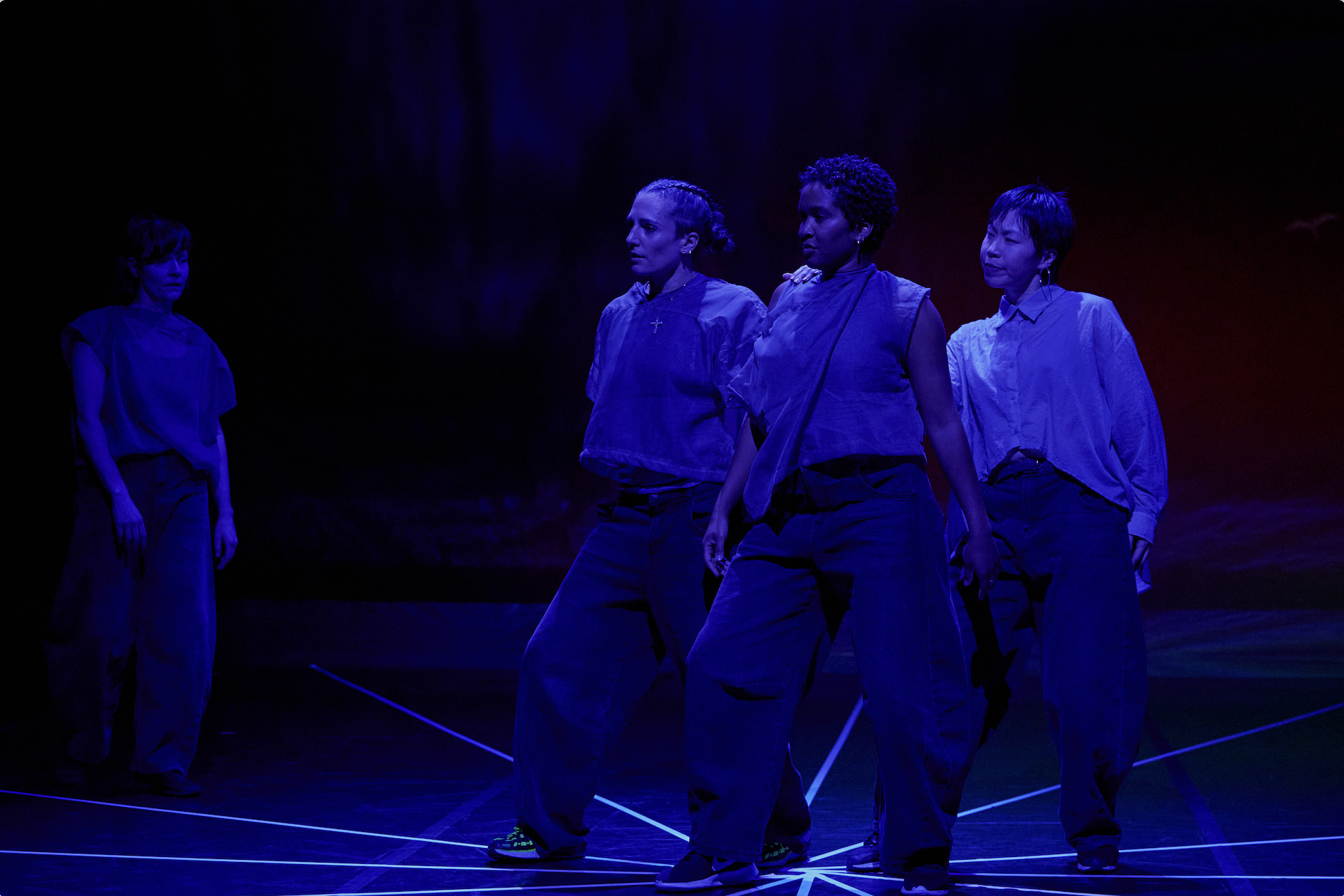 Photo by Allina Yang
In another memorable lighting moment, pie-slices of light revolve in a circle around the center of the stage, highlighting the way that the converging white lines break up the floor into triangular slivers. The acute angle of the light on the floor draws our eyes to the center of the action. The climax of the projections occurs when distorted silhouettes of the dancers begin to bloom across the scrim, leaving acid-trails of motion behind them. A small camera downstage captures the motions of the dancers, which are echoed in flame-like bodies behind them that blur and morph together.
Our eyes rest when O’Neal and Wong take seats in the audience and relax, leaning on one another with friendly intimacy. They sing together playfully. The audience can’t help but join in to the familiar tune. A moment that could have felt trite instead feels healing, because it is delivered with such openness and authenticity. The circle re-opens when the cast is joined on stage by a small group of members of the Seattle house and hip hop communities.
I left the theater feeling grounded and happy, full of echoes of the movements I had just seen. I struggled at times with transitions from scene to scene–the flow from audience participation to performance felt abrupt, the projections and movement did not always connect for me, I wasn’t prepared for the singing scene, and the ending felt anti-climactic after such an energetic show. Nevertheless, I was still transported by the cast and choreography: they had me hypnotized. O’Neal frames this piece as exploring race and gender. For me, the politics of this work is in the examples of caregiving and support we witness, which, of course, is racialized and gendered labor often unseen and unsung. It was a gift to see so much of it, presented as physical evidence, not just performance. I believe in the love this cast has for each other and witnessed the love the audience gave them right back.
In the final curtain call of closing night, O’Neal calls to the stage the entire design crew, and lists everyone by name, letting each person receive applause and whoops of thanks. As the crowd applauds, O’Neil says into the microphone, “it feels good to be home, it feels good to be held.”
Amy O’Neal’s Again, There is No Other (The Remix) ran March 26-28 at On the Boards. The program can be referenced HERE. Featured photo by Allina Yang.


