A dozen kitchen timers are wound and ring their metallic alarm.
Two metronomes tick in and out of sync.
A red ball and a blue ball of yarn are tossed down from the rafters and rapidly crocheted.
A popcorn machine is filled with kernels and escalates into frenetic popping.
A pile of clogs are hurled against the wall.
A trap door opens, leaving a gaping hole in the stage.
The dancers dive in and climb out.
The exit door opens and the dancers jog into the lobby.
Two dueling pianists emerge from the audience to strike at the keys.
The stage and performers emerge covered in glossy polka dots.
Athletic somersaults thud against a gymnastics vault board.
A dancer spits from the rafters, two dancers pee onstage.
Suffice it to say, a lot happened during the five hours of Heather Kravas’s RoCoCoCoCo – A Situation For Dancing in Four Movements. Moments in the performance have the audience shifting and leaning in their seats, rapidly looking side to side, trying to not miss the action. Just as present, amidst the fast-paced commotion, are eons of stillness, time-bending repetition, and movement so slow that it is barely perceptible. In durational work, there is room to play with different extremes in durations and experiences of time; to fall completely out of time, to lose track, or to create small fleeting bursts of micro-time. Kravas, who is well known as a shaper of perceived time, has composed a series of four movements that cultivate our attention.
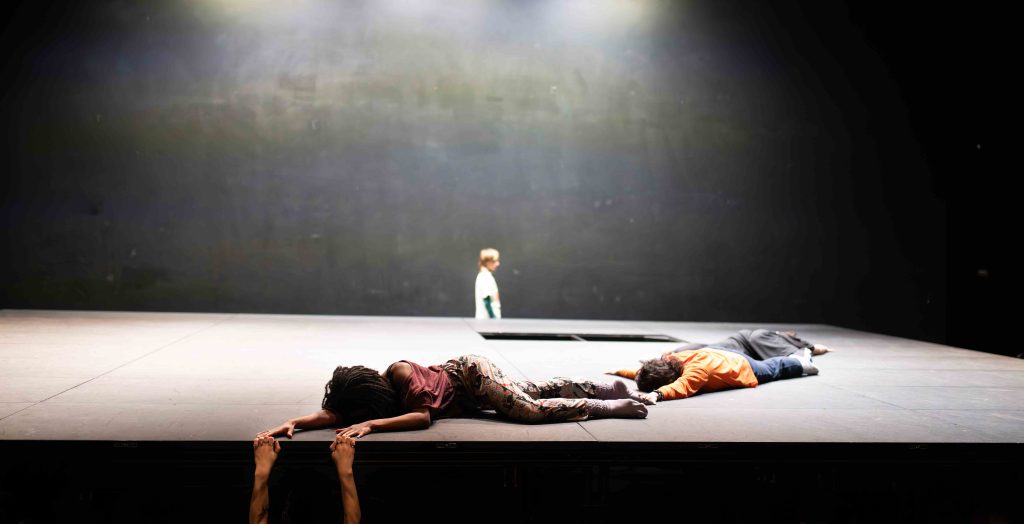 Photo by Jim Coleman
In a note to the audience, Kravas invites us into “an experiment in time,” where we have the options to watch any or all of the four movements separately over the course of the first week of performances, or to watch all four as a durational performance, as I did. While each piece can stand alone, watching the movements sequentially highlighted how each piece prepares you to receive the next: the brisk-paced repetitive Allegro, moves to the sparse slow Adagio, which gets interrupted by rapid cacophony, then introduces the charged and provocative Andante, finally culminating in a collaborative and pleasantly collective Coda. Each section is carefully crafted to constantly be tinkering with our expectations in ways that gratified, challenged, and stimulated the viewer.
First Movement: Allegro Symone Sanz + Julia Sloane
As the audience enters the space, Sanz and Sloane are already sitting on the lip of the stage, a platform three feet above the ground. Sanz and Sloane step onto the stage and begin a series of repetitive steps. Eye-level with their knees, our focus is directed to the footwork patterns. To keep track, the dancers use internal counting systems, with the patterns and sets of repetition tracked between the dancers as they shift formation and transition into different sequences. They glance at each other, check in about the counts, and even mumble a “Sorry” when they accidentally bump into each other. Their gaze is casual and easeful. Sanz and Sloane occasionally step off the stage, drink water, adjust their clothing, check in with each other and resume the steps, reminding us that what they are doing is physical and challenging, as it can be easy as an audience member to fall into a passive trance lulled by the repetition.The unison choreography seems less about a right or wrong way to do the steps, nor about the meaning the movement evokes, but rather about the rigor of connection, of staying together. As they repeat a leaping side grande jeté phrase, Sloane approaches the jump with the gumption of a child propelling themselves across an almost-too-wide-creek, while Sanz has a more measured delicacy. Both seemed to be enjoying their way through the movement, and so these differences in approaches felt celebrated instead of comparative. They still find each other unified in their differences. Kravas seems to nurture in her performers this sense of agency, a way of finding one’s specific self inside of choreography movement scores. Each dancer approaches the movement through the specific realities or desires of their bodies.
At one point the dancers switch to a walking pattern that tracks from side to side along the stage. Based on the subtle changes in their weight shifts, the steps communicate different archetypal personalities – sultry, macho, clownish, driven. Stepping off the platform, they turn on a popcorn machine, and resume a playful foot-shuffling frolic as the kernels pop. When the popcorn is done, so is the first movement. Lights shift, and we are handed popcorn, beers and sodas as we step into the sunny afternoon for a brief pause while the space resets.
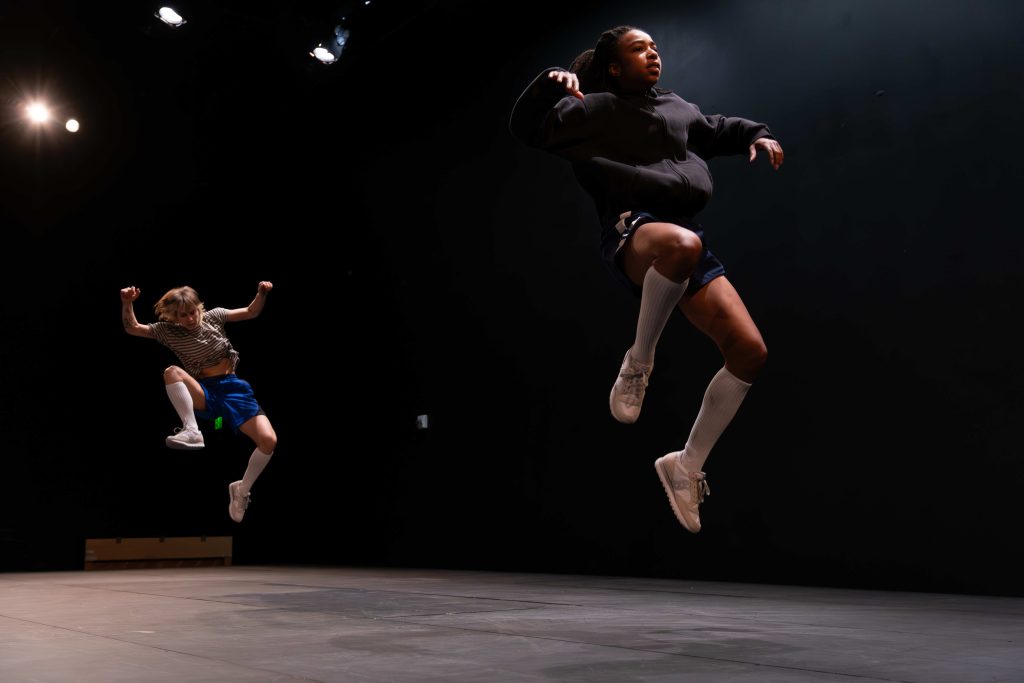 Photo by Erin O’Reilly
Second Movement: Adagio Carlin Kramer + Amanda Morgan with Bathsheba Marcus + Luke Raffanti
Adagio begins with Kramer and Morgan laying on their backs, in matching heather grey sweatpants and tanks. The lights are low, and in the shadows they slowly move their right legs through a developé, tracing up through the shin with gently pointed toes. They move as slowly as possible through a series of shapes, rolling on the floor and eventually up to standing. “Ad agio” or “at ease” does not properly account for the amount of effort and muscle training it takes to move with ease at this pace. Even when the bodies move slower, gravity and the external world continue to enact their regular forces, highlighting how much strength it takes to move without momentum. The audience is pulled into a trance, with each shift feeling like it might never end.
Suddenly, a metal washer falls from the ceiling. Worry, curiosity and speculation flash through the audience and anyone who has drifted into hypnosis is snapped into hyperfocus. We rapidly shift from not a lot happening for a very long time to a whole lot happening in a short amount of time. The shop door opens, revealing Sloane and Sanz pivoting back and forth, two balls of yarn drop from the lightgrid, Hankins spontaneously flips onto a springboard and two audience members (pianists Marcus & Raffanti) take their seats at the pianos situated in diagonals facing each other from the edges of the room. A cacophonous explosion of duets ensues: an invigorating and repetitive bilateral pulsing, whose rhythm evolves gradually.
After another eternity of this satisfying and organized chaos, with Morgan and Kramer still stuck in their eternal port de bras, the yarn is suddenly snipped and falls down, halting all the music and movement on stage. All moments, slow and long, end. Even the ones that feel neverending.
Third Movement: Andante Allie Hankins + Sylvia Schatz-Allison
The third movement, Andante, brings more overt meaning-making to the content, while keeping a lot brewing under the surface. The space dips into a complete blackout, and Schatz-Allison and Hankins stomp their clogs on the floor while music plays loudly. With thighs and forearms visibly bruised from the repetition, they throw their bodies into fast log rolls across the space, tucking and swinging and grabbing their knees. Many moments in Andante push certain unspoken conventions of civility. Hankins screams and stomps “OUCH OUCH OUCH.” She later chucks a dozen clogs as hard as she can against the wall. Schatz-Allison thwacks a metal pipe against a chair over and over; Hankins spits a wad of saliva down onto the stage from the rafters. As a watcher I am often very guarded when it comes to performance designed to stress or trigger the audience. But having watched Hankins for years, I trust her sense of agency and her ability to navigate a complex range of human experiences onstage to lure us into a dark and rich internal world. Only one moment really sends me into discomfort: Schatz-Allison lets their hair down and begins a slow head banging loop which escalates in speed and intensity, lasting an uncomfortably long time. Her breath clearly expressing that she is in pain. It helps me to read in her bio that her own artistic practices focus on the extremes found in “pain, nudity, trance, exhaustion, tenderness, fear, repetition, brutality, and furious hysterical movement.” While many of these things can normally disconnect me from a piece, in the case of RoCoCoCoCo, this section only made me lean in more. It feels charged with defiance, curiosity and secret urges. The performers seem resolute and rapt inside of the tasks and experiences.
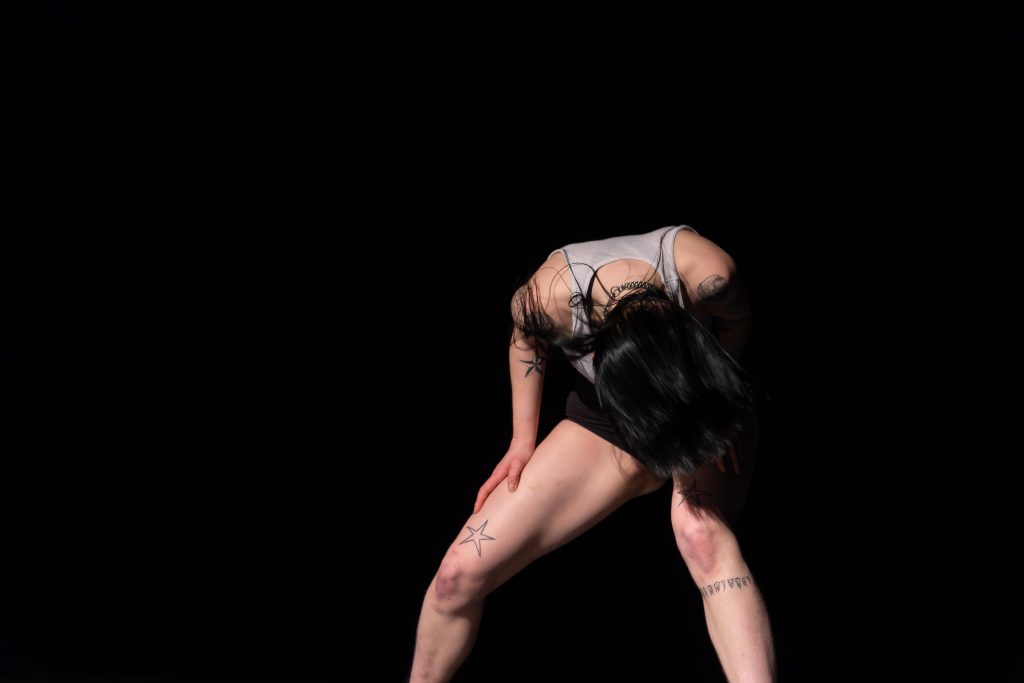 Photo by Erin O’Reilly
Finale & Coda | The Cast
If the third movement was the crescendo of the symphony, the finale feels more like the denouement, casual and sociable, inviting us in. All six dancers are present, their mannerisms gentle and playful as theynavigate an internally evolving score of connection. They remind me of an ant colony, creating a chain of bodies connecting the stage from edge to edge, then crawling underneath the raised stage, whispering to each other while they continue creating the chain. Many audience members shift to the floor to view the above and below stage together. The score evolves: the dancers travel via their replacing chain method, incrementally inching across the perimeter of the room as a travelling clump of rotating bodies. They stack their heads side by side on the lip of the stage, inducing a few audience giggles. We are brought further into the game when the dancers make their way through the risers, sitting beside us in the sprinkling of empty chairs.
Lyrics from Moondog’s song “I’m this, I’m that” reappear throughout the performance. “I’m this, I’m that, I’m sharp, I’m flat, I’m young, I’m old, I’m hot, I’m cold.” RoCoCoCoCo offers many ways to grapple with contrast, contradiction, and paradox. Can two things be true at once? The slower we move, the faster the world around us seems to move. What causes us pain can also elicit pleasure. Dancers moving in unison choreography do not have to look identical. You can run by running or by walking while emphatically proclaiming “I am running.” We can be in time and out of time, distracted or focused, loosely precise, precisely loose, playful or serious, alone and together.
In RoCoCoCoCo, these contradictory things co-exist in their paradox, opening up deeper reflection. Meaning is so rarely singular, and what happens above ground is not always what happens underneath, and what is happening external in presentation can be only a part of a varied internal subjective experience. In the final moment of the piece, the dancers are curled over in a line, linked arm wrapped around each other, gently writhing and inching to get closer to one another. Leaving the space and stepping back outside, I feel a similar experience in my body, slightly exhausted, seeking connection and a desire to grapple with the complexities inside and outside of myself.
Heather Kravas’ RoCoCoCoCo ran March 26-April 3 on the 12th Ave Arts Mainstage as a Made in Seattle project produced by Velocity Dance Center. More information about the show can be viewed on Velocity’s website. Additional credits are as listed below:
Set Design/Sara Walsh
Sound Design/Aaron Butler
Costume Alteration/LeDawn King
Cake/Kayla Waldorf
Program/Maggie Mann
Stage Manager /Cat Urquhart


