Welcome Free Wheeler, have you come to renounce the ways of the auto-overlords?
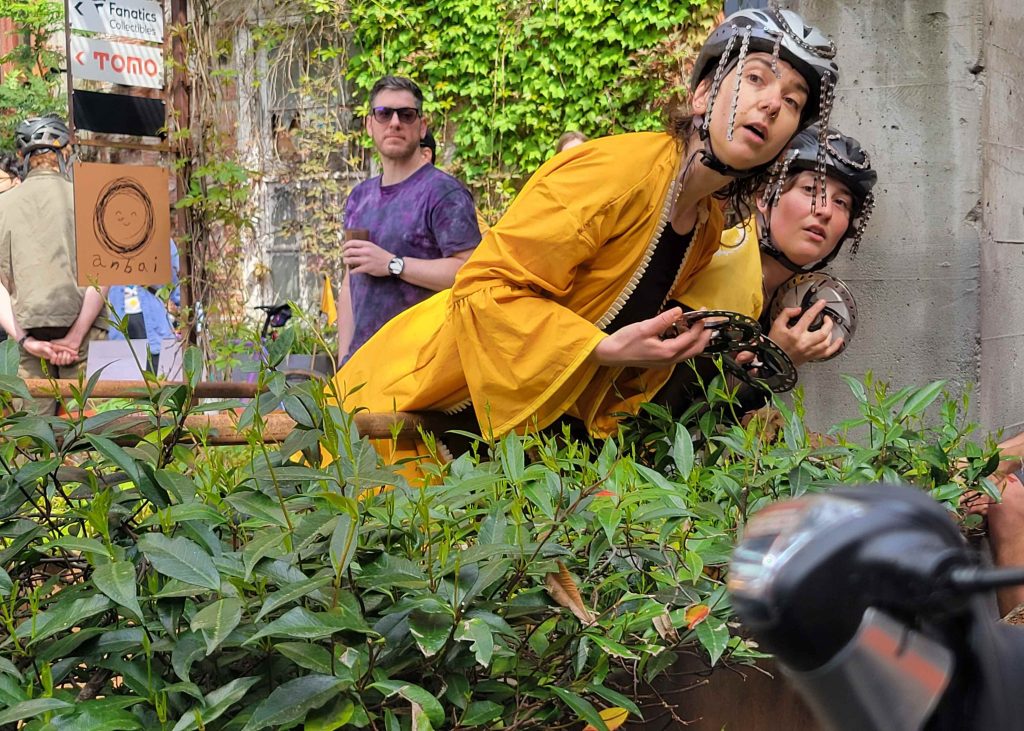
I am greeted by two semi-mystical beings adorned with bicycle chain dripping from their helmets and yellow robes printed with gears. Like emissaries from another world, they emit a patter of affected speech, alien and curious. I’m left both giggling and speechless as they rapid-fire list off bicycle parts, asking me to identify as one. I finally think of something—“a schradar valve?” They are satisfied. “Have you met The Tubes?” they ask.
 Jessica C Levine @olivemybike
The initial stage of May 2nd’s Heap Ride is a site-specific hour at Tailwind Cafe, a cafe/bicycle repair shop that is mostly just cafe now, since their shop has moved down the block, making more room for tables in the warm-wood-drenched space off the courtyard of Chophouse Row. But the spirit of bike positivity is still part of the business, particularly on this sunny Saturday morning where Heap’s performance, part roving installation and part guided bicycle tour, has filled the space with dance fans and bicycle diehards alike.
The yellow-robed emissaries (Kara Beadle and Leah Crosby) lead me to the deepest part of the cafe to where “The Tubes” (Alethea Alexander and Leo Othón) are a stretched web of bicycle inner tubes extending from Alexander’s gloved fingers, wrapping around Othón like some kind of black leather taffy pull. They slowly navigate the space, constantly in tension through the stretched rubber. The protruding tube valves accent Othón’s body like a new take on punk spikes. It’s a vision from another world plopped into an ordinary space—dance watchers intermingle with laptop users in the operational cafe.
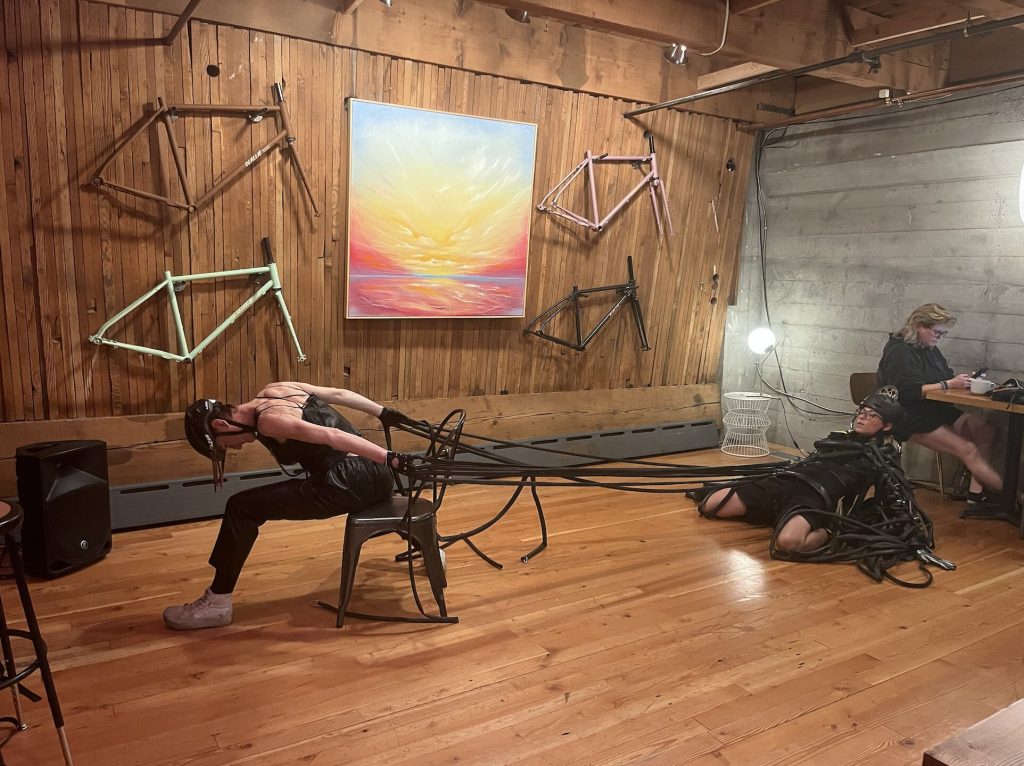 Photo by Kaitlin McCarthy
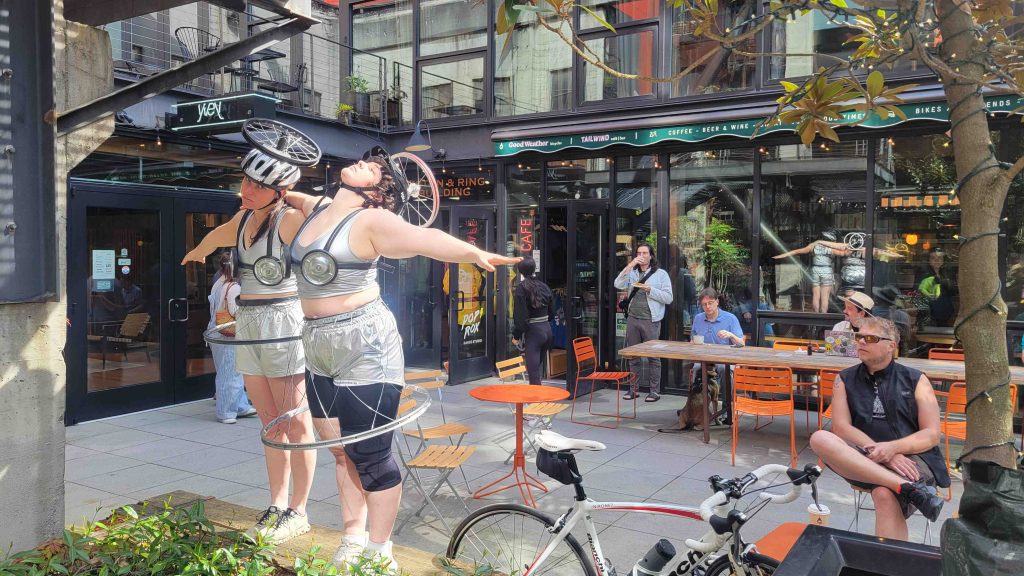
Other characters exist here as well, defined both by their movements and excellent bike-part-integrating costumes by Andy Zacek and Alexander. Back in the courtyard, Rose Amlin and Sam Fabrikant (who I affectionally dub “the weeble wobbles” in my head), wear metallic silver and bras made of training wheels. Tiny bicycle tires attached to their helmets spin freely as they tip and turn through the courtyard’s architecture. Logan Tillery, completely encased in a pile bicycle helmets, inhabits one corner: a sentient ooze in a layered armor. Zacek and Macsen Baumann are yet another breed, their helmets bisected by gear plates that fan out at different angles. They are the more down-to-earth acolytes of Heap’s created world, joyfully conveying some practical information about the ride we are about to embark on, cleverly couched in their elaborate mythology. We’ll pass “hell’s artery” to enter a “trail that’s too narrow for the speed demons,” they continue, describing legibly (if creatively) each part of the route, along with safety tips. All the speed demons care about is “big RPMs” but collectively, by staying together, we’ll exploit their “weakness”—brakes!
To close out the installation at Tailwind, and transition us to the ride, all cast members convene in the courtyard for a group number. Greek-chorus style, they gather around a central cyclist, poised atop a stationary setup. As a group they lean forward, shake, and shift as if navigating traffic. A moment of cascading collapses sends the group into an ever-shifting tableau of bikes and bodies, swinging bicycles fully over their heads in thrilling arches, riding them backwards, carrying their comrades on bikes through the air. In one moment a wheel contacts Beadle’s face and gently rolls down their chest, their expression one of pure ecstasy to be in such close contact with the exhalted.
 Jessica C Levine @olivemybike
Beadle and Zacek co-created the concept, with Beadle choreographing in collaboration with the cast. Their choreography is well known for work with objects, and bikes in particular, with both Beadle and Zacek being avid bicyclists. They recently rebranded from working under Beadle’s name to the group name Heap Troupe. While this may not be their first bike-centric work, it is a departure of scale that escapes the theater, hits the streets, and on this occasion, spans Capitol Hill.
In the ride portion of the performance about 40 bicycling audience members mount their steeds and follow the ride leader in a zigzagging route down the West side of Capitol Hill. Every turn and crossing is assisted by “corks” –designated riders who speed ahead and block potential traffic with their bikes and bodies so that the whole group can pass safely. We are taught hand signals so that the actions of the leader can be passed back, game-of-telephone-style, to riders in the back. Bringing up the rear is another volunteer, with tools and spare tubes to make sure no one gets left behind.
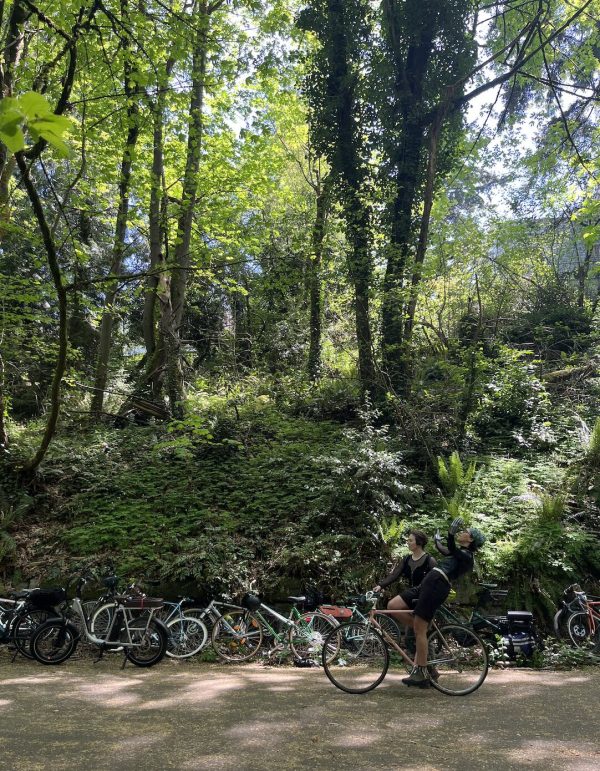 Photo by Kaitlin McCarthy
Our first stop is a tucked away hillside behind an apartment building, directly overlooking I-5. Four dancers press against the chain-link barrier in a tangled web of arms, trying to solve the task of passing several bike wheels between each person. The next stop is under the freeway itself in the unexpected architecture of I-5 Colonnade park. Here we gather around a circular platform that becomes the site of an orbiting ritual, dancers spoking out from the center and witnessing each other move in interconnected chains. We then jump back on our bikes to pedal up through Interlaken Park—a sweeping road cut through a hillside forest. The towering trees and dripping moss the Pacific Northwest is known for is a distinct departure from the previous sites’ urban infrastructure. Here, in the dappled sunlight, we sit on logs and watch walking dancers slowly guide their friends’ bikes, allowing the rider to lean backwards, arms wide, chest to the sky. A total expression of freedom and trust.
The last stop is Foster Island, where the audience gathers in a clump on the lawn and the dancers circle us with their bikes, each speaking their own bicycle anecdotes. You catch fragments as they pass—snippets of the ways bicycles become so much more than objects. A ticket into a world of experiences. For many, a way of life.
They end the work stretching a long bicycle chain between the dancers, each bending the chain to create an interconnected human machine. One cast member starts at the end, clipping off a few sections of chain, which they hand off to another dancer, who approaches the audience one at at time. Eventually it is my turn. I am given a piece of chain to keep, and am asked “Would you like to introduce me to your bike?” For in Heap’s world we understand that people can become machines, and machines can become dear friends.
Dance, for the most part, lives in the representational. Stories for the stage. Heap’s conceit may be cute and clever with its nod to medieval lore, but underneath this allegory is a very real engagement with our current political, environmental, and social dilemmas. Heap Ride goes beyond representation, actually enacting the values of the work inside the structure of the performance. So often in the arts we throw around ideas like “collectivity” and “imagining future worlds” but here that is literally enacted, and we are active participants in those ideas. It begins long before the actual performance, when I have to dust off my bike and fill the tires and plan my route to the venue. And I see a friend along the way, also biking to the show. And then I have to move my bike and my body in coordination with the group who have become my community for this time, and through our collective bodies, take up actual space on the road that is safer for everyone. And then I have to navigate my way back home—an hour long ride along Lake Washington and up Beacon Hill—with just the power of my body and its beautiful integration with frame, wheels, and gears. Over the course of this piece, I start to glimpse a possible future where expressways are the “ruins of an old world.” Where we return to collective human power, to community responsibility, to kinship with nature. Choosing to interface with the world over perceived convenience. For a few hours I got to practice that and feel how good it felt. And in the three weeks since the show, I’ve actually been riding my bike a lot more.
Heap Ride occurred May 2, followed by two other presentations riding through different parts of the city on May 9 and May 17. To learn more about Heap Troupe’s work, see their Instagram. A copy of the program can be viewed HERE. Featured image by Summer Hanson.


