A pink neon rectangle glows on the floor in the Yaw Theater where HYPERNOVA’s show, I’m Almost Me Again, is about to begin. Company director, Rainbow Fletcher, created this evening’s work to help process her mother’s death. In the context of grief, I muse about what the neon rectangle might symbolize. It’s reminiscent of a portal. I think about the Scandinavian philosophy of doorways to the dead—metaphors for transition and transformation.
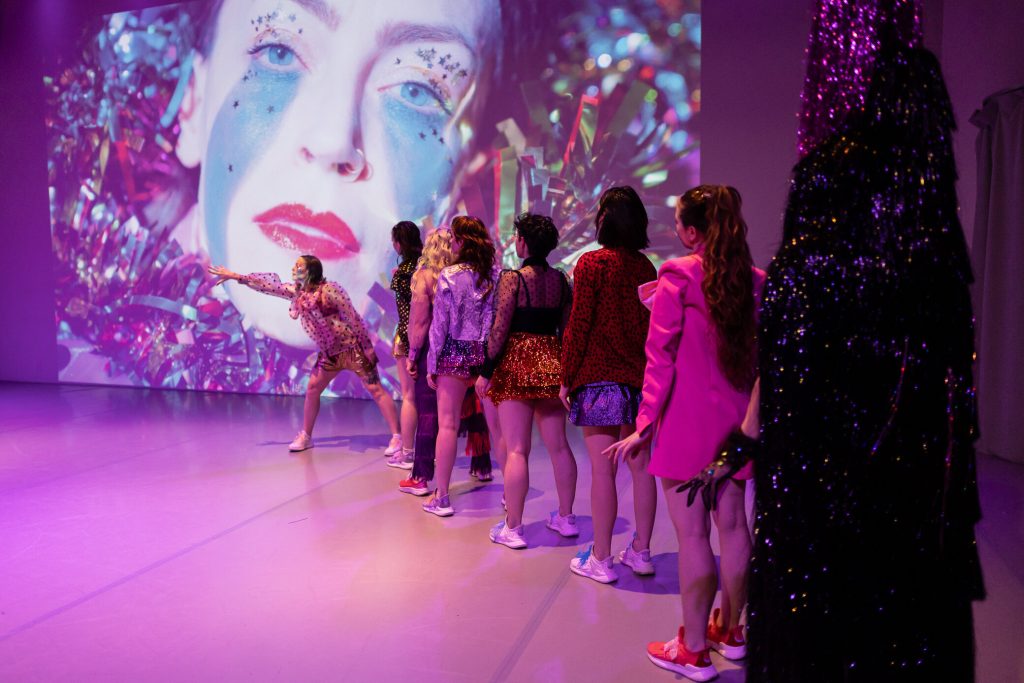 Photo by Trisha French
As the music starts, lyrics say, “It’s the end of the world.” The back wall of the theater fills with video imagery of Fletcher’s bare face, eyes cast up, eyelashes wet with tears, forehead furrowed. I realize by the show’s end that the video, directed by Jonathan Houser, and the music score, composed by Celene Ramadan, are such strong elements in and of themselves that the work is truly a multi-media performance.
Fletcher dances on stage in front of the video wearing white-spangled shorts. A huge, clown-like bow tie adds a touch of surreal absurdity. Her movements are marionette-like as if jerked by fate. Her arms windmill, she seems to be spinning out of control, blown off the course of life as she knew it. On the video, hands fold, clouds scud across the sky. On the stage, Fletcher ends this solo section in a sort of dying swan pose, as if flattened by grief.
Seven dancers–Maia Veague, Madeleine Gregor, C Asa Call, Summer Meyer, Alana O. Rogers, Chloe Dylla, and Maisy Neill–enter, bringing a riot of color. Glittering makeup, cheeks and brows glimmering with gold stars. An orange spangled skirt. Pink and blue fringed pants. Wearing quiet tennis shoes, each performer grasps a rotary dial-phone handset in one hand with the curly cord attached to her other wrist. Like the costumes, every phone is a different, bright color. It’s clear by now that vibrant colors and unabashed unique fashion sense reflect Fletcher and her mother’s approach to life. Her first name says it all: Rainbow. The retro phones combined with the lyrics, “I reach out every day,” remind me of the Japanese wind phone —an old-fashioned phone booth where grieving people can talk to loved ones who have died. But the dancers cover their mouths as if muffling their voices, unable to reach the other side.
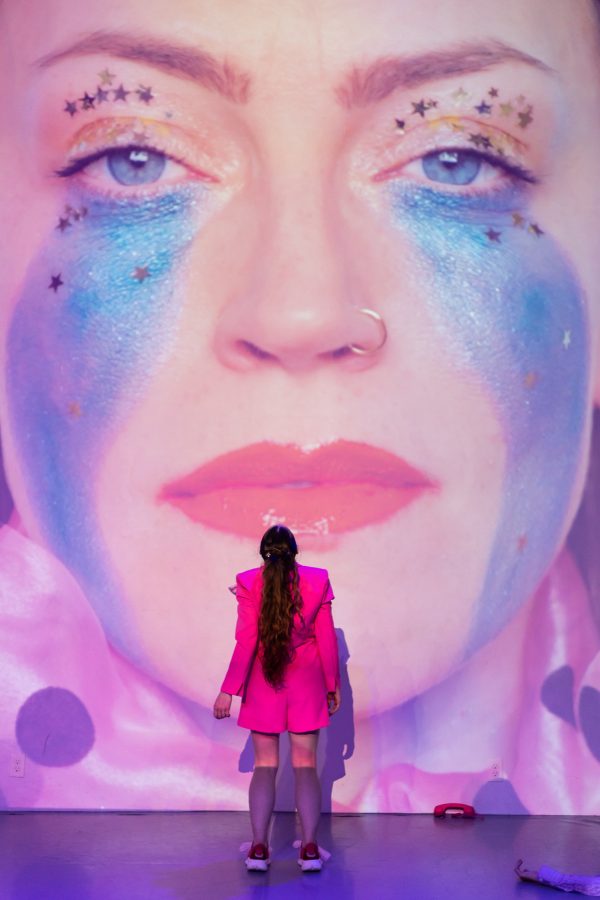 Photo by Trisha French
A dancer moves to hug another, but the hug isn’t returned. Dancers break from the group and perform fast-paced solos, while the group behind maintains a slower pace. This rhythmic juxtaposition captures the way my sense of time collapsed after my dad died very unexpectedly. It was incomprehensible that I hugged him the day before, that I talked to him that morning, that he was going about his life the year before unaware of his fast-approaching death. And yet, other people’s lives continued as normal, at the same pace. “You take your time, I’ll take mine,” the lyrics seem to grapple with a similar struggle to reconcile death and grief’s timing.
I snap back to the present when a performer empties the contents of a purse near the pink neon rectangle. You can’t take it with you, goes the expression. The dancers hold their index and middle fingers glued together. They sweep their outstretched arms in arcs, as if scanning the audience for answers, or seeking new directions.
In the video, we see Veague’s face resplendent with blue metallic streaks down her cheeks. Hands adorned in black mesh gloves covered with multi-colored gems hover around her neck. I have the sense that they are Fletcher’s mother’s hands. The off-screen presence slowly pulls off the gloves and trails them over Veague’s eyes, perhaps the way ancient Greeks placed coins on the eyes of the dead to pay for safe passage into the underworld. The vocals murmur, “Nothing feels like it used to.” Throughout the piece, the video is so stunning and captivating that it is hard to absorb both it and the live performance simultaneously.
As the video shifts to reverse coloring like a negative, a black fringed figure enters the space. The head, covered with glittering fuchsia, floats high above the shoulders where strange mannequin hands stick out wearing the jeweled black gloves. Talking with my friend from Peru after the show, she said the fringed figure was like a “mojigangas”—a tall-headed puppet popular for celebrating the Day of the Dead in Latin America. It certainly felt like death had entered the room. The video stops and the lighting dims. A young girl seated in front of me gasps and pulls close to her father.
I realize now that we walked by this figure hanging in the doorway when we entered the theater. While I noted it then, I didn’t really pay much attention to it. Much in the way that while we all know that we’re mortal, we never know how close we are walking to death. There is otherworldly moaning. The dancers are lying on their backs, feet up in the air. The figure drifts through the dancers gently touching their feet. Like a reminder that they may still be walking the earth today, but who knows for how long. Or maybe grieving has knocked them off their feet. Dressed in a hot pink suit, Madeline Gregor stands alone. After death brushes her hand, death goes and looks through the neon portal. Fletcher’s choreography poignantly demonstrates that when someone you love dies, your relationship with them doesn’t end, it just morphs.
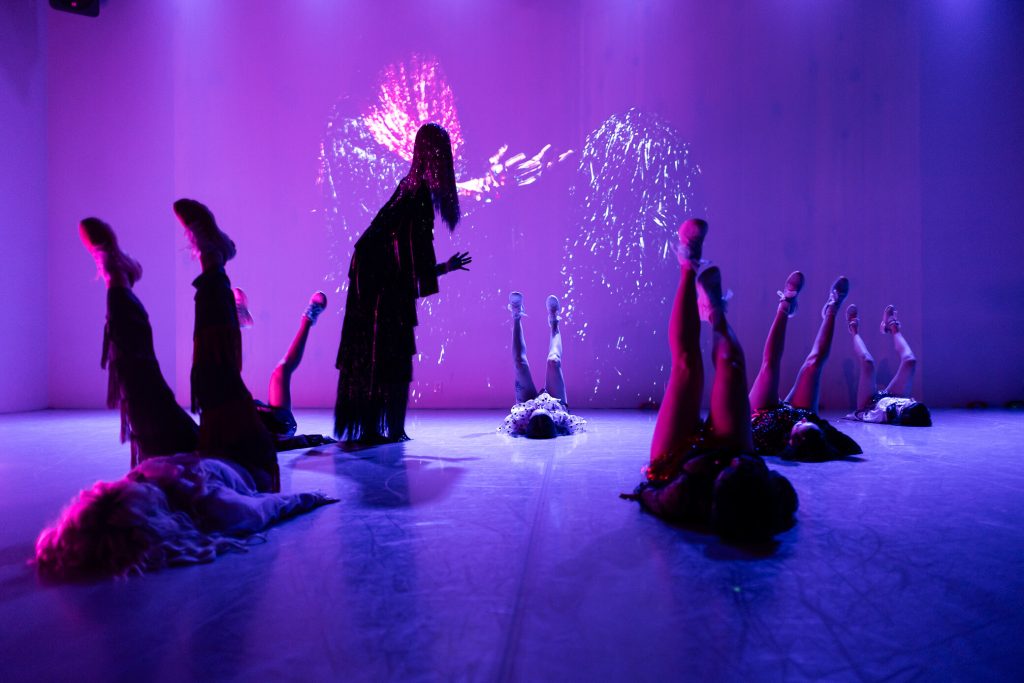 Photo by Trisha French
The technicolor video returns this time with Fletcher’s face. No longer bare and bereft like in the show-opening footage, but shimmering with gold patches under her eyes. She looks almost like herself again. Words float from the soundtrack, “I see you looking at me, all eyes looking at me.” The dancers’ index and middle fingers have separated into peace signs. The fringed death figure moves to the end of the diagonal line of dancers where she appears content to wait. It is not their time yet.
I’m Almost Me Again was performed at the Yaw Theater on April 17 and 18, 2026. A copy of the program can be viewed HERE. Featured photo by Trisha French.


