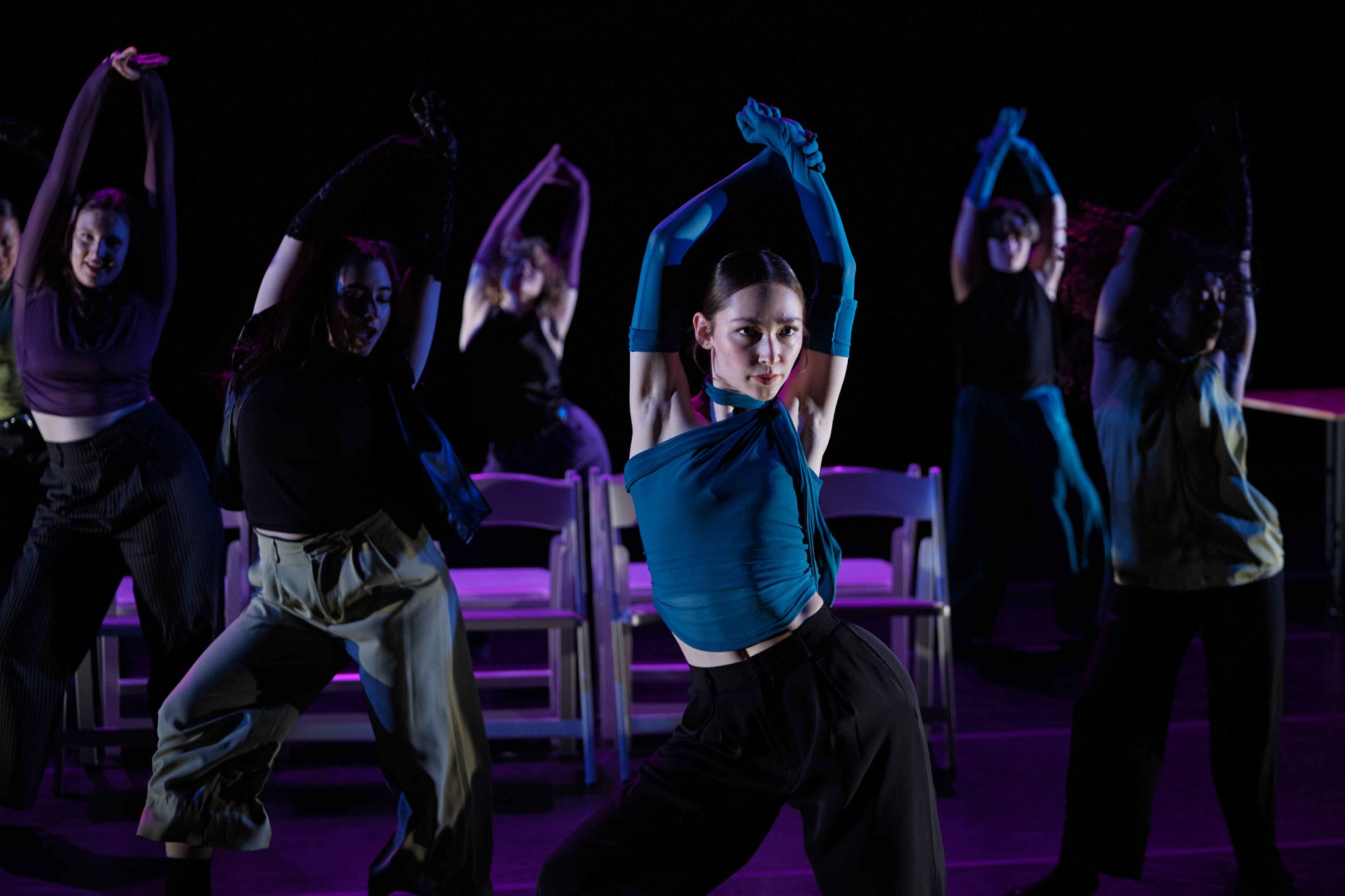
An orange moon, silky gloves, paint splatters, and lipgloss! The University of Washington’s Dance MFA candidates, marco farroni leonardo, Tracey Wong, Jake Bone, and Jillian Amadi Roberts showcase four new works in the MFA Dance Concert highlighting rigorous play, the strength of softness, and the power of precision.
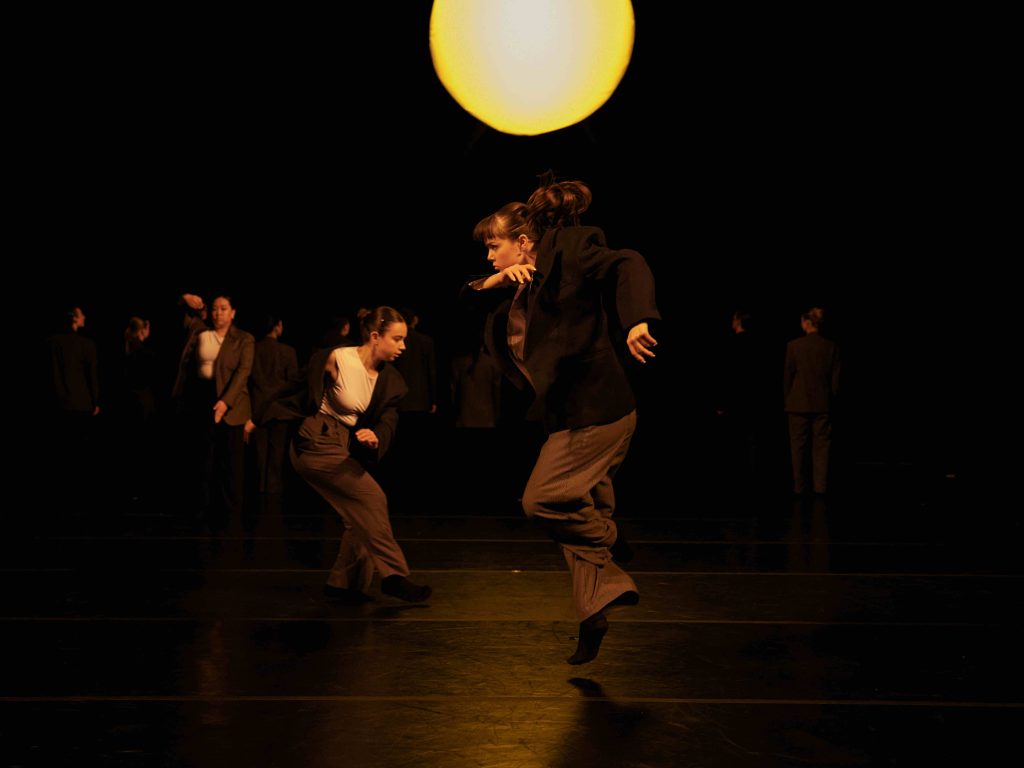 Dancers Kendall Ursula Imus and Ali Schmidt in marco farroni leonardo’s work. Photo by Allina Yang.
In Dancefornineteendancers:messynessofbeingtogether:somethingaboutthemoon:citrusbroughtuscloser:longingtosee&feel:suitwithshoulderpad:apracticeofprocessing, conceived and directed by marco farroni leonardo, a glowing orange moon hangs low over the stage. The dancers fly out in blazers and slacks with slickbacked hair. Marching rhythmically in unison, they create intricate patterns weaving through each other and popping their blazers like birds puffing their chests. Coming forward in a line, they each address the audience and begin simultaneously talking with their hands, discontent like disgruntled coworkers. Slipping oranges out of their pockets, they each begin peeling and snacking, recklessly tossing the peels on the floor, the aroma of citrus filling the studio. The sweetness of the shared oranges disrupts the seriousness of the march. They back up in the line, as dancers break out, lunging and suspending low, kicking and swirling around themselves. Chaos builds in the center, as they continue linear kicks and jumps, constantly twitching and redirecting. A square begins to build around the playground at the center, as dancers slowly swing their arms in unison like hands on a clock. They begin to run in a circle, stopping abruptly to rip off their blazers. Collectively, they thwack their blazers towards the center with force. The beating and slamming of the blazers continues to echo as the lights and music fade. The violence of this scene feels like watching a stoning, the collective swarm coming together with rage. As the lights come back on, Kate Hancock slips into the center and emerges like Barbarella in the bird’s cage. She begins contorting and quaking, holding her center as if wounded. The other dancers watch and back away cautiously. Throughout the piece, we watch the dancers move through conformity and confrontation, at times breaking out of monotony. Exploding and falling, only to be witnessed and left behind by one another.
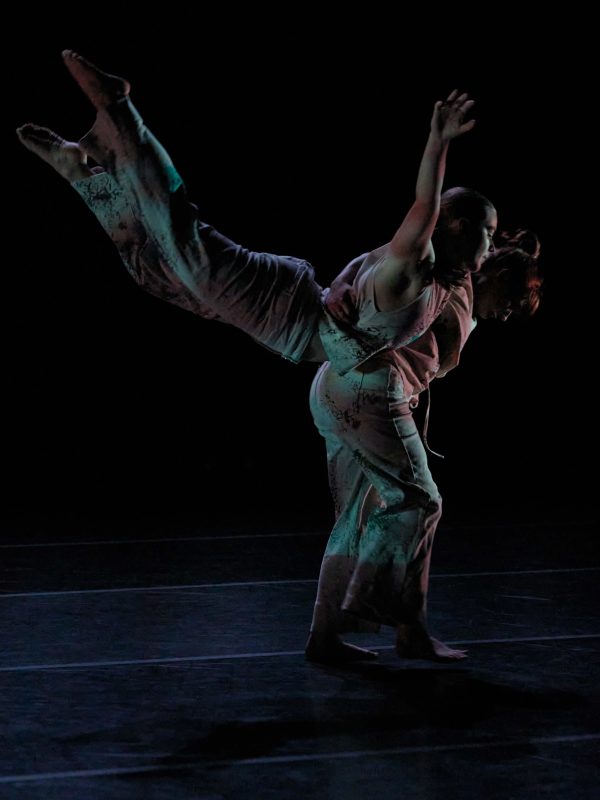 Dancers Sam Stratman and Gianna Di Loreto in Jake Bone’s work. Photo by Allina Yang.
“How do we want to live in this world?” Wong asks in the program note. Show Out, Feel In, conceived and directed by Tracey Wong, is a masterclass in luxurious worldbuilding. Across the stage sitting on chairs and tables, an arm wave rolls across a long line of dancers, washing over them all to lean on each other. Two dancers seated on a rolling table fan their legs and pose lusciously, as others spin the tables glamorously. A chandelier lowers and we are invited into a speakeasy filled with flirtatiously feminine frills. The dancers–draped in purple, blue, and green silks and satin–sport magnificent long gloves, highlighting their hands that whack with precision and frame the face with poise. They slink across the stage together, walking with softness and power. Wong cultivates an authentic feeling of kinship on stage as trios and duos form, communing playfully while sitting on tables. The chairs move towards the center in two parallel lines facing out. Vivian Augustine struts through the chairs like a train car as dancers roll and flick their arms in a line like the Bellagio fountain. Facing the crowd, the dancers take turns being the ass shaker and the one hyping up their peers. The sharing of this moment is incredibly sweet in its silliness, simultaneously dissolving binaries and expectations of who can perform what role. In this moment, and throughout the piece, each dancer’s personality shines through, while still holding a unified collective charm and suaveness. Wong cultivates a divine and radiant world, dreaming of a space where marginalized people and feminine joy are impervious to harm.
Dressed in white clothes flecked with paint, the dancers splatter and schmear their limbs across the diagonal. Conceived and directed by Jake Bone, after the first drop, is a sharp and rigorous piece painted across the stage. Explosive lifts catapult the dancers into space. They push and pull each other from the floor seamlessly, arching like slow fan blades. They leap across the stage with stag jumps and quick balletic influences. The expressive and weighted movement paired with the garments resemble a Jackson Pollock painting. Duets break out, slinging one another beneath legs like layers of paint. The dancers pique and circle around each other, covering the stage like a canvas. As an oil painter and a dancer, I craved more moments of stillness to let things settle, and to see the different layers of what has been added to the canvas, before jumping to the next section. Sections overlaid without air time means colors become muddled. The piece is rigorous and attacking, watching the dancers connect and then discard each other felt both dystopian and reflective of current political violence. At the end they move with urgency, rush crawling towards the center, taking cover in each other’s arms on the floor. As they hold each other and the lights go out, I wonder what they are protecting each other from?
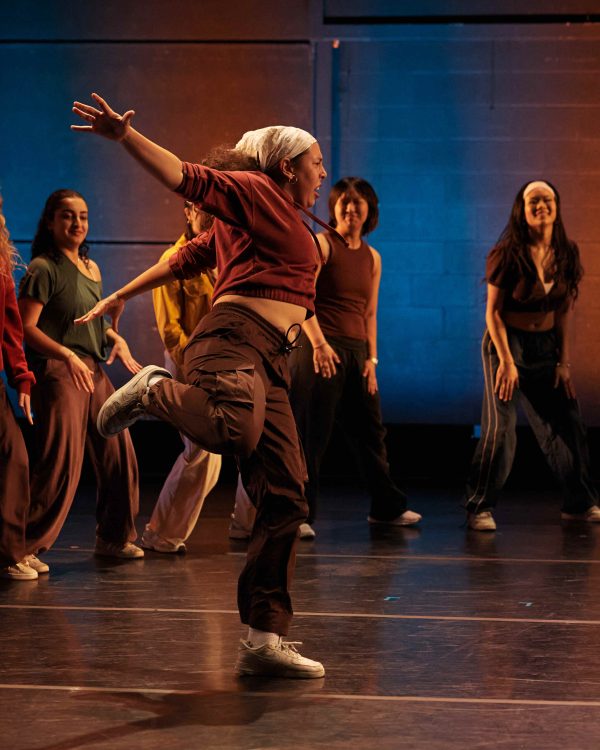 Dancer Maura Banks in Jillian Amadi Roberts’ work. Photo by Allina Yang.
A basketball court is projected above the stage. A crowd of twenty five dancers skip out on stage, cheering and chatting. Crossfade/Showtime, conceived and directed by Jillian Amadi Roberts, fuses a multitude of dance styles and honors their Afro-diasporic roots. The dancers begin a rhythmic and satiating body percussion section, stomping and clapping. Lil Mama’s “Lipgloss” plays, as the dancers form a semi circle and begin jumping and crossing their legs to the beat. A cypher showcases a wide array of movement including waacking, baby freezes, fancy footwork, isolations, grooves, dips, and even the occasional shooting of hoops towards the scrim. The dancers hype each other up, encouraging play and silliness in the circle. The projector shifts through the piece to rolling ocean waves, a subway station and train car, and auditorium seats, showing us different homes of these dance forms. Things shift midway through the piece to introduce a quartet tap interlude. Natasha Crowley, Clara Bloom, Natalie Enman, and Jacqueline Ivie, emerge dressed in yellows and browns like sunflowers and begin conversing with their tap shoes. Feet fly and click meticulously as they dazzle and swirl on their tap boards. Roberts puts these dance vocabularies in conversation with each other, as we trace their lineages and explore how rhythm has traveled and been translated through history. Continuing the theme of connecting to rhythmic conception and roots, there is a recurring motif of the music cutting out. The dancers continue carrying the rhythm, clapping and chanting, “no music, hey hey, no music”, getting the audience to join in as they continue their party grooves. Full of play, sweetness, and celebration, Crossfade/Showtime blends styles showing their interconnectedness and shared pulse.
Each piece in the show has a clear distinct point of view, while still sharing similar themes of connection, play, precision, honoring history, and building a future. The UW Dance MFA program has recently switched from admitting students every year to every other year, making this the first cohort to enter independently. These pieces showcase the unification of the new cohort, through the shared ideas on stage, as well as the unanimous decision to credit the undergraduate dancers above each graduate student in the program. Watching them put the youth first and dissolve hierarchies makes me excited to see what this cohort of MFAs will create next.
The spring 2026 MFA Dance concert occurred May 14-17 at Meany Hall Studio Theater. You can view the program HERE. Featured photo: Dancers Amanda Winterbauer, Aysem Cam, and Viv Augustine in Tracey Wong’s work. Photo by Allina Yang.