Honoring ancestry and tradition, artists come together at the James Ray Residency showcase to bridge culture, and connect to their loved ones and roots. Seattle International Dance Festival returns for its 21st run, programming over a week of local and touring artists. The James Ray Residency supplies artists with rehearsal space, arts consultation, and funds for the development of work to be shown at SIDF over two nights. June 10th’s program presented local artists Davianna Griffin and Tatkaar y Taconeo, which is comprised of Kathak dancer Pooja Ganesh and flamenco dancer Eve Salonen. In Griffin’s Seeds of Mourning the collective helps Griffin navigate immense grief. Tatkaar y Taconeo’s Panchaboota creates complementary and contrasting cultural fusion.
Before the artists of Tatkaar y Taconeo emerge, a track plays overhead introducing the piece, explaining that Panchaboota refers to the five elements of life: earth, water, fire, air, and ether. The piece traces classical Indian mythology using live music and dance to express a colorful and flowing fusion of culture and rhythm. Salonen and Ganesh enter, in green dresses dripping with gold applique. Each outfit mirrors the other in color palette while presenting their own unique traditional silhouette. Salonen wields a mantoncillo, a triangular fringe shawl, like a weapon. The wings of the shawl undulate in front of Salonen, creating a clione sea angel in the air. Simultaneously, Ganesh creates paralleling figure eights waving hands to the front. We are introduced to the element of earth first. The dancers move harmoniously but not synchronously. The sounds of Salonen’s shoes striking the floor layer over Ganesh’s feet stepping and echoing ghungroo bells. Ganesh’s hands move sharply with an open offering gesture, as Salonen’s moves softly, creating blooming flowers from the wrists. The section concludes with Salonen removing the shawl and placing it at the foot of the stage. The mantoncillo becomes a continuous motif to mark each element. At the end of the section, Salonen continues placing the shawls at the edge of the stage until all the elements lie across the stage like flags, marking the passing of time.
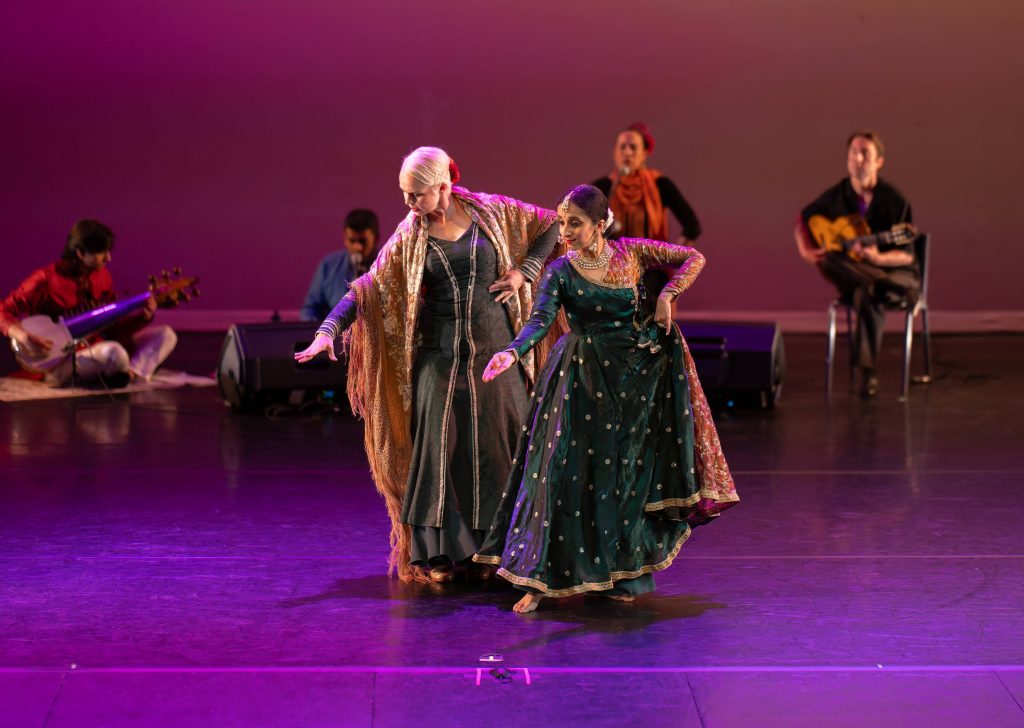 Photo by Jim Coleman.
They share the stage with four musicians, flamenco guitar player Jed Miley, singer Erin Lau, Sarod player Rishabh Mcintosh, and beatboxer and percussionist Sivaraj Natraj. Sitting centered upstage, an arch of light domes above them on the scrim. In between each section is a musical interlude, transporting us to the next element. Introducing us to water, Natraj creates rolling waves by tongue, occasionally making a gentle popping sound to emulate bubbles. Lau sings passionately before we meet fire, cheerfully and light before air, and lively before ether.
Ganesh performs water as a solo, with swirling spins like a whirlpool and quick footwork like seafoam. The dancers change costumes for every element, their outfits reflecting the colors and energy of the element. The costumes, created by Fabrica Flamenca and Abhinava Dance, are grand and vibrant, painting beautiful images on the stage that the dancers utilize to their full potential. Salonen emerges in white, the mantoncillo draped over one shoulder with a long ruffled skirt train trailing behind. She swings the shawl behind her, creating flying figure eights effortlessly. The shawl transforms her form, creating a towering cocoon when arms are lifted to the sky that opens into floating feathery wings as she spins. The two perform fire and ether as duets, continuing to play off of each other’s rhythms by creating visual and sonic exhilaration. Through their collaboration, we receive not only a dynamic retelling of the elements, but also a clear image of the impact Indian culture has had on the formation of flamenco.
The lights come up on Griffin lying alone on stage, an audiotrack begins to play. Griffin’s voice addresses her late sister with the opening sentiment “It’s Thanksgiving, and I am so mad you are not here.” Griffin expresses her anger for all the moments she can’t share with her sister anymore and updates her on what’s going on in the world. The movement echoes the audio, as she kicks with frustration, and expresses sorrow while grasping her head. Earnestly the track moves through moments of play and laughter, remembering the sweetness of being together. Griffin’s live laugh on stage reverberates over laughter on the track. The solo expresses all the forms grief takes on and the unexpected places it manifests, noting how a simple “remember this day” can bring on a surprising attack. Griffin navigates the frustrations that coincide with loss, trying to figure out how to go on without her. Gold light pours in from the downstage corner, kneeling before it, she scoops like light with her palms and lets it wash over her body like water from a river. The light reaches her like a sister’s touch, the solo becoming a duet in conversation with her. Lying in the liquid light, Griffin reaches one arm towards the heavens. The open letter ends with a call to never forget her love.
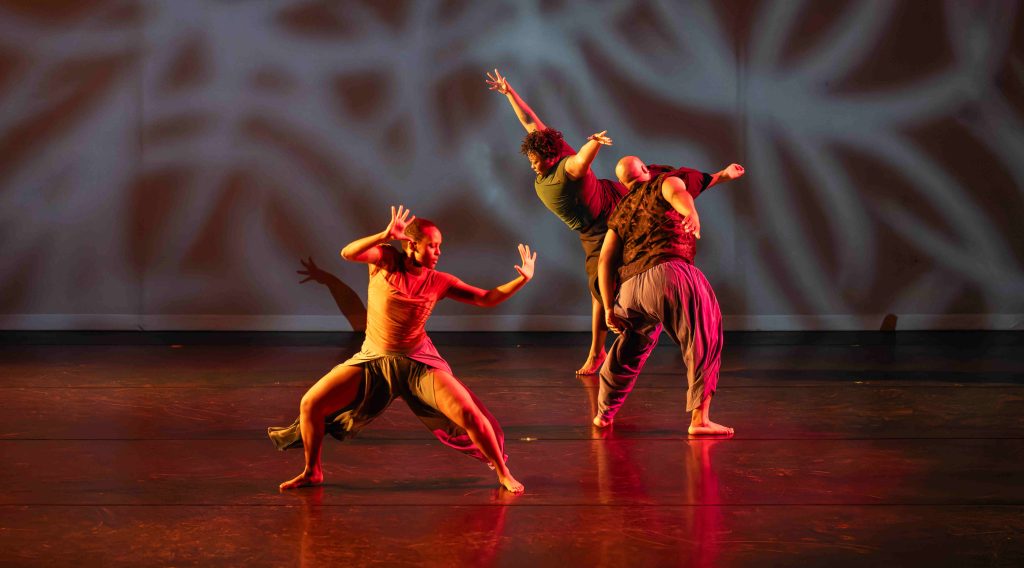 Photo by Jim Coleman.
Hana Carlson and DéShawn Morton come out to support Griffin. The three hold each other’s shoulders, circling their necks in their enclosed embrace. They reach their legs behind them, kicking and swooping. The waves of grief echo and ripple across one another, phrasework cannoning their grounded and rolling movements. Expressing vulnerability and trust, they take turns sharing weight, holding each other’s necks and backs with support. They move through different configurations, taking turns supporting each other and feeling the weight of isolation. Heavy chest movements contrast free falling arabesques. The dancers continue finding each other, as the sound of rain echoes.
In post show talkback Griffin expresses the ways in which grief is not linear, but rather circular. A smell, photo, or memory, can take your right back to a moment, over and over again. In Seeds of Mourning, this is reflected through the repetition of movements, watching Griffin and the dancers journey through sections, returning to motions in unison and isolation. While Griffin navigates grief and preserves the memories of her sister on stage, Tatkaar y Taconeo preserve cultural memory. The two works become bridges to remembrance. The body becomes a vessel for the archiving of memory, story, and cultural exchange. Embedded in both these rich and emotional stories are celebrations of life through the navigation of hardship. Whether through adding musical variation or carrying another dancer on stage, the collective builds something new, pulling from history and memory. At their core, these pieces reflect on how the people from the past and present touch our lives eternally.
The James Ray Residency Project –Program A ran June 10, 2026. More info about the artists HERE. Featured photo by Jim Coleman.


