Is it curation, aesthetic trends of the zeitgeist, or some secret third thing?
Whatever the reason, exciting overlaps abounded between pieces at this year’s NW New Works festival at On the Boards, curated by Rana San, Parmida Ziaei, and ILVS STRAUSS. The evening showcased six new works: Elegy for a Former Best Friend by Swim Pony, gig// assembly by Meysha Harville & Mare Hirsh, whole by Tariq Mitri, Surface Tension by Undercurrent, The Identity Ballgown by Naomi Deckard, and Antiq by Nia-Amina Minor.
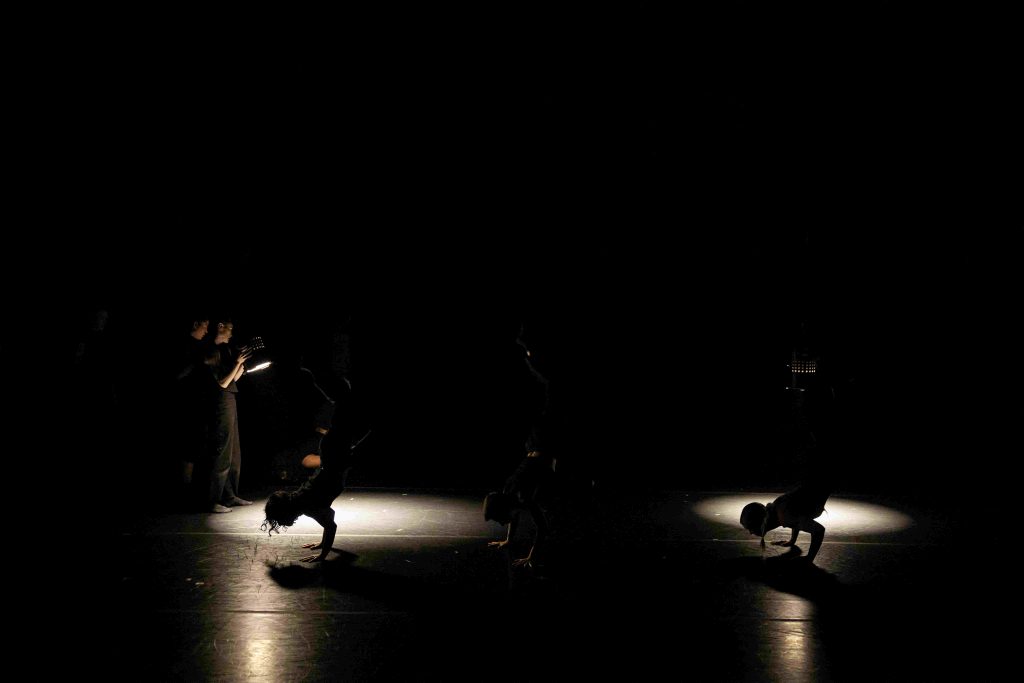 Undercurrent’s Surface Tension. Photo by Allina Yang.
In these types of split bill festival formats, I am as excited to see the grab bag of unique ideas as I am enamored by the unintentional throughlines, connective tissue, and signs of the times that happen between pieces. From the audience participation which bookended the show, beginning with Adrienne Mackey’s invitation for the audience to read and perform her script together and ending with Minor calling on the audience to echo lyrics as she sings them out. Or the neon ombré lighting that gig// assembly and The Identity Ballgown used to highlight their musicality. Or the intricate group choreography of Undercurrent and Mitri’s pieces
In particular, and since this is SeattleDances, I was intrigued to see that the three movement-centric pieces – Surface Tension, whole, and Antiq – could be viewed as a tryptic of interrelated worlds.
In Undercurrent’s piece, Surface Tension, the space is a dark expanse, with two lighting apparatuses hanging from the grid by long cables. Suspended 4 feet from the ground, they cast two pools of light on opposite sides of the stage, and remain the only light sources throughout the dance. As our eyes adjust to the darkness, we see seven dancers – Hilary Grumman (co-director), Alethea Alexander (co-director), Danielbi Perdomo, maia melene d’urfé, Leah James Russell, Nicole Flores, and Emma Sumanaweera – costumed in all black swaying side to side as a clump, rotating with the occasional arm or limb flashing bright as it sweeps under the pool of light. Sinking to the floor, dancers roll in unison under the pools of light. What is highlighted and illuminated takes the focus, while the dancers drift in and out of the darkness. durfee rises from the floor with their chest shining up towards the light, suspending time, floating in the void.
A dynamic shift midway through cracks the piece open. Alexander takes hold of the lighting instruments and redirects the beam towards the movement across the stage. Different dancers catch and pass the lights. The risk feels high-stakes as these heavy metal objects swing like pendulums, narrowly missing torsos and limbs while dancers move through a tempestuous foray of floorwork. The lights swirl around the space, sometimes catching secret glimmers of movement, sometimes the dancers appear to be struck by the light’s beam. Russell grabs onto one light and then hangs her full body weight onto it as she swings into a knee spin across the floor. Just as the chaos is cresting, the dancers pull together into a unison phrase that charges through the space, before calming into a soft ebbing movement. Walking on all fours across the space, they nestle around the edge of the spotlight as Grumman remains in the pool of light. An earlier duet and this ending image, begin to explore an idea of touch, with tender connections and hands reaching to hold each other. While this physical motif could have been further developed or refined in the choreography, the earnestness of connection was overwhelmingly evident throughout the piece. Surface Tension necessitated the dancers have an incredibly honed attunement to the space and each other in order to navigate the darkness with such voracious movement.
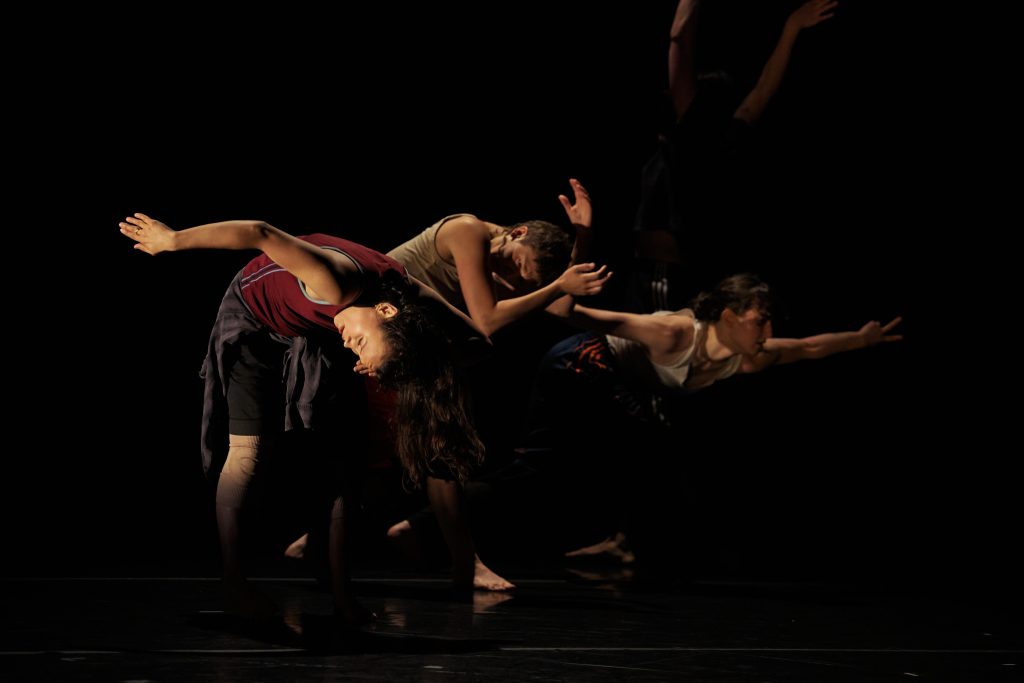 Tariq Mitri’s whole. Photo by Allina Yang.
A similar sense of collaboration and of navigating moving together showed up in Tariq Mitri’s piece whole, performed by Carlin Karmer, Una Ludviksen, Maya Tacon, and Tshedzom Tingkhye, who began reclined together in a clump, while softly uttering a steady pattering of words. The quartet shifts through an intricate sequence of movements which, much like the casual streetwear rehearsal costumes, had an everyday and effortless quality. Even in the moments of athletic rigor, the choreography was down-to-earth, tangling and coalescing into new shapes and formations. The dancers moved between each other with lithe ease, arms wrap around waists, a hand gently pushes a head down, elbows knock to pivot into motion, disassembling and reassembling connection points. As the group phrase repeats into a second variation, the necessity of these touchstones of connection ground and hold the dancers together, like free electrons heading back towards stable atomic structures.
The dancers break apart into solos, each occupying their own corner or the stage. A searchlight pans around, allowing us to focus on fleeting vignettes, in neighboring vocabulary to Surface Tension. Unlike Undercurrent’s bare stage, whole exists amidst the cluttered disarray. Piles of clothes are draped in long tied chains across the space. Furniture and detritus fills the space with something concrete yet unnameable. Even the dancer’s words, which have returned as a quiet stream of consciousness accompanying their movement, are just beyond recognition. In the fragments of phrases that I can discern, the spoken text seems sourced from their own personal memories. As stated in the program, whole “explores the tension between heritage and upbringing” and Mitri asks “what it means to be whole amid global fracture, displacement, and inherited grief.” There is something inconclusive and unsatisfying about the piece which seems fitting: that we do not know the answer, that all we have is the detritus, the fragments. Kramer, Tacon and Tsingkhye cluster on one side of the stage, staring across at Ludviksen. From my seat, I cannot see Ludviksen hidden behind one of the broken and uprighted tables, strewn with clothes. What happens when we’re cast apart? What happens when we can’t name or see what’s missing? How do we attempt to regroup and reunite when it seems an impossible task from the onset. Ludviksen eventually refinds the group. The quartet, once again whole, cuddles into a four-person spoon, breathing and holding one another at the edge of the stage, the clothing and detritus left more bared and unsalvageable than where we began.
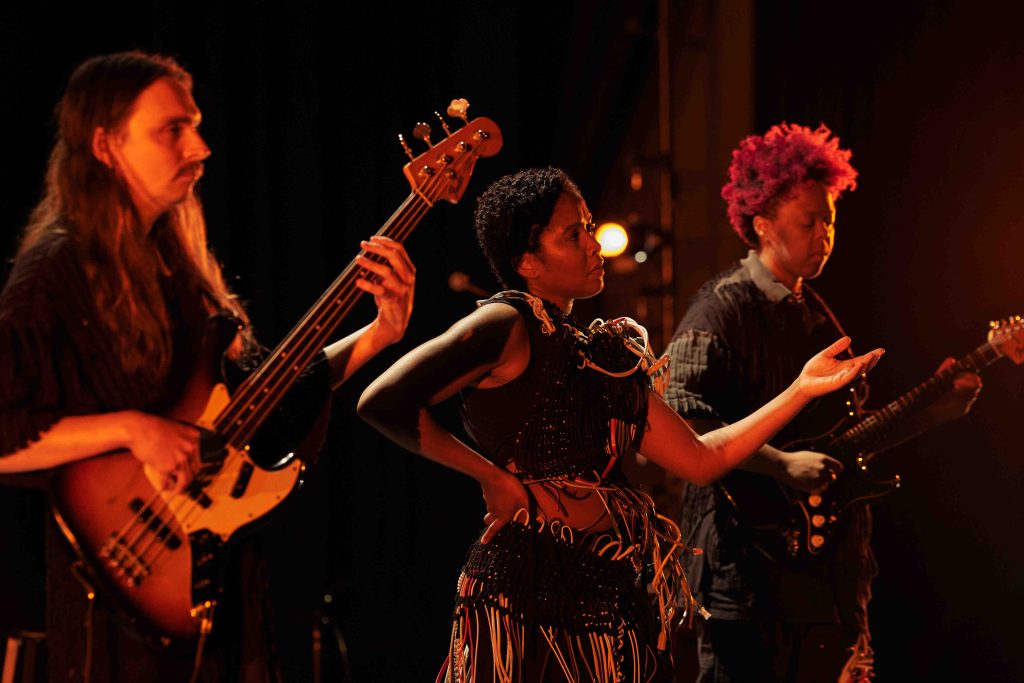 Nia-Amina Minor and the Black Ends in Antiq. Photo by Allina Yang
A similar echo of the obsolescence of materiality, as it relates to where we are, where we’ve been, and where we’re going, comes to the final piece of the night. Antiq by Nia-Amina Minor, begins with each performer encircled in their own tangled bird nest clusters of power cables and wires. Minor undulates the center, flanked on either side by Nicole Swims (guitarist/vocalist) and Ben Swanson (bass) of local Seattle band the Black Ends. Costumes by Janelle Abbott repurpose these electronic cords into sci-fi tech-noir garments. Minor opens their arms like a satellite dish picking up the frequencies of the sonic missives, Swims and Swanson respond, strumming thick rattling notes into the air. In an interview, Minor describes this piece as “dance sermon, a message and transmission.” Minor pulls a corded microphone up to her mouth, letting words flow towards us and through us, a conduit between past and present soundwaves.
The trio forms into a line across the stage and slowly makes their way toward us, heads tipping in unison to the beat of the song. It feels as though a journey is just beginning, the sun is rising, we are looking ahead to what’s to come. Minor asks us to join in singing the lyrics to “Somebody Else’s Idea” by Sun Ra Arkestra & June Tyson. We repeat, echoing Minor’s voice “Somebody else’s idea of things to come, need not be the only way to vision the future,” as the trio saunters into the fading light, backs turned to us.
“Need not be the only way to vision the future.”
There is something bleak and uncertain about this moment we are in, and it can be easy to only see the future as a place where things get worse. In these festival formats we are given a finger on the pulse–a sampling of what our contemporaries are feeling compelled by. It is clear that we are in uncertain times. I hesitate to label these pieces dystopian, but there was a heavy tone in the air, with industrial soundscapes and dark aesthetic. We’re not always sure what to believe in or where to send our energy to effect change. The entities we oppose are often larger and more insidious than we can name. It can be difficult to integrate our resistance principles into our daily actions, let alone our art. We’re trying to figure out what we believe in, and we find ourselves internally conflicted as we try to justify the impact of our work as artists and to maintain financial viability by getting the festivals, gigs, and grants.
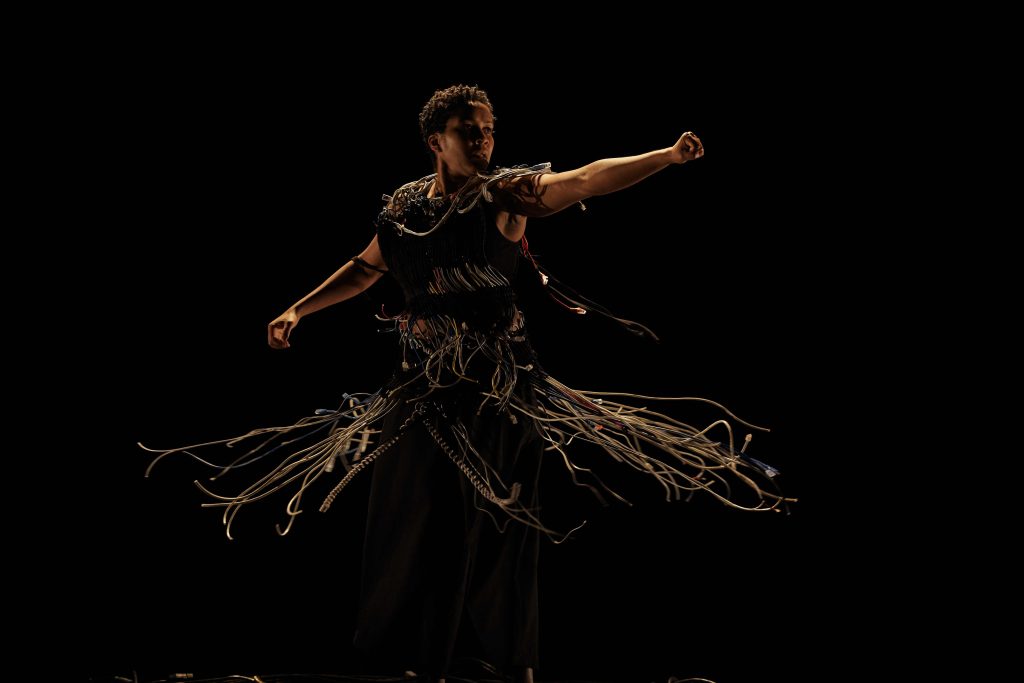 Nia-Amina Minor’s Antiq. Photo by Allina Yang.
What I like most about how dance was represented at this year’s festival is that these selected choreographers are active mavens and community builders in the Seattle dance scene, who center collaboration and collectivity. Undercurrent has built a tight-knit community through weekly classes, where Hilary Grumman and Alethea Alexander have developed and honed a floorwork movement technique. You’ve seen Nia-Amina Minor perform for many choreographers, and her own work makes a meaningful impact uplifting the Black archive and honoring the legacies and origins of sound, through knowledge sharing, and embodied rhythm. And, of course Tariq Mitri, who works onstage and offstage as a performer, creator, teacher, admin, and active community member of the dance scene. How each of these artists are showing up for community, what they are reaching towards, what they believe in, and their deep commitment to their craft is evident in the pieces they created.
We don’t need to have it figured out, we can ask the unanswerable questions, and it’s okay to feel incomplete while we’re at the beginning of the journey. But action and collectivity, coming together and moving together is necessary fuel for imagining what can be possible.
NW New Works 2026 ran at On The Boards June 4-6, 2026. More information about the program HERE. Featured photo by Allina Yang from Tariq Mitri’s work.


