We get it. Seattle is far from New York. And LA. And San Francisco. We are not that far from Portland or Vancouver, but can still get lost in our own little cultural bubble. Seattle International Dance Festival has spent the last 21 years trying to break, or at least stretch, that bubble by creating festival experiences that bring international and regional dancers together in a series of curated evening shows, this year at Broadway Performance Hall. This year’s Spotlight on Seattle showcases voices from Seattle, but also Tacoma and the South Sound.
The show opens with Zihao Yuan’s expressive and subversive solo, The Hidden Q.U.E.E.R., which according to Yuan, “challenges traditional gender norms, expressions and perceptions in dance and reflects my ongoing journey as a “Kuer” (酷儿 or queer) Chinese dance artist-scholar.” Yuan carefully steps onto stage like a tracker following a deer in the woods. He reaches into the bundle of white cloth he is holding to grasp white flower petals. Holding the handfuls out, he lets the petals cascade to the ground. Letting the bundle rest on the floor, he rises, and then stamps a foot to the thunderclap of a drumbeat, opening his chest, looking up, arms and hands thrown open wide. The bundle of fabric is revealed to be a tunic with long Water Sleeves ( 水袖), typical of Classical Chinese Dance, which extend far past the fingertips. After donning the tunic, the water sleeves become a thrilling punctuation to Yuan’s grand sweeping gestures, barrel turns, and lunges. He tosses the sleeves up, catching the bundled fabric that then bursts forth, shooting out as his radiant movements swirl through the air.
To audiences unfamiliar with Classical Chinese Dance (myself humbly included), this piece would seem to be a beautiful expression of a cultural form by an artist who breathes deep care and reverent energy into this historical vocabulary. This solo is, in fact, a subvertive form of movement research and revolution stemming from Yuan’s doctoral research. The movement vocabulary of Chinese Classical Dance follows very strict gender binaries. In The Hidden Q.U.E.E.R, Yuan uses both the flower/feminine hand gestures, and the lion/masculine hand gestures, and also his own in-between, nonbinary hand gestures to create his own movement reality. The effect is a deeply researched, reverent dance of quiet gender outlawdom.
Freedom in Motion Dance Collective under the direction of Rodrick Barnes brings us big juicy moves in a fast-paced swirl of anxious collectivity. In Unpeeled in a Volatile Light, Barnes and dancers Olivia Link, Staphany Olalde, Emily Walter, and Angela Ye alternate between fast flowing and hard hitting movements that spill into and out of the floor. They are powerhouse performers with great technical acuity, moving through sequences that demand it. The movements are at times aggressive, painful, suspicious, and somber. The dancers look confrontationally into the audience, seeming to meet our gaze. In one moment, the cast stands in formation, laterally flexing their spines back and forth like hand clapper toys. They move so rapidly, they almost create acid trails. Midway through the piece, house lights come up and suddenly we the audience feel exposed. As Barnes completes a series of slow, sustained balancing postures, other dancers slide off the apron of the stage to walk up the aisles through the audience and out the back door. The house lights dim again and a dancer slowly walks onstage, bent double underneath a large and heavy rolled-up carpet that they carry like a burden. The carpet is laid out and bathed in red light, and becomes a new, smaller stage for the dancers (returned to the stage via an offstage crossing) to play with. While I was initially confused by the choice to break the fourth wall, and then set it right back up again, in retrospect, I think this may have been part of the strength of the work. Looking back, this piece’s greatest accomplishment might be the way it plays with scale, pulling us into the dancers’ evocative and swirling movements, zooming out when they walk through the house, and then pulling in tightly to the tiny rug stage.
What’s in a name? opens with choreographer Lucille Jun and collaborator Issana To standing, wearing street clothes, facing the audience. A projection on the scrim behind them shows each of their names, followed by their names written in additional languages. We learn from the program that Jun is Korean/American and To is Cantonese/American and that What’s in a name? “untangles the race-relations held within the body.” The two performers revolve on the spot, almost imperceptibly slowly. They eventually break out into repetitious accumulations of gestures, some stylized, some pedestrian, that all function as an extended and collaged sort of greeting. Their affects shift back and forth between self-serious and self-effacing. The relationship to music is, at times, one of disconnect- the grooviest movements sometimes happen in silence, and simple gestures happen to thumping beats. Phrasework is broken up by little self-indulgent grooves, a shake-off and a smile, a grin and a wink at the audience. What’s in a name?, rather than untangling race-relations, seems to honestly show the cultural levels and layered selves living inside these two performers, and to demonstrate their shifting feelings about these multiple identities. The repetitions give us time and a frame to make our own meaning. This piece too plays with performer/audience eye contact, bringing up and down the house lights several times throughout the duet. The piece progresses slowly in ways that make me crave seeing it in a different format. It feels both too long and too short at the same time–a challenge of the festival format. I found myself craving being on the same level as the performers in a gallery or warehouse, no need for lights up/lights down cues for us to feel connected. I wanted the duet to have room to stretch for an hour or two, with audience members coming in and out in a durational installation. Jun first showed an iteration of this work in 2019 and I hope she continues to return to it over the years.
In IM Resting, Hana Carlson seems to do anything but rest. Running full-tilt onto the stage in a black slip, Carlson spins smiling downstage, looks into the audience, and clutches her chest just as Aretha Franklin croons “I’M IN LOVE!” We believe it, we believe that Carlson is in love! She moves with a rush of excitement down a line of clothing items, putting them on one at a time. She layers them on her body like a kid on their birthday, trying on every single one of their beloved new dresses. When all of the clothing is off the floor and on her body, Carlson comes upon a green and white quilt which she holds to her chest and sniffs. It is clear this quilt is a very real artifact of life, not just a thrifted prop. Kneeling downstage, Carlson quietly counts out loud as she repeats rhythmic scrubbing, swiping, throwing, catching, and folding movements, sweeping and tossing the quilt around her, totally focused. I don’t see any rest in the work–I see very pure joy bursting unabashedly in a way that is refreshingly uncool. Carlson takes me with her entirely in her raw sincerity. She shares in the post-show talkback that this piece was created after feeling severe burnout following graduation from a competitive university program where she didn’t feel she had much agency. It seems her understanding of resting in this expressive work is not as an inward and quiet practice of recuperation. Rest, in this case, is an abandonment of academic scrutiny, and a sinking into movement that lives within a body of pleasure.
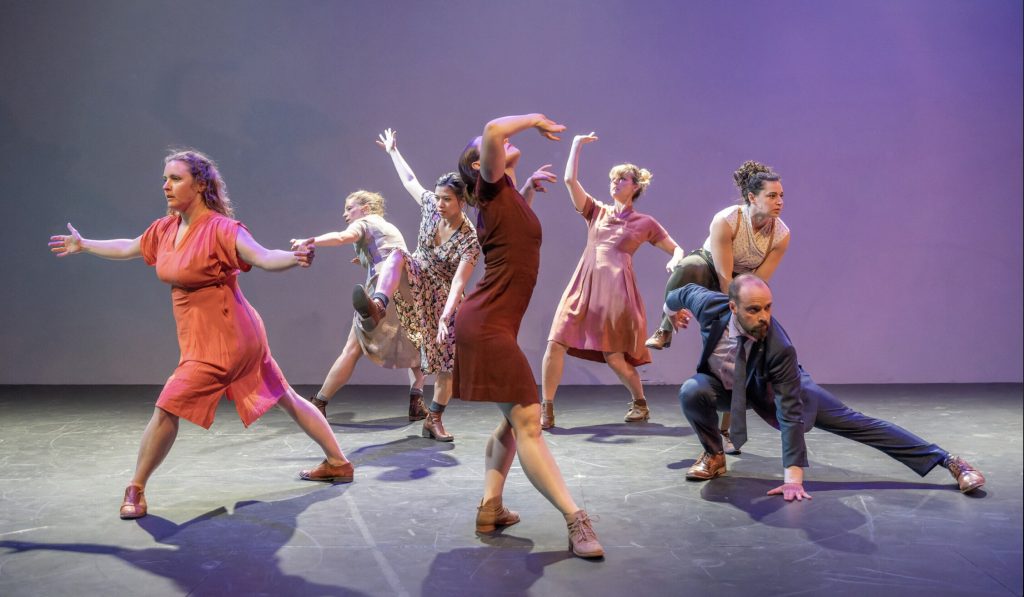
The evening closes with Wade Madsen Dance Group’s celebration of humanity, Being. A line of 15 bodies emerges slowly from stage right, hunched over, stepping slowly. Shoulder-to-shoulder, they fill the stage’s entire depth. It feels like so many more than 15 people, maybe 500. The group reflects the democratic, community-oriented space that choreographer Wade Madsen has been cultivating through decades of classes. We see different heights, builds, ages, clothing styles, and they all have a place in the community we witness on stage. One by one, people begin to trail behind the line that continues moving slowly across the stage like a scanner beam, as they pause to maintain held shapes. The piece unfolds as a series of scores and explorations that take advantage of the groups’ large size. Rather than fighting to achieve uniformity, this piece embraces how moments of organization, unison, and clarity always seem to emerge when large groups are invested in communal exploration. Each dancer is visible as a unique and precious human, and as part of a whole. Lining up shoulder to shoulder against the scrim, the group processes forward, each dancer executing an individualized series of personal gestures, which range from contemplative in essence to revolutionary. Being radiates a kind of purity, and watching it I am deeply calmed, oddly nostalgic, and filled with hope. Watching these humans experiencing each other’s humanness makes me feel glad to be a part of our flawed species, and gladder still for dance and the communal experimenting and experiencing it gives us.
Spotlight on Seattle was presented on June 9th as part of the 2026 Seattle International Dance Festival, at 7:30pm at Broadway Performance Hall. https://seattleidf.org/event-details/#sos


