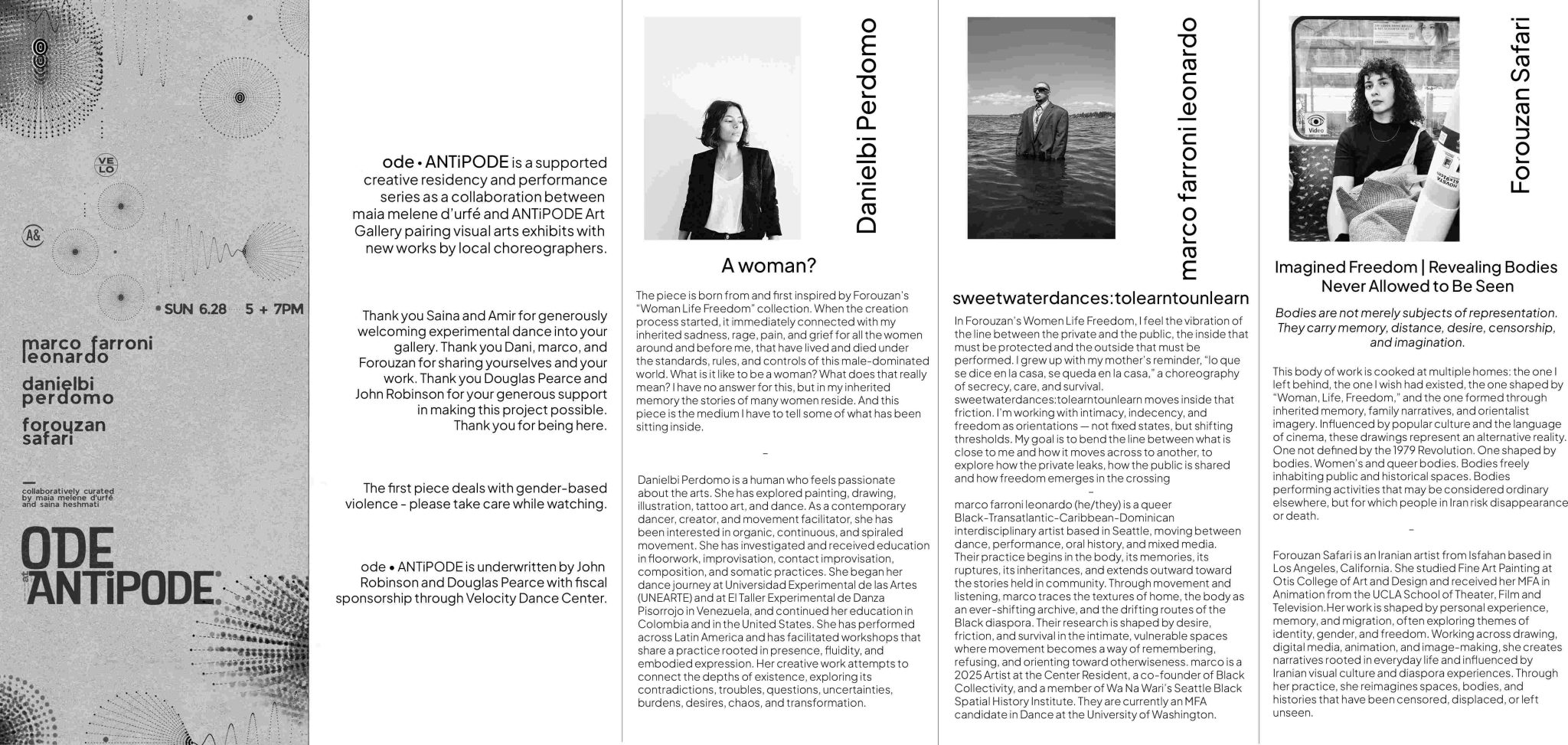
Stepping into ANTiPODE gallery, you find bodies that move freely. On the walls, images of women and queer people play, fight, swim, scream, and lounge across public and historical spaces. A mural depicts women, some nude and some in swimsuits, swimming among ornate walls of Chaleshtor castle. “Imagined Freedom, Revealing Bodies Never Allowed to Be Seen” is the collection of LA based, Iranian artist, Forouzan Safari. Depicting the memories, dreams, and reimagining of freedom, belonging, and identity. The collection traces memories from Safari’s upbringing–the gatherings, music, women, and life in Iran forced to remain hidden. The memories move into dreams of bodies being liberated and women moving freely. The dreams moving toward reality in 2022 with the Woman, Life, Freedom movement. Black and white prints show women breastfeeding in public, rowing a boat in a bikini top with exposed pit hair, and lots of queer kisses. Safari illustrates activities that get to be ordinary for some, and simultaneously create risk of disappearance or death for Iranians. Incense burns by the door creating an aromatic entrance and a timer to the performance that’s about to unfold. Curated by maia melene d’urfé and Saina Heshmati, ODE at ANTiPODE is a collaborative show, pairing Safari’s collection with two new dance performances by local choreographers Danielbi Perdomo and marco farroni leonardo. Safari’s artist statement writes: “Bodies are not merely subjects of representation. They carry memory, distance, desire, censorship, and imagination.” Surrounded by the “Imagined Freedom” collection, Perdomo and leonardo share their stories, memories, and imagination through live and embodied works.
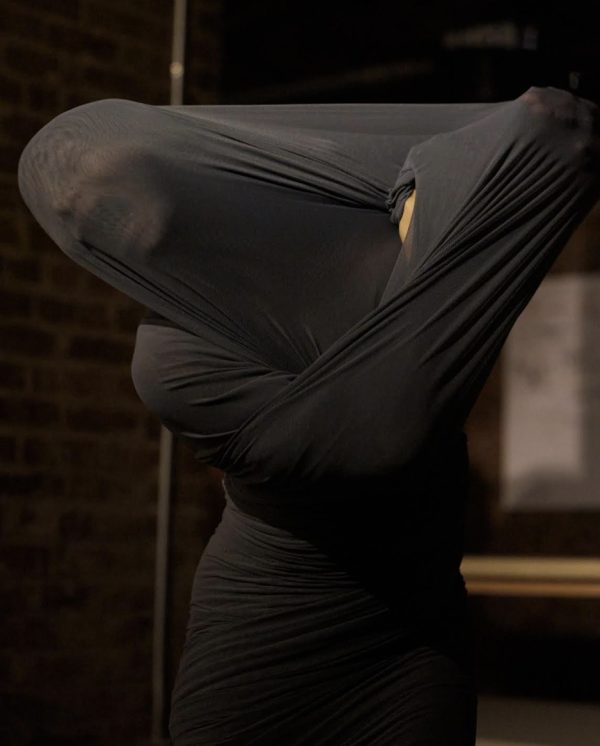 Photo by Allina Yang.
In the back of the gallery, we find Perdomo wrapped in grey mesh like a cocoon. Elbows and hands slowly push through the fabric like a butterfly trying to escape its chrysalis. Her face mimes a scream through its meshy enclosure and the fabric begins unraveling, freeing bound legs to reveal a flowing black skirt. The body, no longer hidden. Beginning to move freely, Perdomo approaches the audience. Soft hands swirl, now floating through the crowd. With open arms and flexed palms, she moves with quick and spry feet. Perdomo’s movement reflects the composition above her on the gallery wall, Safari’s “Strike a Comfortable Pose” and “the Grove” depict zoomed in images of a folded bare stomach and pierced nipple. A diagonal line painted across the wall behind the images to emphasizes their perspective. Perdomo moves into a deep lunge, legs parallel to the painted line, chest still exposed.
The piece takes a dark turn, when Perdomo begins convulsing on the ground, pushing the skirt down forcefully, and gasping for air. The scene is visceral and hard to watch. Eyes across the gallery filled with concern and fear. Perdomo finds her way up slowly, facing a mirror with her back turned toward the crowd. Placing a cap over her hair, she turns back to the audience, revealing painted blood now pouring from under her chest and between her legs. The prior lively and open movement, is now harshly contrasted with cowering and facing cautiously away from the crowd. She clings to the brick walls of the gallery for support, crawls under tables, and hides in dark corners. As Perdomo crawls and leans against the walls with a bloody chest and arms, I am reminded of Ana Mendieta’s “Body Tracks” for their similar usages of blood as a life force and performance as a means to conveying a feminist body politic. Perdomo’s A Woman? is a challenging and haunting portrayal of the gendered violence people endure in the fight for freedom.
At the other end of the gallery, sweetwaterdances:tolearntounlearn begins. leonardo leaps back and forth and in a lacey red bodysuit, leather chaps, and a blazer decorated with a back of black fringe and long flowy shoulder ribbons. Speaking into an echoing cell phone microphone, leonardo repeats, “Lo que se dice en la casa, se queda en la casa” (What is said in the house, stays in the house). They continue asking this question dancing across the gallery, getting delightfully close to people in the crowd, repeating the phrase almost as a question. Playing sonically and physically with the idea of public and private space, leonardo hides and peaks behind the gallery walls, creating unique and distinct images for each viewer, his voice still heard even when not visible. Legs extend and swoop grandly, with 180 degree kicks that just nearly miss the gallery lights. The cell phone stays in hand through the piece as they dance, occasionally being used to oscillate between functioning as a microphone and device to play various songs and tracks.
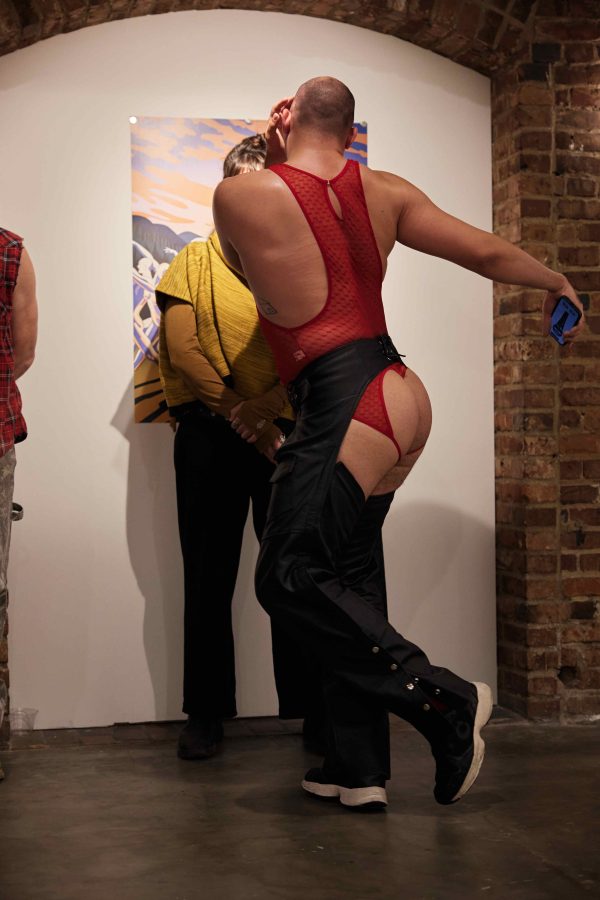 Photo by Allina Yang.
leonardo begins twerking on various walls and audience members to music, before switching the track to the audiobook of bell hooks’s Feminist Theory. As hooks discusses the effects of capitalism and patriarchy, leonardo continues “throwing it back.” The image appears comical or light hearted at first glance, though is an excellent method of putting the theory into practice.
The scene is nuanced when contextualized by the audio and surrounding artwork. The gogo dancing holds space to freely express queer desire, while simultaneously questioning the limitations of sexual labor as a means of liberation under capitalist patriarchy. Safari, leonardo, and hooks are now in a multimedium conversation about freedom, indecency, gender, survival, and care, expressing similar ideas and questions with body, the brush, and the pen.
Before exiting the gallery, leonardo stands just outside the door frame of the gallery. Removing the blazer to fling it like an extension of the arm, flailing rambunctiously through the doorway. We see glimpses of limbs and the coat in the wind, before he drops the coat on the floor. An arm extends out and drops the cell phone on the jacket with a concluding untethering thump. A final mic drop.
Safari’s images paint memories and dreams of freedom, showing women and queer people as fighters, rebellious, and autonomous. Perdomo and leonardo echo these desires, while navigating the harsh path to these reimagined futures. The movement feels grounded by the collection, reflecting images on the walls while still showcasing each dancer’s unique story, history, and memory, adding layered complexities like coats of paint. Sharing these works in tandem today also reiterates and reflects upon how intrinsically tied our collective struggle for freedom is, and how grotesquely counterproductive bombs are toward liberation.
ODE at ANTiPODE took place July 28, 2026. You can view the program HERE. Featured photo by Allina Yang.