Dim-lit haze blooms around Shane Donohue, Joseph Hernandez, and Nia-Amina Minor, who are all invested in a slow and specific unison phrase they are doing as the audience enters 12th Ave Arts for the evening-length work KEEPING, by Blue Screen Contemporary.
The dark floor of the black box theater is checkered with body-sized, black and white photos and light-pink rectangles, printed on vinyl and adhered to the floor. In the floor photos, we see a treetop, a blurry body, a set of pornographic playing cards mostly face down but with one visible penis, a giraffe, and other images that become blurry context for the piece. We walk across these images and take our seats, in the round, and start to more clearly make out shapes of the three dancing bodies through the cloud-haze. Stark and spare light emanates from bare fluorescent bulbs, suspended at various heights around the theater. The light bleeds through and sticks to the haze such that it only partially illuminates body sections of the performers, all dressed in black, which otherwise meld into the dark black of the walls and floor. We see an arm, a half-face, a chest glow, emerging from dimness.
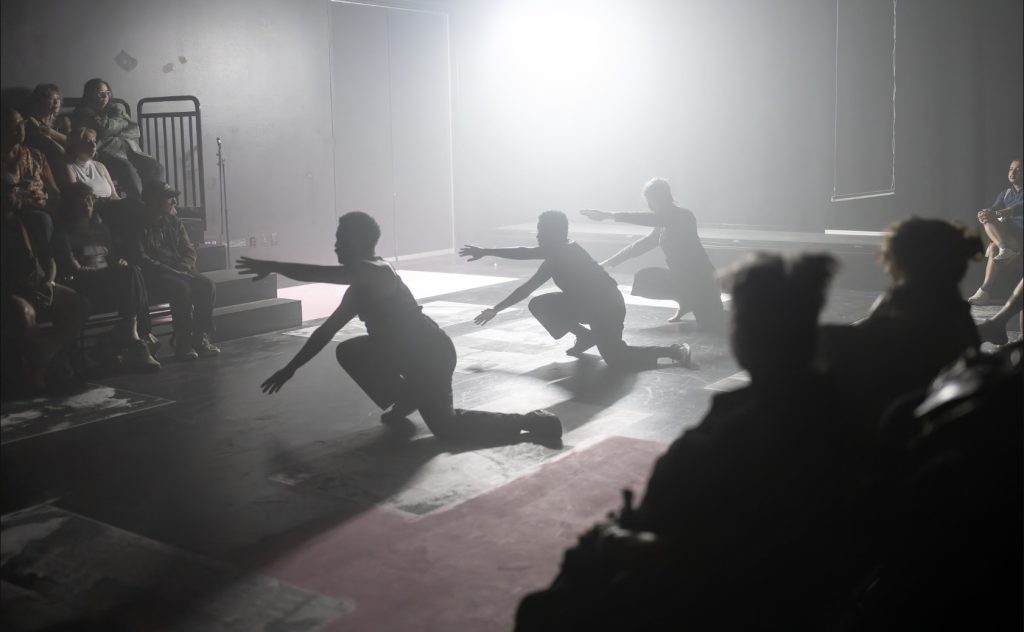 Photo by Jim Coleman
An atmosphere of playful collaboration and acknowledgement of the audience is set immediately and maintained throughout KEEPING. As we settle into our chairs, Hernandez comments on how quickly everyone got here, says hi to a few individuals, and muses out loud about what would happen if someone came in right now, what we might be thinking and feeling, and checking in with the other two performers, all as they continue moving.
“Are you still there?”
“Yes.”
All three performers quip amongst themselves, acknowledging the audience, but never taking their visual focus away from what they are doing. Rather than addressing the crowd directly and with eye-contact, they let us know that they see us seeing them while they keep moving. One fluorescent bulb goes out, replaced immediately by the harsh glare of another, higher bulb, shifting the filter through which we see the dancers. Hernandez giggles audibly. It is, indeed, extremely satisfying to watch the lights, designed by Catriona Urquart, go on and off so abruptly and cleanly, shifting our perspective in an instant.
Hernandez, director of Blue Screen, writes on his website that “the art we make is the kind of art that keeps your experience in mind without being too clear about what any of it means.” Throughout KEEPING, dancers Donohue, Hernandez, and Minor present us with loaded gestures, big and bold fullbody movement, and spoken half-narratives that they leave us to thread together into networks of meaning … or not. This seems to be the ethos of the work–that meaning is there, for the eye of the beholder, only if you make it. This review, like any, reflects some of my attempts at meaning-making, which may be different from the artists’ intentions, which, ironically, is their stated intention.
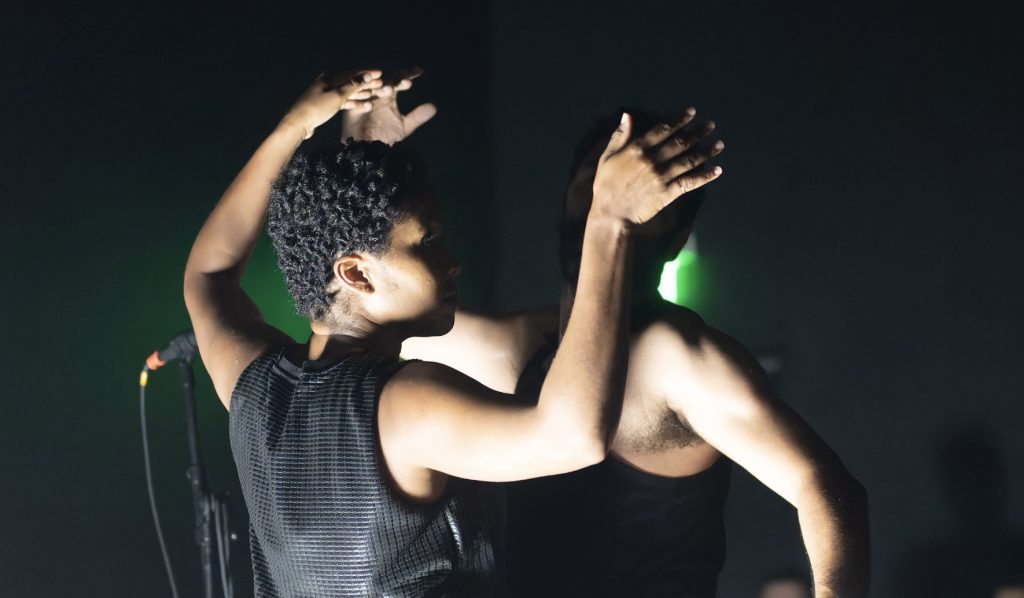 Photo by Jim Coleman
Movement and spoken text reference missing bodies, people who are not there, and memories of people and things that once were. Eyes closed, the three dancers hold their arms outstretched, slowly lowering them in unison, verbally checking in with one another, sightlessly reaching toward shared experience, trying to link up without looking. The title, KEEPING, is alive in these moments, which nod at keeping in touch, keeping close, keeping pace, and collecting shared moments.
“I’m just about all the way down now.”
“Are you still there?”
“Yes.”
“I think I’m still too high.”
“Are you still there?”
Hernandez cradles the unseen body of a loved one in his rounded arms, eyes closed again. He drags the held hand of a missing sweetheart, and leads them slowly across the stage. Early touches between the dancers elicit flinches and recoils, then contact becomes exploratory, like they are trying to figure out how to move their bodies in relation to one another. In other moments, contact becomes trusting, intimate, in particular one image of all three dancers, seated with legs spread softly, cradling each other and rocking back and forth.
When the movement is not intentional and slow, it becomes wild, full bodied, athletic, and strange. The dancers throw their bodies off-axis, seeming to be caught in a series of perpetual falls that never land, last-minute grasping temporary balance on a single leg while torsos twist like caught fish, flipping and arching back. This movement style makes all 3 bodies seem huge, unruly, and just at the borderline of control/chaos. Fluttering gestures in the hand become erotic when they seem to trace the edge of an unseen body, intensify in speed and urgency, then release and relax.
The movement and spoken word are textured by undertones produced live by pianist Barret Anspach behind a baby grand, with several other electronic instruments at the ready. Anspach’s discerning use of sound to support the performance feels intuitive, effortless, and a product of his multi-year collaborations with Hernandez. The commanding presence of live piano so often can overpower performances in small theaters, but Anspach’s understatedly virtuosic figurations vibrate on the same level of the movement, bringing both to even more resonance.
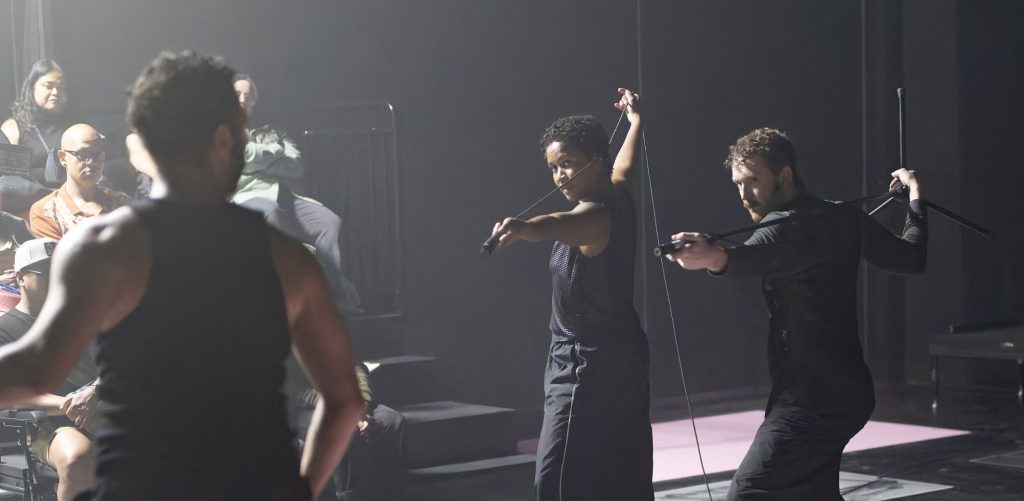 Photo by Jim Coleman
Hernandez and the cast give us guides and tethers to hold onto in our journey of meaning-making. Repeated images, gestures, and phrasework are returned-to, and with each iteration, we get to re-see them in new ways. In the first of several “context speeches,” Hernandez lays out the general structure of the piece’s unfolding: we will see phrasework, followed by spoken text that gives us context, then a unison “little song,” then the pattern will repeat. Hernandez lays out some rules that the cast set for the piece during its creation which include “we will not end with a pop song, no matter how good it might feel,” and “we will not break and laugh.” In this speech, he references the absurdity of dance culture without judging it or aggrandisement, giving us signposts to help us understand, while admitting that we might not like the piece, or get it.
With the first “context speech” over, the dancers each position themselves in front of a microphone stand and begin to chant in a unison incantation with accompanying gestures:
This is my back, this is my left, this is my lip, this is my foot, this is my toe, this is my toe, this is my toe, this is my toe, this is my head, this is my pit, this is my deep dark pit, these are my friends–NO, this is my stomach…..
They list and affirm the existence of their bodies, I imagine in contrast to the invisible bodies whose absence they feel. They assert and name their body in pieces, the same way that the shifting fluorescent light segments their bodies into bits of back, left, lip, foot, stomach.
The mantra ends and the cast slips into movement, performing a frenetic trio with the microphones, which are dragged, thrown, and swung. Hernandez holds a microphone to Minor’s skin like an ultrasound wand, seeming to search for information, waiting for her skin to begin speaking discernible truths that could be amplified if he could just get the microphone in the right place.
In the next context speech, from the very edge of the theater, Nia-Amina Minor tells us through a microphone that
“I’m here, at the edge of the black and the pink,
I’m here
and you’re there
and you’re not there.”
She repeats her assertions that she is there, at the edge, noticing where her body is, where our bodies are, and who is not in the room with us.
In the final context speech, Donohue half-sings a story about burning down all of their memories. “You know when you are hanging out in your closet with your brother and you are playing with hairspray and matches…” Donohue takes a beat to address Anspach directly, asking for something “a little more upbeat.” Anspach’s drones shift to something eerily vaudevillian–upbeat in a way that makes me imagine carneys waiting to turn the roller coaster knob up to 11. We learn that Donohue grew up with many birds, including one named Pretty Bird, and that the birds, along with all of Donohue’s memories, burned down, along with his childhood home. He is matter-of-fact. It is not Donohue’s goal to traumatize us or to ask for sympathy, they are presenting facts for us to make meaning from.
At the beginning, Hernandez set some rules, that they would not end the piece with a pop song and that they would not laugh. Since Hernandez laughs within about 30 seconds of the show beginning, I had a feeling we would end with a pop song. We hear the iconic opening guitar of Don’t Stop Believin’ and watch as the dancers form a slowly rotating huddle with blinding fluorescents screaming from underneath the audience seats. In the context of all of this context, the well-known song takes on new meaning and certain phrases emerge more potently as recognizable images in the piece:
…A singer in a smokey room…
…Their shadows searching in the night…
…Streetlight people, livin’ just to find emotion, hidin’ somewhere in the night…
The song crossfades with more piano rhythms from Anspach. The huddle breaks apart for a few more spare seconds of motion before a tight embrace. The bubble of their embrace bursts and they let go and fall away from each other just at the moment that the lights go to full dark.
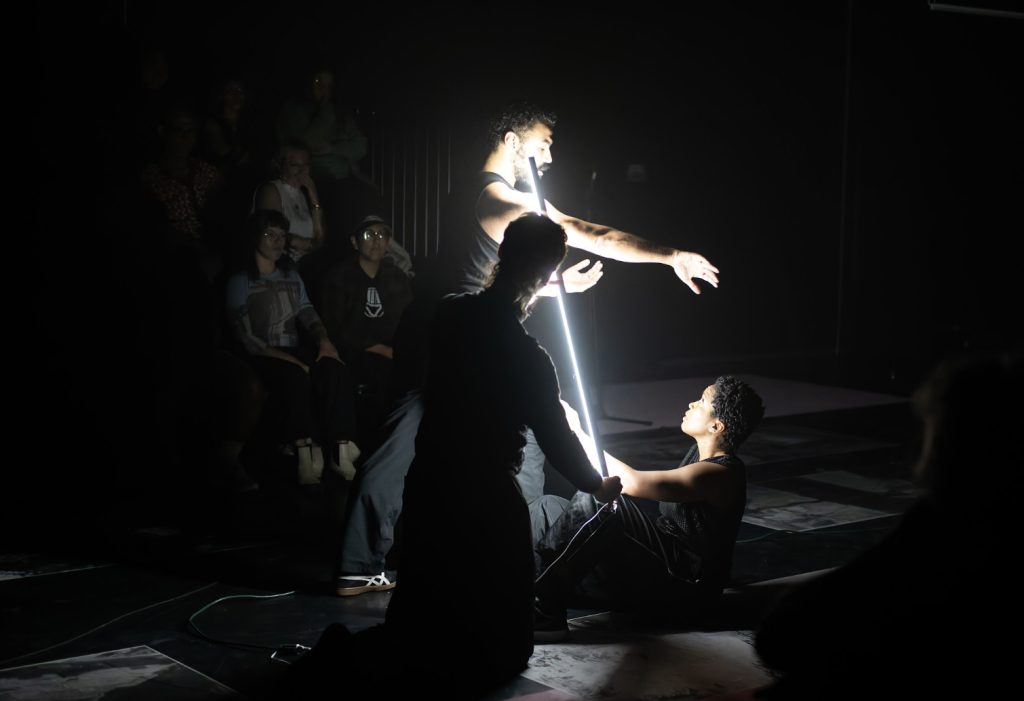 Photo by Jim Coleman
24 hours after I attend KEEPING, I open an email from Hernandez, titled “Thank you, further reading, LAST SHOW TONIGHT!.” In this email, he shares context for the work; that the piece’s creation began while visiting a long-distance boyfriend across the country. It unfolded as the two of them shared letters, snippets of text, and the book “The Wonderful World that Almost Was” by Andrew Durbin, which focuses on the relationship and life of artists Paul Thek and Peter Hujar. Hernandez and his “painter professor boyfriend” found themselves seeing parallels to their own lives and connection through the study of the love and correspondences of Thek and Hujar.
It is unsurprising to me that in a deeply-researched piece, whose structure leans on the sharing of context, Hernandez would have more to say. I am grateful that he gave me 24 hours without this final bit of context, to feel my way through the work with eyes closed and rounded arms. I wait to open the email until I’ve finished writing this review, and cannot help but think to myself “oh wow, I got it.” In the first context speech, Hernandez seems to doubt dance’s ability to transmit information, but remains devoted to making, performing, and promoting the slippery language that is contemporary performance. What better form though, than dance, to ask us to sit with the unnameable feelings of missing, corresponding, and keeping.
Hernandez closes his email with these thoughts:
The work of KEEPING is to hold onto those hands and to present other hands into the future, for other people to hold onto, other people to triangulate their relationships around and to link generative art practices with as many people as possible. It sounds obvious that our lives and actions affect one another, but it is dizzying and beautiful to meditate on what is still here, what is not here anymore, and what hands you happen to be holding at a given time.
KEEPING was choreographed by Joseph Hernandez and was presented at 12th Avenue Arts from August 19-22. More information about Blue Screen on their website.


