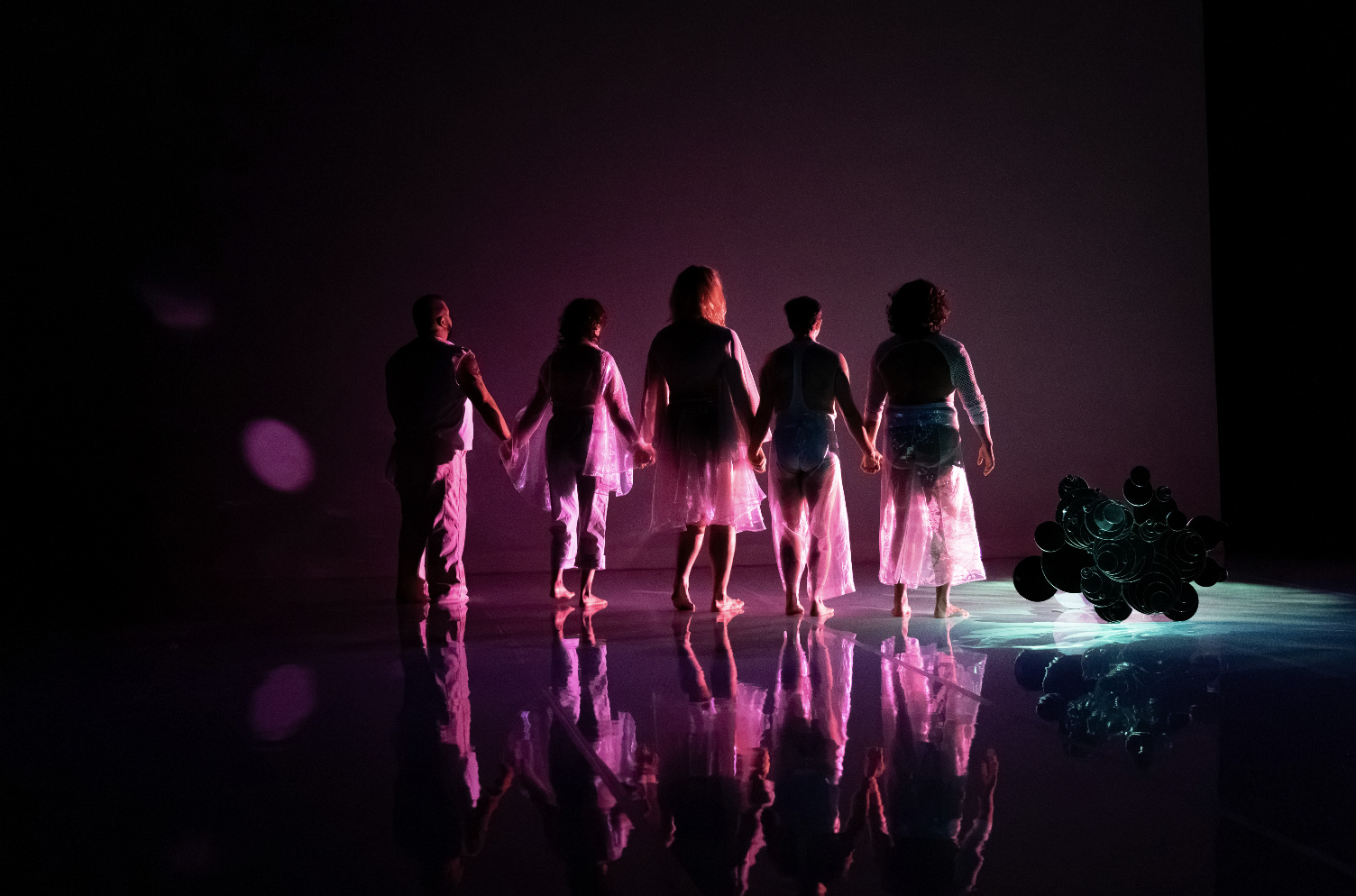
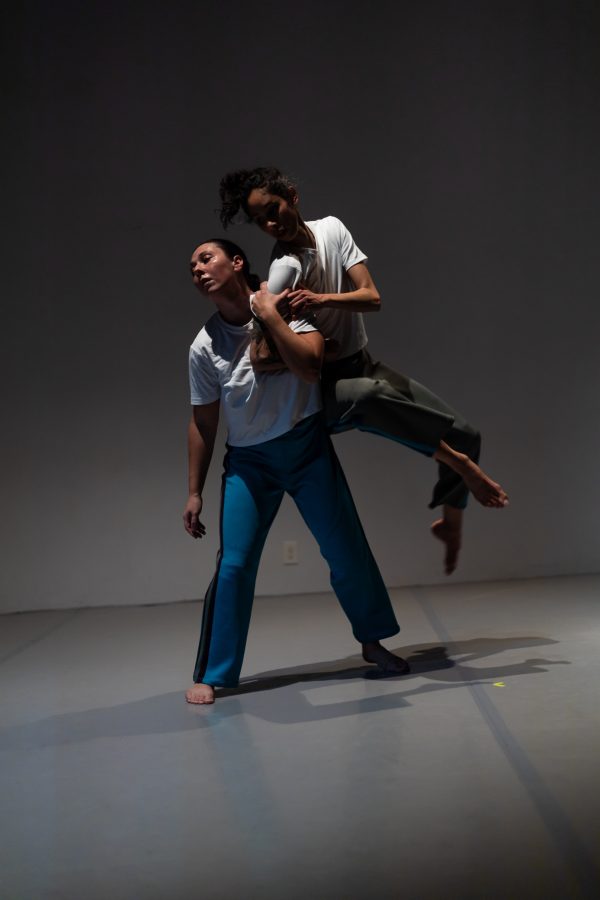
 Photo by Trisha Mark
The two performers bend down in unison to roll up a single pant leg, as high as it will go, bunching it up furiously until it is held in place by the upper thigh. They are both wearing the soft knee pads sold by Contact Quarterly. They each have one sock on, and one sock off. All of the dancers crammed into the YAW theater audience quickly identify one another through giggles of recognition of themselves, or past versions of themselves, in the actions and in the outfits of performers/choreographers Sara Caplan and Anja Kellner-Rogers.
Caplan and Kellner-Rogers’ evening-length work, Millennial Dance Complex, centers on the idea that life and school have trained them to believe in, and aspire to be, a rigid and mythic idea of a Professional Dancer™. Their education and conditioning have prepared them for an identity that no longer exists, if it ever existed, and their inner teachers have shamed them for their shortcomings. Caplan and Kellner-Rogers are, at the moment of this presentation, neither old, nor young–too old to believe that this specific and rigid dream will come true for them, but maybe not yet old enough to have made peace with the death of this narrow definition of success, and to have found a new way.
The opening movement phrase draws from vocabulary that fellow millennials will remember learning in BFA programs, consisting of body halves, undercurves, and turning combinations: movement that was handed down to us and put together in such a way as to teach us concepts and techniques. Caplan and Kellner-Rogers are at home in this movement, we see their training and their mastery, but Losing my Edge by LCD Sound System plays underneath, hinting at outward excellence, but internal anxieties. Losing my Edge is followed by Lana Del Rey singing repeatedly, “Will you still love me when I’m no longer young and beautiful?” As an audience member, I cannot help but be both sad and furious at the implication and hard truth that young, beautiful, technically talented dancers are conditioned to feel that their value is dependent on their fleeting youth and beauty. I firmly believe that performers only become more interesting with age and deepening practices and life-experiences, but as they age, dancers are all doomed to lose access to the highest of kicks, the cleanest of turns, and the loftiest of jumps. It can be challenging to let that go, and we witness Caplan and Kellner-Rogerns in this struggle to understand the role of their training in their slowly aging bodies that are truthfully, still quite young.
Caplan and Kellner-Rogers employ choreographic tools from college comp class including repetition, theme and variation, and directionality. The almost mathematical structure of the repeating, but varying phrase, draws us in to the movement mantra of thumbing a nose, dodging as in a basketball game, a pilates double-arm pump, a side-lying a la seconde leg kick with the head propped on a bent elbow….all of course, with a smile. There are inside jokes in movement, staging, affect, and dancer fashion sense/nonsense that seem to land for the entire audience, not just the other dancers in the room.
Caplan and Kellner-Rogers set the stage with a sturdy wooden dining room table and a freestanding full length mirror. Kellner-Rogers, holding a Solo cup, approaches audience members, asking them to take photos of her. She pouts and poses like a sorority girl, before demanding that we put our phones down and watch. She gets up on the table and twists and undulates like a girl at the club, locking eyes with us and daring us to watch. Seductive glances over the shoulder and hip pops are interrupted by moves ripped right out of a Graham or Limón class. While Rogers performs for us, Caplan sits in front of the mirror, straightening her hair until half her head of bouncy curls lays flat. We are watching them each mold their bodies into someone else’s codified version of a good, attractive, sexualized but not threatening girl.
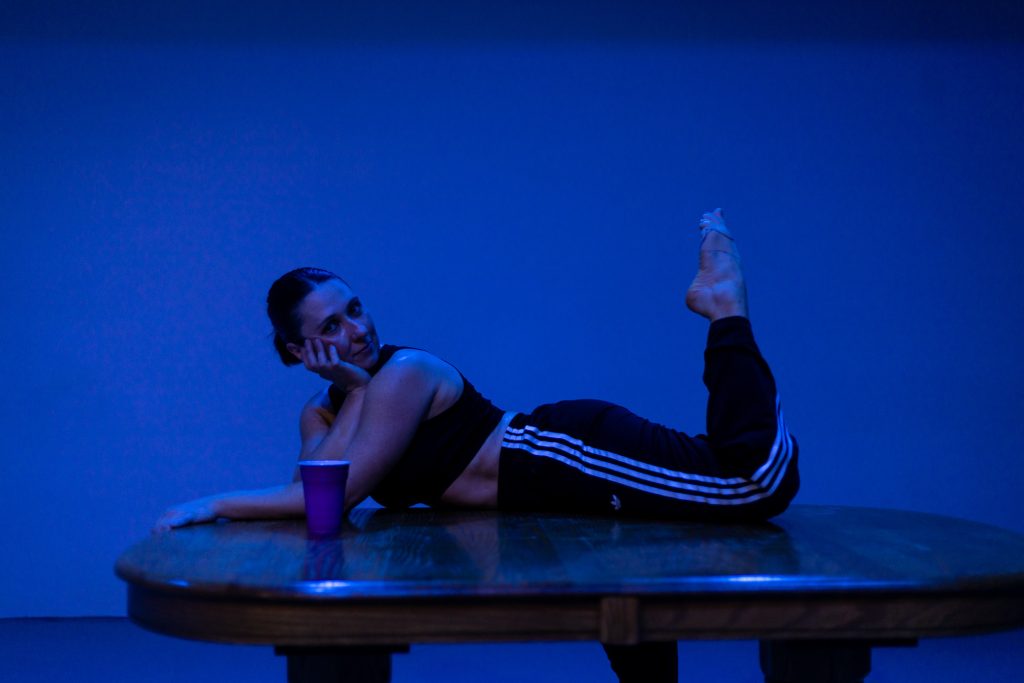 Photo by Trisha Mark
Kellner-Rogers exits and the focus shifts to Caplan, who brings out a large mixing bowl and offers it to an audience member. They take out a small strip of paper and are instructed to read it out loud. Caplan responds by completing a score based on the line of speech. She offers the bowl to several other audience members and responds to each with a specific phrase or score. She instructs all audience participants to read the text all at the same time, it reads something like:
I hate that you don’t pay
I hate your sweeping expectations
I hate how you make my body ache
I hate when people ask what you are, and I don’t know what to say
I hate how I can’t leave you, and how I don’t want to, can’t imagine it.
Caplan’s accompanying movements include rubbing her sacrum, attempting and falling out of pirouettes again and again, and a loud groan. The scores are all strung together into a dance of dejected frustration. Caplan fumbles codified movements repeatedly and purposefully, we can see she is more than capable of still doing the movements (as evidenced in the rest of the piece), here, she is sabotaging herself.
She takes the pieces of paper from the audience members and returns them to the mixing bowl, opens up a nalgene of water and pours it all in. Energy on fire, she dunks her half-straightened hair into the water. She wrings it out and scrunches her curls back to life in a gesture of rejecting attempts to change her body to fit some sort of uniform ideal.
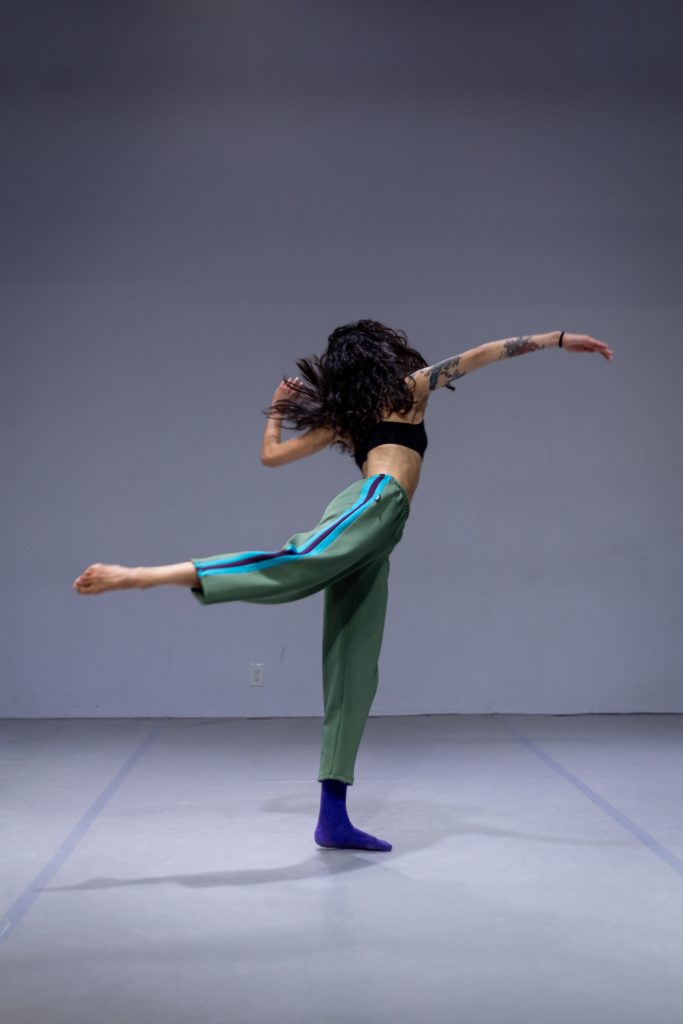 Photo by Trisha Mark
The dancers mark through a combo in unison, talking through each of the components as in a rehearsal, including announcing which of the steps they are doing/faking because they hurt. There is weariness, but also competition and tension between them. They do the phrase, full-out and fast, ending by alternately falling and catching each other, singing aloud to Don’t Dream it’s Over by Crowded House.
At first, I read this piece as the dancers satirizing themselves. The lyrics in the show’s playlist of popular songs all reference getting old, having missed out on chances, and the feeling that it’s over for them. My biggest critique is that they don’t convince us: they pretend to flub movements. I imagined that the trajectory and research of the piece would lead them to a broadened definition of success, and new discovery of what their bodies and minds are becoming, imbued with the richness and wisdom of adulthood. They do not give us that catharsis. The piece ends in desperation–they have given up, they are sad, the dream is dead. We are left in the chapter of reckoning and realization before the discovery. The one glimmer of hope is that we leave the two of them catching each other as they fall, and I imagine a chapter 2 where they lose their competitive spirit and come together to playfully discover what is next for them, because for me, the future looks bright for Caplan and Kellner-Rogers, though perhaps different that the one they originally imagined.
Millenial Dance Complex is a dance piece made by, for, and about dancers. To understand all of the jokes and references requires a familiarity with millennial dance culture. Despite its niche audience, the piece evidently has broader appeal. What we collectively have access to as humans are feelings of not measuring up, being born at the wrong time, having missed that thing we were destined for, over-training for a Job You Will Love that doesn’t exist. At the curtain call, the audience jumps to their feet and whoops and hollers–evidence that this is a story they needed to hear and see and that though we did not get to see the curiosity on the other side of the dying dream, we are reminded that dream death is a space we have all shared.
Millenial Dance Complex ran Oct 9-10, 2026 at Yaw Theater. Their program can be found HERE.