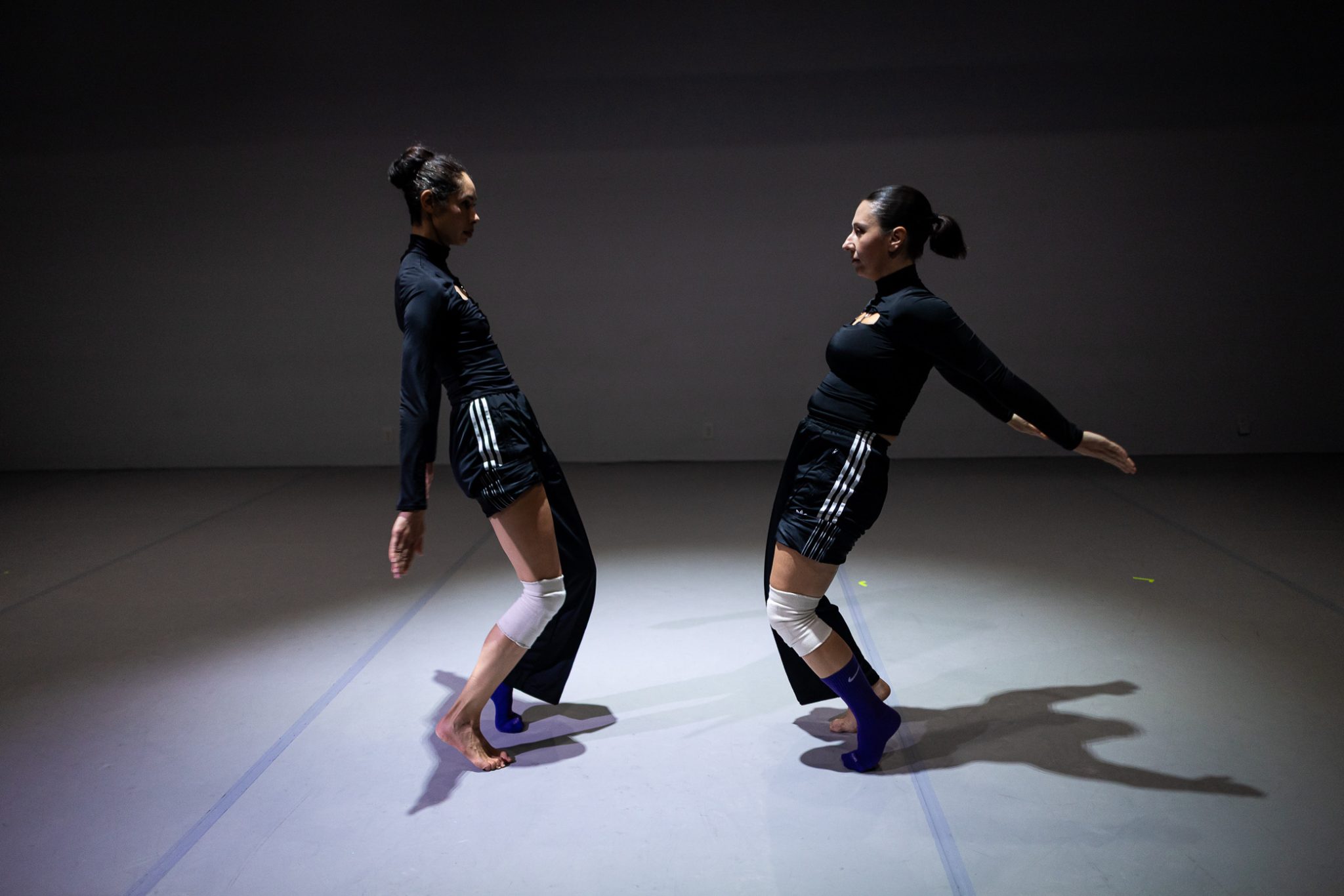
Orange cellophane coats the doors of 12th Ave Arts. People stop on the street, peering through the portal made of amber glass with curiosity, like an aquarium tank of experimental dance. Velocity’s West Coast Experimental Dance Festival OUT THERE is back for a second week. Week two features a new work from local artist Vlada Kremenović and a work from regional artists Jesse Zaritt and Sara Shelton Mann. Unfortunately due to injury, Shelton Mann was unable to perform live, though her presence is felt throughout the piece via audio recording and projection. In addition to the headliner artists, week two hosted two free pre-show performances in the lobby by Kelly Langsley on October 9 and Tariq Mitri on October 10.
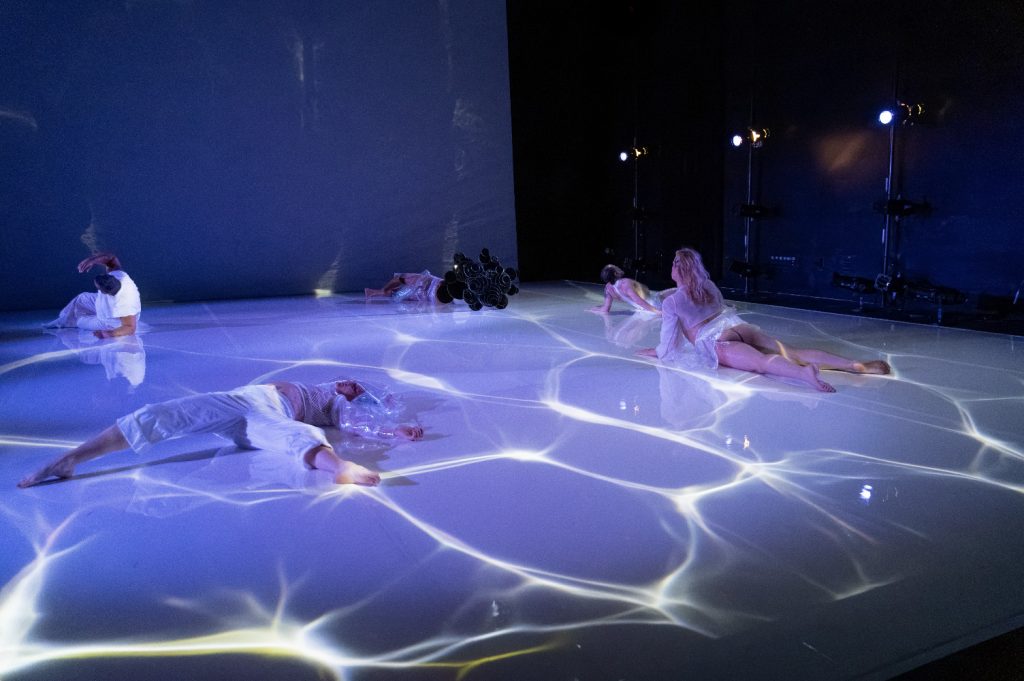 Photo by Erin O’Reilly
Fluffy pink and white checkered fabric covers the floor and a couch upon which Langsley sits. In an intimate circle like a living room gossip session, Langsley performs a sped-up synopsis of previous iterations of their Crush performance series, before diving into a recent memory of watching a wasp try to crawl out of their bathtub. An edited durational and instrumental version of Sheryl Crow’s “Soak Up the Sun” plays, as Langley hangs and falls from the underside of the staircase, bounces on their knees, and repeatedly tries to stand before falling. The task-based performance of trying to stand closely mirrors the wasp’s effort and then defeat, sliding back into the pool of water. The piece ends with Langsley rolling their body up into the carpet, inch worming themselves up the stairs, then repeatedly sledding down the staircase headfirst holding the edges of the carpet. The show has a sweet feel to it, as Langsley playfully uses the creature as a modality for queer expression.
Tracing the journey of a creature as a means to understanding the self is additionally a central theme in Vlada Kremenović’s MEDUZÆ. This piece features an all trans and all star cast (Kremenović, Fox Whitney, Taylor Tucker, Leo Sainz-Jones, Will Courtney) and traces the life cycle of a jellyfish through syncopated and flowing movement. The piece opens with Kremenović inverted, balanced on her shoulders with her bare legs reaching skyward, behind a bubbly and reflective sculpture made of mirrors. Her legs float in the air softly in the dark, light refracting from the mirrors like sunlight ripples on the sea floor. The reconfiguration of the body is not only impressive for the duration in which Kremenović remains upside down, but also for its reframing of the body. The image of just the bare ass and legs become a larva on the ocean floor budding into polyp. She dismounts slowly and the cast around her rises, creating an interlinked waving body, floating easily like seagrass. An anemone’s tentacles swaying together. This evolves into a rhythmic stepping pattern with arms linked in a line. The group travels in a circle with arms still linked, staccato movements propelling them as their bodies undulate collectively like a wave. The group becomes detached, and they melt to the floor. From distal points they begin rolling at a low level like they are gliding along the seafloor. Sensually, they move through baby cobras and kneeling arches, their movement growing larger as they spiral and inch closer to one another. This departure and return represents the process of stobillation, in which a jellyfish’s strobila segment detaches and floats away, becoming ephyra.
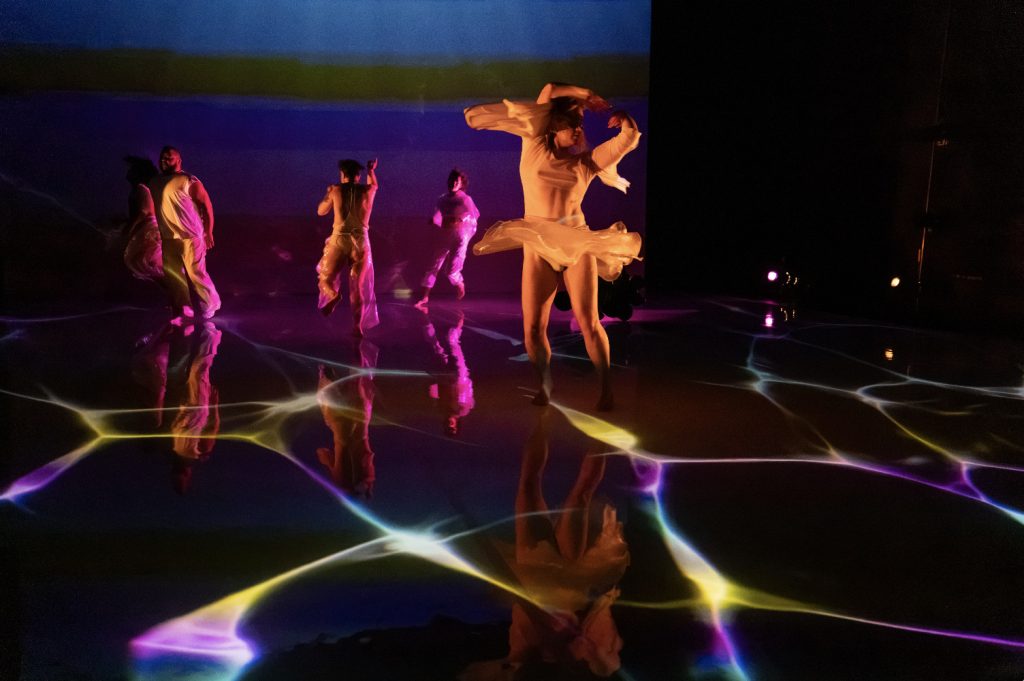 Photo by Erin O’Reilly
The journey of the group accumulates to the climax of the piece, in which ephyra have developed into fully formed jellies (aka the medusa stage). A rave-like under the sea party, everyone navigates the space differently, creating a queer symphony of play, curiosity, and care. Sainz-Jones bounces energetically with a leg extending out like a pulsating jelly, before falling into sensuous crawling and pounding the floor. Whitney hops in place while Tucker moves limbs with contrast in an exploratory kelp-like fashion. The dancers oscillate between vigorous pouncing, delicate floating, explosive and frisky outburst, and synchronized twerking. The lighting by Jessican Jones is outstanding throughout the piece, and shines in the climax. Swirling pink, purple, and blue perfectly invoke a queer dance party on the ocean floor, with occasional streaks of gold light hitting the dancers like sun coming through the meniscus of the sea. The scene is incredibly joyful and inviting to watch. They go hard, then they wash up on shore.
Along with Jones’ lighting, projections by Kremenović help tell the story throughout the piece. In the final moments, ocean waves coming into shore cover the back scrim and the floor, transforming the stage into a sandy beach. Kremenović and Whitney roll with the waves while the rest of the cast lies at the foot of the stage. There is something meditative and soothing about watching them roll. Their bodies appear completely at the whim of the waves. The piece traces transience, transformation, and migration of the trans body, using the medusa as an allegorical tool. The movement and message had a clarity that sublimely balanced exquisiteness of the medusa with the care and sweetness of trans community building.
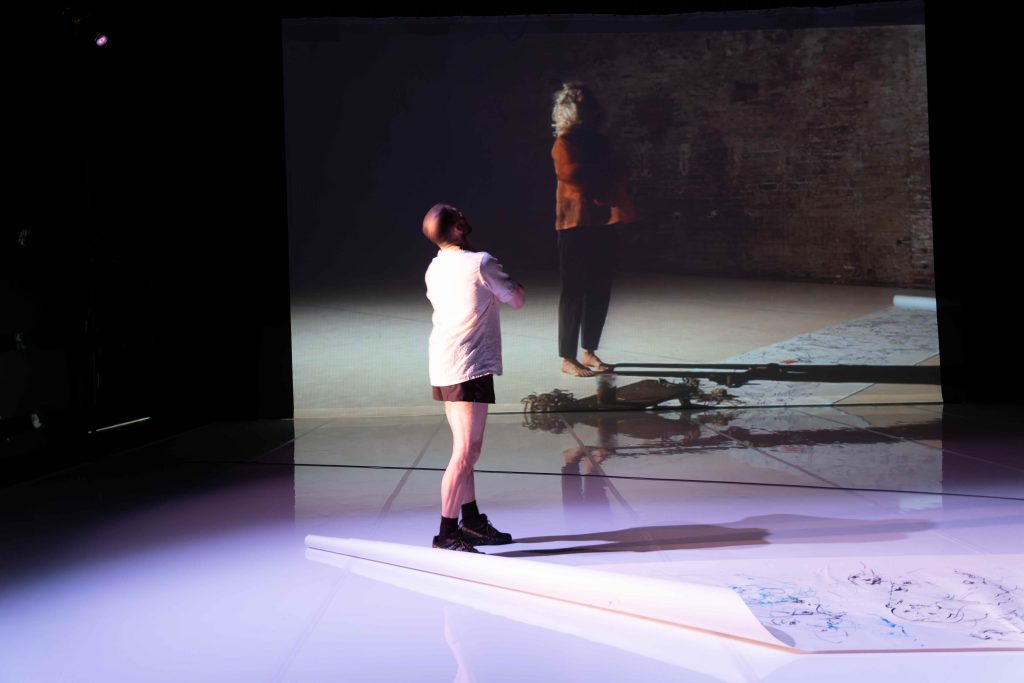 Photo by Erin O’Reilly
As we reenter from intermission, Zaritt, on his knees, scribbles and scribes across a long scroll.. Green, black, and blue markings coat the downstage paper, as Zaritt creates blind contours of the crowd– a collage of chicken scratches. L/are we dreaming incorporates visual art, movement, and language to examine power, violence, and to provoke the heart. We are introduced to Shelton Mann through a recorded projection of a previous performance. Holding a microphone, she asks us questions and makes statements like: “Do you think your body is more important than someone else’s body?” and “History smells a bit like an onion.” The two engage with the scroll of paper in various ways, Zaritt drawing, dragging, and dreaming with it, Shelton Mann pours sand atop of it, suspending time for a moment. Throughout the piece Shelton Mann pleads “please don’t bomb the sun,” as Zaritt dances with elongated and gestural movements. While Shelton Mann speaks into the microphone, Zaritt runs in circles orbiting around her. The live Zaritt holds the Jacket Shelton Mann is wearing on screen like a flag, running opposite of his projected counterpart.
The two use everyday objects to convey political violence through abstracted forms. Shelton Mann holds a microphone like a gun and aims it at the crowd. The image is striking and invokes questions about the power of the voice and how it becomes weaponized. Whose voices are amplified and whose voices are silenced? The incorporation of the drawing continues when Shelton Mann covers Zaritt’s body with red lipstick. Creating continuous lines across his limbs, she traces the shape of the body creating a corporal diagram. As Zaritt dances, the red lines mark the stark white marley like blood.
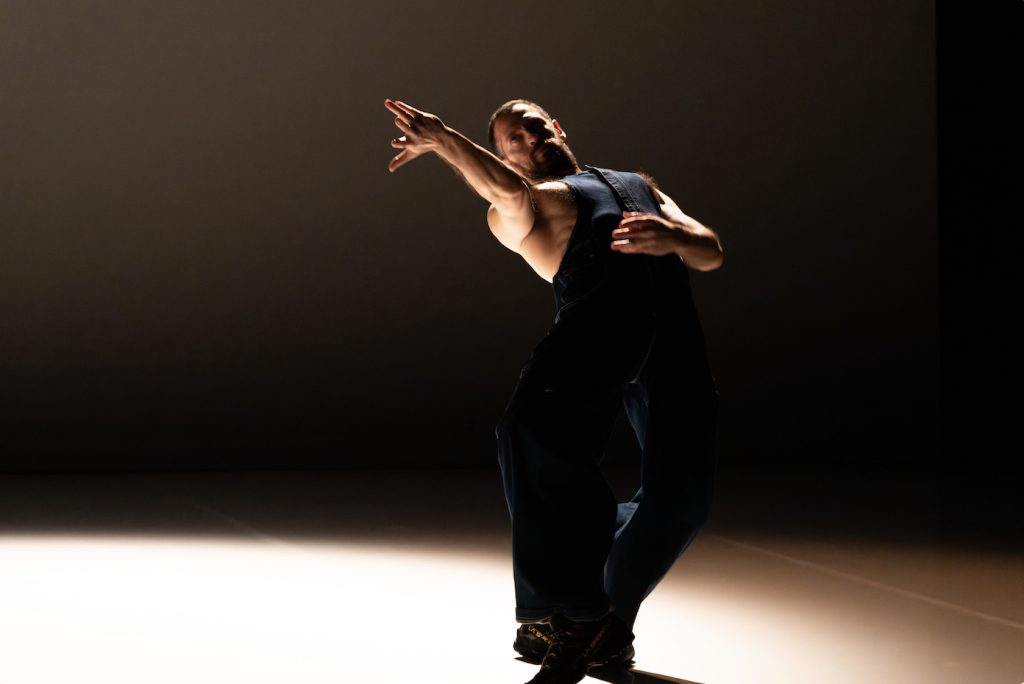 Photo by Erin O’Reilly
Like a dream, there is a sense of vagueness and incoherence throughout the piece. The poignant acts feel a bit abrupt and free floating like we are swimming through existential soup. The lack of groundedness feels somewhat responsive to a chaotic and confusing world. The two ask questions with their bodies, questioning and confirming their own conditioning, searching for a sense of heart throughout the piece. The piece ends with an extravagant and abstracted final solo performed by Zaritt. The absurdity of the solo is veiled by balletic grandiosity. Zaritt soars across the stage leaping and kicking with precise and snapping limbs that stretch to 180 degrees. He melts with feathery fluidity, playing in every corner of the stage. Up against a wall, he wraps his body around a lighting post, making additional contact with the fixture with his tongue. He runs off and scales the side of risers, surprising the audience, looking at them like a curious bird. The chaos and unexpectedness of the final dance feels reflective of navigating the sheer ludicrousness of the world right now.
While Zaritt and Shelton Man are making an attempt at describing and questioning the world around them, I felt Tariq Mitri’s WHOLE is directly responding to it. I returned for the final night of the festival to catch WHOLE, asking the question: “What does it mean to be whole in a fractured world” as stated by the program. Tied together articles of clothing create grand steamers through the lobby. Three cascade from the balcony like a waterfall, one trailing off in an S shape like a river of garments. At the end, Mitri begins a slow durational crawl towards the flowing fountain of clothes, his eyes covered by a hood, lipsyning softly in the crawl to Sade and Night Tapes. Mitri climbs one of the cascading ropes, suspended in the air for a glorious moment before the fabric tears. He runs throughout the room, using the fabric to catapult himself into the space before sliding and swirling through the lobby. He shouts about free will before tying the clothing to the outside doors and running into the vestibule, where he talks with his hands and quite literally bounces off the walls. Mitri talks directly to people in the crowd, asking for guidance, and snuggling up next to audience members. Zarrit and Mitri share a boldness in the way they both move, though I found Zarrit’s gaze of the audience more observational and interrogating, while Mitri’s to foster a sense of collective resonance. If Zarrit is observing subject formation, Mitri is engaging in subject refusal. When all of these pieces are paired together, we watch how the unexpected, bold, brash, choice can question our conditioning. Our environment, our neighbors, the land, and the creatures around us, hold the inspiration for new pathways and modalities of viewing.
Velocity Dance Center’s OUT THERE West Coast Experimental Dance Festival Week 2 ran Oct 8-10, 2026 at 12 Ave Arts. More information at velocitydancecenter.org.