In the 48 hours moving about my life after seeing Sad Boys in Harpy Land by Alex Tatarsky, I encounter several everyday objects that, in the aftershocks of Sad Boys, have been temporarily made magical. A pear. A can of sardines stored next to my coffee grounds. A rubber glove. A half-drunk Big Gulp of some brown and evilly bubbling liquid on top of a bus stop trash can. A flattened earthworm on the sidewalk. I have the great pleasure of letting each object transport me back in time to Tatarsky’s self-described “magnum o-pussy,” which they go on to describe as a “one woman show” that attempts to disrupt the ideas of “one” and “woman” and “show.”
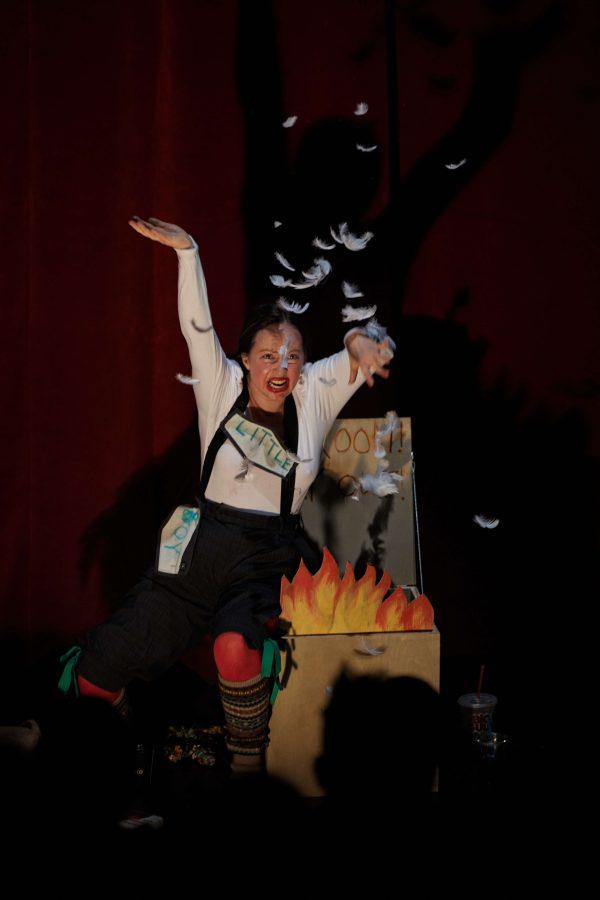
It begins with a series of false starts and interruptions by multitudinous, unhinged characters and spirits, all played by Tatarsky. These interruptions and shifts become the way that Tatarsky expertly collages literary scenes, physical explorations, and elements of their autobiography into a chaotic, but meticulously cohesive whole. Tatarsky signals shifts in characters through donning different costume elements, revealing fake beards and strange wigs from behind podiums and underneath pianos. The large and bulging pants they wear at the beginning are a veritable Mary Poppins bag of props, tricks, and ever-smaller pants and lederhosen. With each interruption, Tatarsky digs up new voices and affects, shifting their face to the widest edges of expressions that human faces can make.
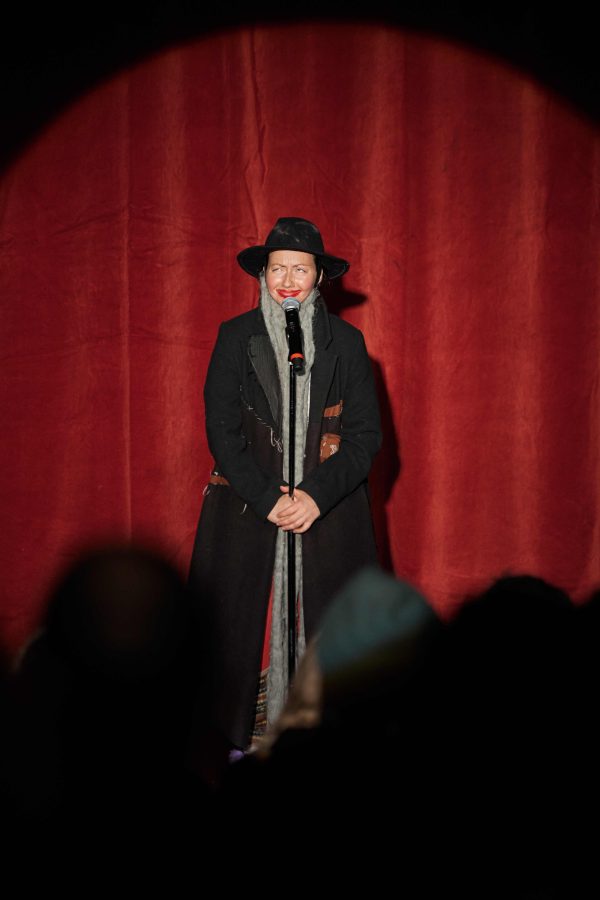
Tatarsky says, of their process, “I drink a lot of coffee and jerk off and cry.” We see them lewdly slurp beverages appearing from all manner of places throughout the show. They mime jerking off and their laughs and cries are unbounded, maniacal, and blend together without clear lines of distinction. “MY MIND IS A HELLSCAPE” becomes a refrain. Wearing a long and tattered trenchcoat, they bend down, then flip their head up to reveal a strange wig made from what looks like furniture tassels or graduation cord. They smear rings of red lipstick on and around their mouth and sing with the smoke-tinged voice of an aging cabaret performer–did you know that we can’t drink the rain anymore, because of what we’ve done?
Sad Boys in Harpy Land is built in reference to the bildungsroman: a genre of novels about the moral and psychological growth of the protagonist, or more specifically, a künstlerroman, about an artist’s maturation. Recurring major characters in the show include German-sad-boy Wilhelm Meister, who is lifted from Johann Wolfgang von Goethe’s coming-of-age novel Wilhelm Meister’s Apprenticeship, and Oskar Matzerath, German-sad-boy from Gunter Grass’s 1959 novel Tin Drum. In literature, Wilhelm Meister was born to a bourgeois family but left all that to make theater. Unfortunately, he wasn’t very good at it and never wrote the show. We learn from Tatarsky that at 24, they made a solemn vow to adapt Wilhelm Meister’s Apprenticeship multiple times, alongside their own growth as a theater artist, for the rest of their life. According to Tatarsky, the parallels have been alarming. Sad Boys in Harpy Land collages material from Tatarsky’s many adaptations of Apprenticeship, unfolding as a show about making shows. It is interwoven with scenes from The Tin Drum, in which Oskar is born fully mentally developed, but insists on remaining a child forever. We are made to feel squirmingly uncomfortable alongside Tatarsky, who challenges the political and social relevance of art, all while making a show that elicits deep feelings about fascism, bodies, cruelty, and the evasive search for a life path full of meaning. The artist keeps looking back on themself and wondering aloud, is this what you have chosen to do with your life? At 37, why are you still just playing?
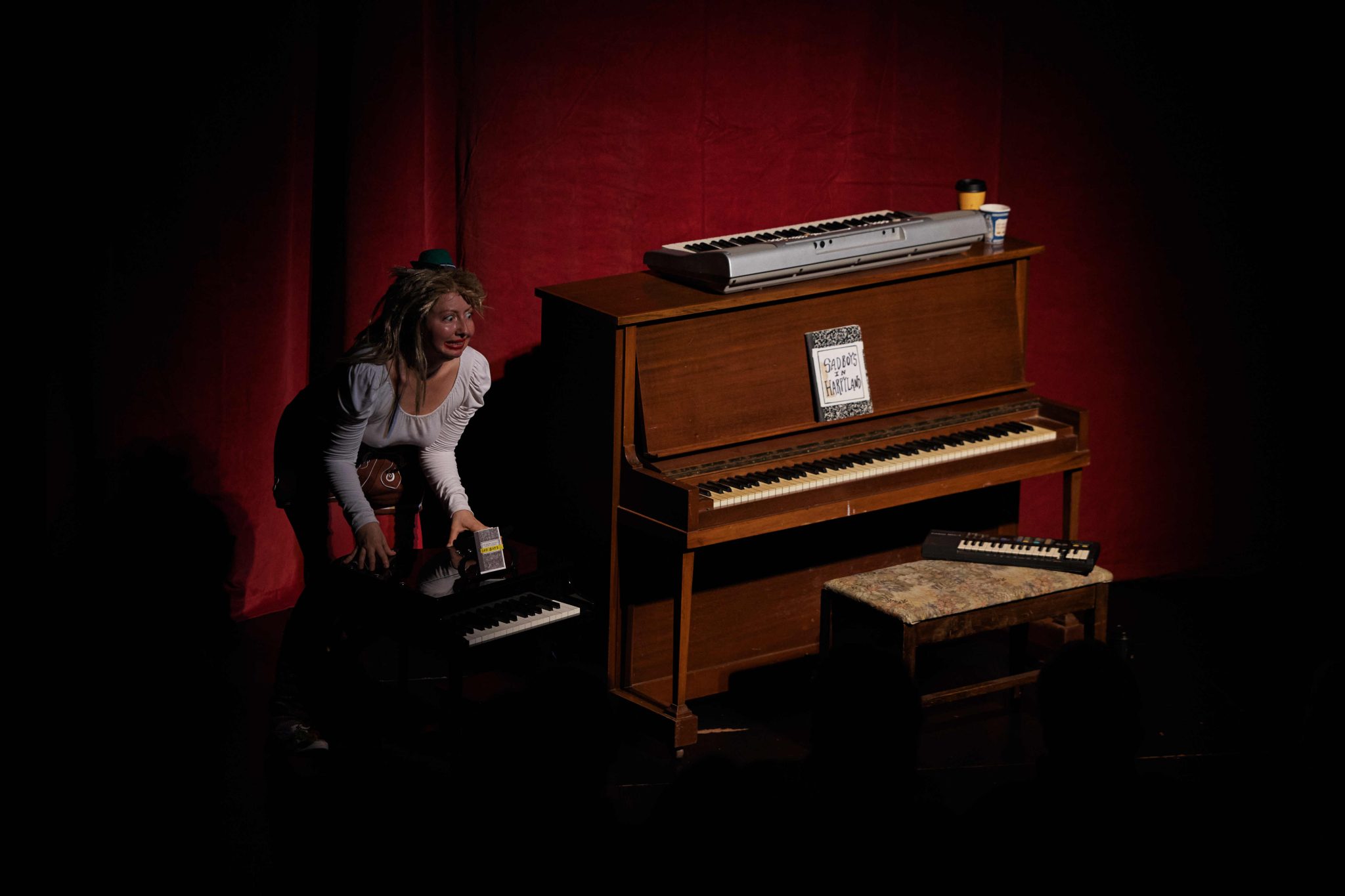
The years-long research and self reflection in this work are evident in the choice Tatarsky makes to follow the rabbit holes all the way down. Meister is obsessed with Dante’s Inferno, and thus, Tatarsky too becomes obsessed with Dante’s ring of hell, where deaths of despair become harpy-pecked trees, that, when the branches break off, words come out. Oskar attends the Wagner opera The Flying Dutchman, about a Ghost Ship that sails in circles forever, which, Tatarsky tells us, is derived from the trope of the Wandering Jew, who also appears as a character in this show. The farther into these stories Tatarsky reaches, the more overlaps between the stories and Tatarsky’s artistic development are unveiled. They yell “oh woe is me,” while banging their ass on a piano, re-enacting the first performance Oskar sees in Tin Drum. They disappear behind said piano to reveal a smaller electric keyboard. They disappear again, then wheel out an even smaller toy piano, pushing it to center stage as if it is large and cumbersome. As they do over and over again, Tatarsky takes the bit to the very farthest end of its reasonable edges, and then farther. There is a tiny, palm-sized piano that tinkles softly, a piano necktie that Tatarsky plays, and finally, a piece of wood with “this was supposed to be a piano” written on it. Tatarsky continues to wail along to the pianos, seeming to ask how small can an act of performative desperation be, while still demanding attention and sympathy from an audience? Despite the convoluted and obscure literary and historical references, Sad Boys in Harpy Land brings the audience along for the ride, assuming no prior knowledge. We don’t need to “get” the references outside of this container, it is enough to see how they are all connected through Tatarsky’s “hellscape” mind.
Dressed as the Wandering Jew, Tatarsky yells “the end is near!” before reassuring us that we are only about halfway through. They lead us in a song and dance, which goes something like:
When the messianic age comes it will be like this one
but a little bit different
And when the whole world goes to hell, well,
it will be basically what it is now
We stand up and process slowly down the aisles to join them, behind the red curtain, on stage, bunched in close and seated on chairs and cushions. When I look around me, all faces are beaming and pointed upward, eyes wide like kindergarteners at a magic show. In this half of the show, the harpies have arrived, criticizing and tearing apart the audience, the artist, and the bodies that have become trees. Because Tatarsky has taken the time to bring us into their world, we are able to track them as they shift at breakneck pace between scores, personae, and premises:
…They put on a shirt upside down, gloves on their feet, shoes on their hands, and birth a wigged styrofoam head through the neck of the shirt.
…They spill a bag of potatoes, apples, and pears that skitter all over the floor. They bring out a knife and mime as if they are about to slice open a wrist—then grab a pear and start keening “Despair! Despair! Dis pear! Dis pear!”
…They take off their unsnapped white leotard and pull their ruby stockings up to their collarbone so that it becomes a sheer tube over no underwear, with the word “hole” written in cursive gold puffy paint, over their asshole. They wiggle and yell “I am an earthworm!” Then, “stop looking at my hole!”
…They ask for a word from the audience and then go letter by letter, embodying each and tying its attributes to themes of the show, drawing out each vowel as a prolonged scream.
…The stage gets messier and messier with quart containers, coffee cups, feathers, sticks, and other detritus.
… And then the pacing calms, slows, stills.
Tatarsky begins to gather and tenderly place the strewn items into a circular nest around them. They pick up a guitar, and begin to sing. The song is sincere, bravely so, bringing us back and together around the idea of The Wandering Jew, seeking and circling, forever and ever, without knowing the answers.
On its surface, this work is a work about making work and the existential crisis of the artist; what am I doing, why, who is watching? If I am not directly the changemaker, but am calling for change in a violent world, am I motivating the person-who-is-not-me to do something….anything real? This is an old and somewhat tired question. We have all seen the hand-wringing of artists before, and likely have done our own self-indulgent spiraling. Frankly, I am often unmoved by the performance of these questions. What makes Sad Boys different and profoundly moving, is that like every other thread, Tatarsky takes this question and tugs and tugs and tugs at it til it unravels. The role of the clown historically has been to say the thing that shouldn’t be said, to speak the unspoken truth loudly and strangely in the face of the monarchy. Tatarsky, who is Jewish, makes seemingly offhand statements like “what, Jews can’t be funny anymore? Turns out you can’t be funny and have a nation-state–you can’t have both,” that linger in the air for a long time. They do not need to yell Free Palestine or mention genocide for us to then interpret the chaos they perform as part of a commentary on immobilization in the face of state violence. The Sad Boys whose spirits they are possessed by are confronting their artist-identities amidst historical state violence. Meister’s Apprentice was published in 1795, the same year as the Rhine Campaign. In The Tin Drum, Oskar Matzerath begins his perpetual childhood in early WWII and the novel follows him into post-war Germany. These Sad Boys do not go to war, they do not start mutual aid orgs or burn down buildings, they remain children at play.
This show split my face in a grin that never rested, and I laughed til I hurt. It also made me vibrate with anger and sadness at myself, the world, and our uncertain future. In the post-show talk back, Tatarsky reflects that this show has a way of becoming a lens to understand whatever is happening in the current news cycle. It is able to stay contemporary because the chaos and violence never stop, the existential crisis is never resolved, and the harpies, within us and outside of us, circle overhead, pecking and pecking at our despair until words come out.
Alex Tatarsky’s Sad Boys in Harpy Land ran Nov 12-14 at On the Boards. Find out more at ontheboards.org and Alex Tatarsky’s website.