A loud heartbeat hammers against the walls of the intimate Jewelbox Theatre. I flash to Baryshnikov dancing to his audio-amplified heartbeat in the late ’90s. It was fascinating. Why? Perhaps for the same reasons I find it unnerving to hear my heartbeat reverberate in my mattress springs—beyond the mortality reminder, the insistent metronome prompts me to realize the bravery it takes to live baring one’s heart. I know I am not alone in my strong response to hearing this most basic rhythm of our existence as there is a content warning for the heartbeat sound in the program for URGE—a movement-informed triptych of short plays by local Seattle playwrights Montse Garza, Alina Rios, and Miriam BC Tobin. Bringing these three plays to life is Verbooom physical theatre company.
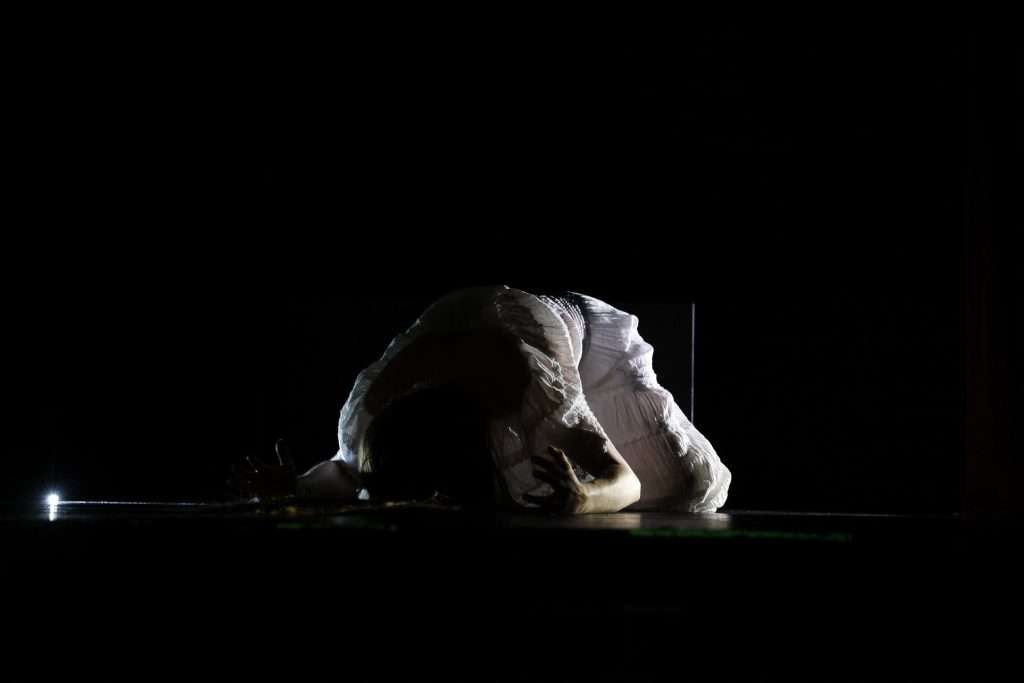 Photo by Allina Yang
When the curtain parts, a brother, Hermanito, and sister, Niña, (adult actors Elijah Spreier and Montse Garza, respectively) clamber around their mother (Adriana Hillas) telling stories that begin as entertaining around-the-campfire one-upmanship. They each tell their own version of the Latin American legend in which a woman, Maria, becomes the unhappy ghost, Llorona, after she and her sons drown. In Hermanito’s telling, Maria’s children drown at a pool party because they were too poor to take swimming lessons. As Llorona, the ghost haunted rich people who wouldn’t share their wealth with the poor. Niña, insisting Hermanito’s version is wrong, holds a flashlight under her chin, telling the one where Maria’s husband gets so angry and drunk he beats her. The flashlight casts grotesque shadows on Niña’s face as she describes the domestic abuse. When her husband beats their sons, Niña continues, Maria tries to flee on a raft with the children, but they all drown.
As they talk, Niña and Hermanito fidget with a red rope. They twist it, create new designs, pull on it, but it never breaks. It feels like how we can simultaneously strain against and be held together by family ties.
Niña and Hermanito’s mother sadly and gently tells them that neither of their versions is quite right. La Llorona drowned her own children on purpose. She went crazy. Niña and Hermanito, horrified, ask why a mother would go crazy for no reason. The stage lights go off. Like a clap of thunder their mother stomps and replies in anger, “People don’t just go crazy.” I empathize with the mother’s frustration. The children seem to reflect a cultural unawareness of the effects of abuse, and how it can drive healthy people to extremes. The mother mutters it’s just a story and the scene ends. It strikes me that, as in this scene, stories are the way cultural norms are shared widely and passed from generation to generation. Stories though, like the red rope, can be malleable and have the potential to change shape with the telling. It is up to both the audience and the narrator.
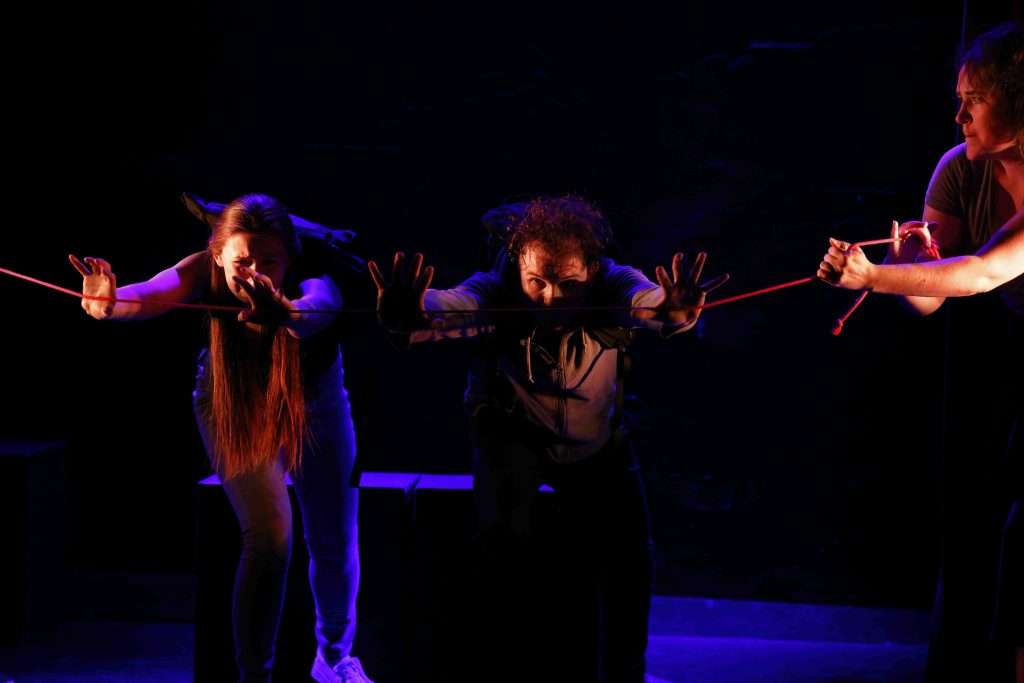 Photo by Allina Yang
For playwright of the Llorona section, Montse Garza, URGE is her first devised theater production. Devised theater is a collaborative process of creating new work without a pre-existing script where often the creators are also the performers. Everyone from actors to technicians can be involved in the creative process. The devised theater approach to URGE is heavily influenced by Director Alina Rios’ training with London-based Frantic Assembly, a leader in movement-based theater direction and production. On her website, Rios describes how “Performers are encouraged to take a moment back to its simplest truth and build from there.” Rios’ sentiment reminds me of Martha Graham’s famous assertion that “movement never lies”—that how we move provides conscious and subconscious visceral clues to our life pulse and the verbal stories we tell.
Rios teams with choreographer Natalie Grant to deepen the messages told in URGE through movement. The duo, Rios as a scriptwriter and Grant as a dancer, were also involved in Dragonslayer, an immersive dance/theater production SeattleDances audiences may remember from earlier this year.
It is Grant’s movement in “Snow,” written by Rios, that is like an electrical conduit to my embodied experiences as a mother of an infant. The scene opens with Grant frantically pacing an apartment space littered with laundry, holding a baby in one arm and pressing a phone to her ear with the other. When she gets no answer, she slams the phone on the table, rushes off stage, gives the baby (a doll) to someone in the audience, and upon her return to the stage dances frantically. Her erratic movements shoot in all directions like an Etch-A-Sketch illustration. It is a visualization of what I felt like doing in my own early parenthood experience, when instead I was trapped breast feeding for hours on the couch—all I wanted to do was move freely.
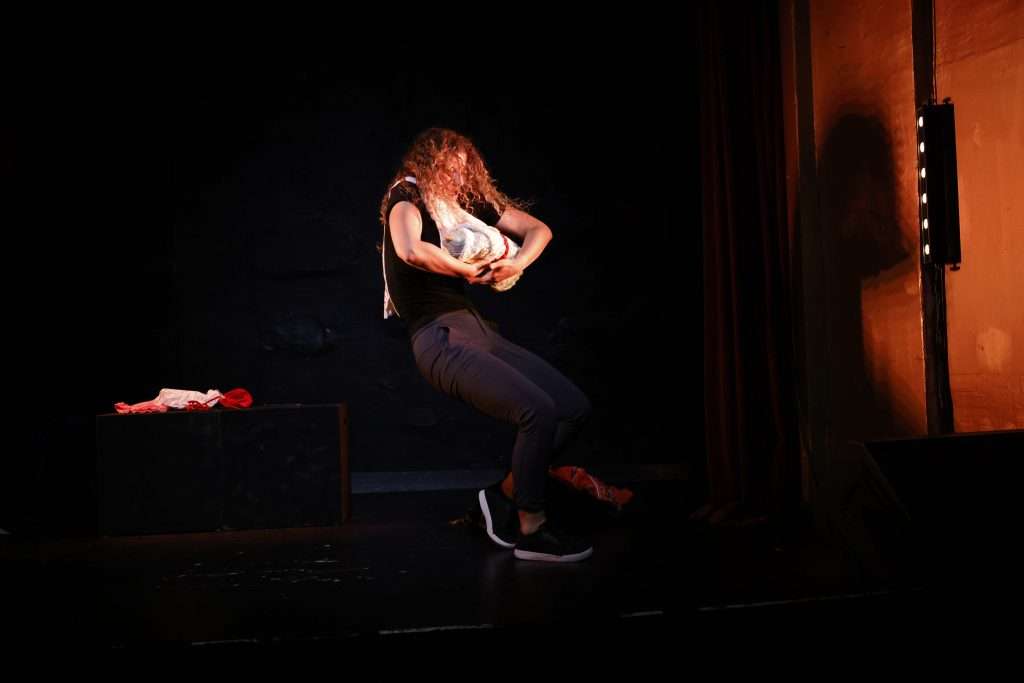 Photo by Allina Yang.
Unconventional and poetic dialogue couple with strong movement sequences throughout URGE allowing for a layered, complex interpretation. When the spouse (Adriana Hillas) finally comes home the exasperated mother demands, “Why didn’t you answer your phone?” The spouse replies that her stomach fell out in the snow on the walk home. The strange image suggests the figure of speech of “losing your stomach” for an endeavor. When I think of this stomach in the snow, I have an empathic response to feeling gutless or hollow in the face of overwhelming identity shifts like parenthood.
The moody preposterousness of “Snow” creates room to relate to common relationship struggles. Leveraging theatrical absurdity characterizes this evening’s Verbooom production in ways I find delightfully provocative. In the section, “Battle of the Whisps” written by Miriam BC Tobin, a man (Elijah Spreier) hungrily listens, almost like an addict, to the dreams his wife (Hillas) mutters in her sleep. It seems he lacks vision for his own life. Sometimes the woman’s intriguing dreams are interrupted by her farts and snores. The husband is disgusted. I’m getting whiffs of Ken and Barbie here. No one talks about the unglamorous work that must have gone into building Barbie’s dream house. Periodically, another actor appears from behind the woman’s bed and operates her like a marionette. Movement-wise the somnolent woman controlled like a puppet reads as someone paternalistically trapped in a domestic role, someone who has lost her identity, but whose socially unpolluted creativity still leaks out in her dreams.
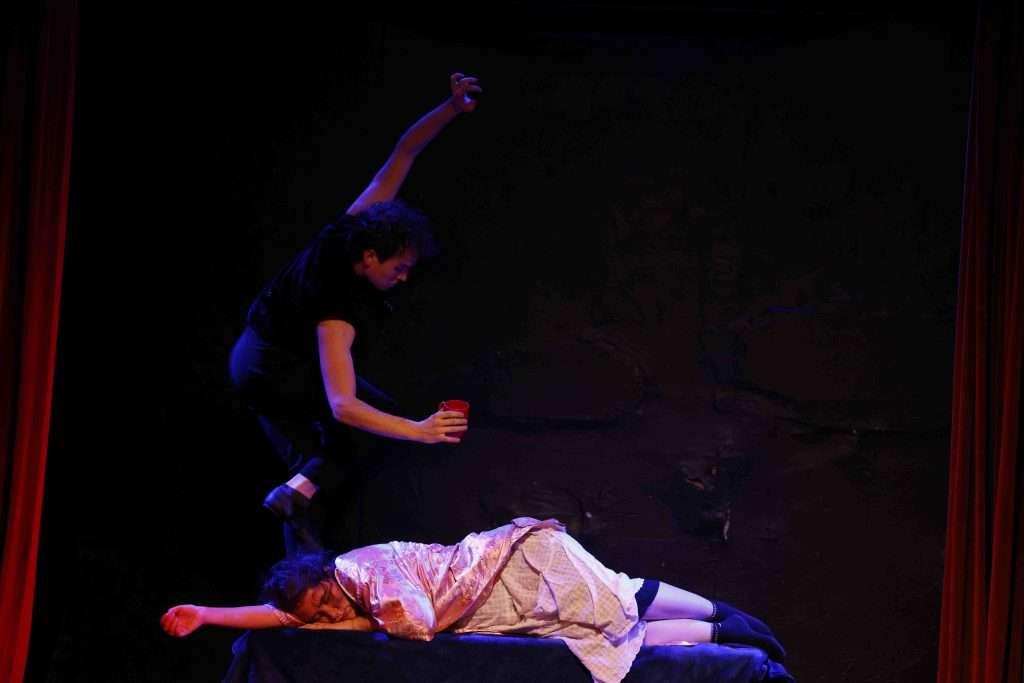 Photo by Allina Yang.
When the curtain closes and the lights come up, a voice quotes Puck from Shakespeare’s A Midsummer’s Night Dream saying, “If shadows we have offended, think but this, all is mended. That you have slumbered here while these visions did appear.” This first Verbooom production certainly stirred the shadowy subjects of domestic abuse, alcohol abuse, and mental illness in puckish fashion. The company approached these taboo topics through playful, unexpected movement and dialogue that left my heart beating URGEntly with desire to devise my own narrative anew, even though it includes its share of shade.
Urge showed at the Jewelbox Theatre on July 18th and 19th.


