“Cindy. This is a bird flying in the breeze.”
“Michael. Attempting to drop the façade.”
“Mary. Do ‘the Mary.’”
“Chris. Reaching up to a higher power, coming up empty-handed, coming back to myself.”
The lights rise and ten dancers, clad in white, are standing spread across the stage. One at a time they speak a name, a phrase, and an accompanying gesture, originally performed over three decades ago by the person named. Arms reach and swipe at the air above. A hand covers half of the face, then lowers. Legs shift and flick back in. The entire ensemble wiggles their hips with their palms outstretched for ‘The Mary’ and the sassiness elicits a surprised chuckle from the audience. We’ve come here to talk about death. But, right off the bat, we are reminded that there will be humor as well.
 Photo by Jim Coleman
Still/Here originally premiered in 1994, as a culmination of the two years of research Bill T. Jones conducted across the country, through “Survival Workshops: Talking and Moving about Life and Death.” During these workshops, Jones collaborated with participants who had terminal illnesses and diagnosis, asking them to discuss “the profoundest question…literally, the issue of life and death. What does it look like? What does it feel like, taste like, smell like?” Through movement, exercises, and group discussions, participants shared their stories. Jones then built a dance with his company members sourced from these collective experiences. And now, in 2026, over 30 years since the initial creation, Still/Here is being presented at University of Washington’s Meany Hall.
This piece unfolds in many chapters and vignettes, opening with the soft gestural introduction. Standing in a line, a winged arm gesture ripples from back through the ten dancers. Though the movement in this first section is simple and stationary, there is a poignance in how the gestures shift between group unison, then pass to partial groups, sometimes leaving behind one dancer in the previous shape, unchanged. Not a monolith. Not a singular experience. These stories are sourced from almost 100 individuals, and these movements shift and expand, as we make room and welcome more and more names into the dance.
The initial gestures come back and morph throughout the piece as the energy picks up. Like flying shrapnel or whirling tops, dancers catapult their bodies across the floor spinning on their hands and knees. We hear audio clips about fighting and surviving, and conquering the diseases, accompanied by athletic feats of gymnastics, running, high kicks, and roundhouses.
Throughout the dance, there are recurring gestures that depict collective care: that we need to hold one another and lean on each other. A dancer walks forward alternating their legs in the splits, held by the arms on both sides by partners. Lowered again into the splits, they are gently rocked back and forth, eventually pulled up to be cradled, in shapes they can only do with the support of their partners.
Towards the end of the first act, all the lights turn off except for a single lightsource silhouetting one of the dancers, their larger than life shadow stretching to the ceiling of the theater. One of the performers is the light’s operator, and they shift the focus of the beam as they move through the space. In the dark, the dancers tumble, writhe, and ecstatically jump. The light casts them in relief, smoothly panning across the space following a series of jumps and spins, then darting to a partner being lifted into the air. In the director notes, Jones names that “mortality is an aspect of the human condition that does not follow fashions nor aesthetic conversations.” There is something so arbitrary and random about who lives and who dies, who is in light or not, and the suddenness at which that can change.
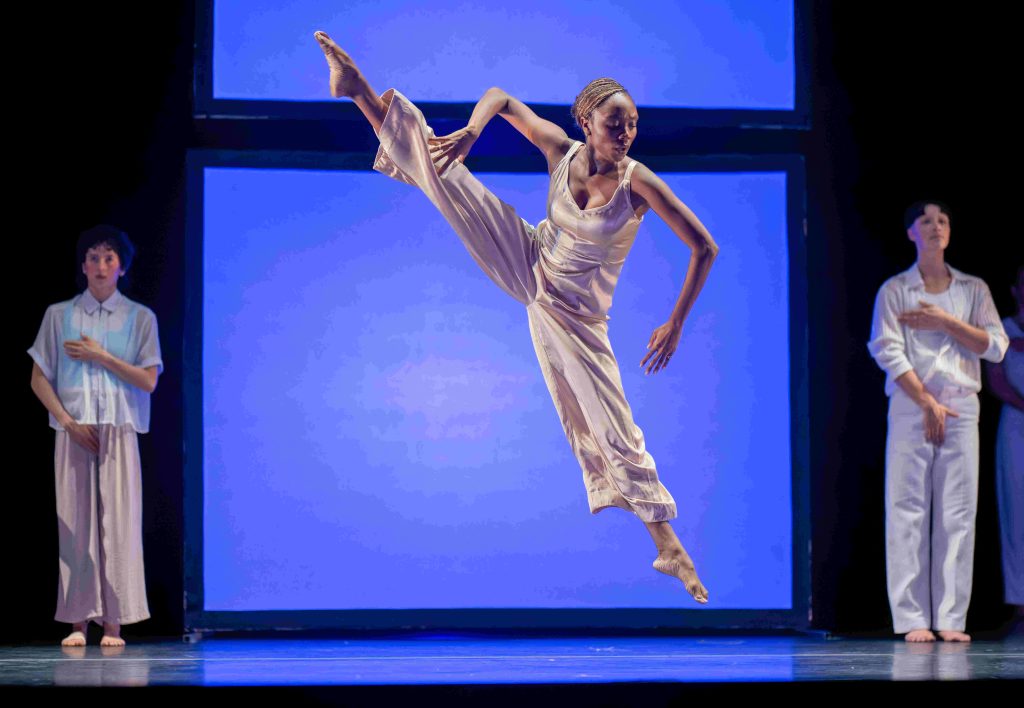 Photo by Jim Coleman
The use of flashlight and shadows was one of many technical elements used to heighten the precarity of life and death. In Act 1, three blue screens projected videos of the workshop participants performing their gestures and facing the camera. Onstage, as the dancers pushed the screens forward and backwards from the audience, the projections would grow and shrink in size. At the end of the videos, the projection light would turn blue and shutter closed, creating the illusion of a shrinking blue rectangle pulling back from the space, like a tunnel of light leaving us. In another moment, a stack of two screens play a looping video of an agile martial artist from the workshop. Onstage, a soloist flips and kicks in front of the screens around and around till they can no longer, while the projected dancer could loop that movement in perpetuity. In Act 2, a row of five evenly spaced screens alternate between videos of the workshop participants with bright red pulsing heart animations. The dancers move in front of and behind the screens, momentarily obscured, their shadows interplay with the projections. Sometimes the bodies create a multiplying and disorienting sensation of who is still here. Timelines and lifetimes are folded in on each other, where the present-day dancers, many of whom were not yet born during the 1994 premiere of this piece, are dancing with and interrupting the images of the workshop participants from over 30 years ago on the screen.
Onstage, a single dancer walks through the space with all the other company members forming a touch connection point around them. The online archival footage shows workshop attendees in the same configuration, as one participant walks everyone through a map of the notable events of their life, after which Jones instructs the group to let go, walk away, and give them alone time, followed by everyone returning to them. Still/Here is a highly choreographed dance with very technically trained dancers, but at its core it is a living archive of what was discovered in the Survivor Workshops. These participants shared their voices, movement, and their experiences of grief, frustration, levity, fight, hope, fear, and love. They then discovered and expressed these experiences through dance, which now gets re-embodying through the live performance of Still/Here. Jones says that “movement begins to negotiate the distance between the brain and the body and it can be surprising what we learn about each other.” Dance has the unique ability to let the body discover. Even now, when it is likely that many of these participants are no longer alive, the truth of what they shared still resonates.
Still/Here persists as a work of art because it has never tried to say a singular thing about death, life, dying or living, other than to say that death is inevitable and living is currently possible. The curtain lowers as the piece ends in a cacophony, exhausted and effortful, the dancers leaping, clutching hands, games being played, unity, guttural screams, ecstasy, exhaustion, without conclusion, ongoing.
Bill T. Jones/Arnie Zane company presented Still/Here February 26-28, 2026 at University of Washington’s Meany Hall.


