Walking into the theater, spotlights precisely illuminate an array of bubbly pink and reflective objects. Wigs, heels, and pink tissue paper are scattered across the stage. Two massive pink fabric circles sit across from each other like tree skirts, accompanied by a long stretch of magenta fabric running like a river across the stage. Fauxnique poses just off center, shimmering in sequins and chrome heels under a spotlight, oscillating between kneeling and sitting, greeting each member of the audience with her eyes as they find their seats.
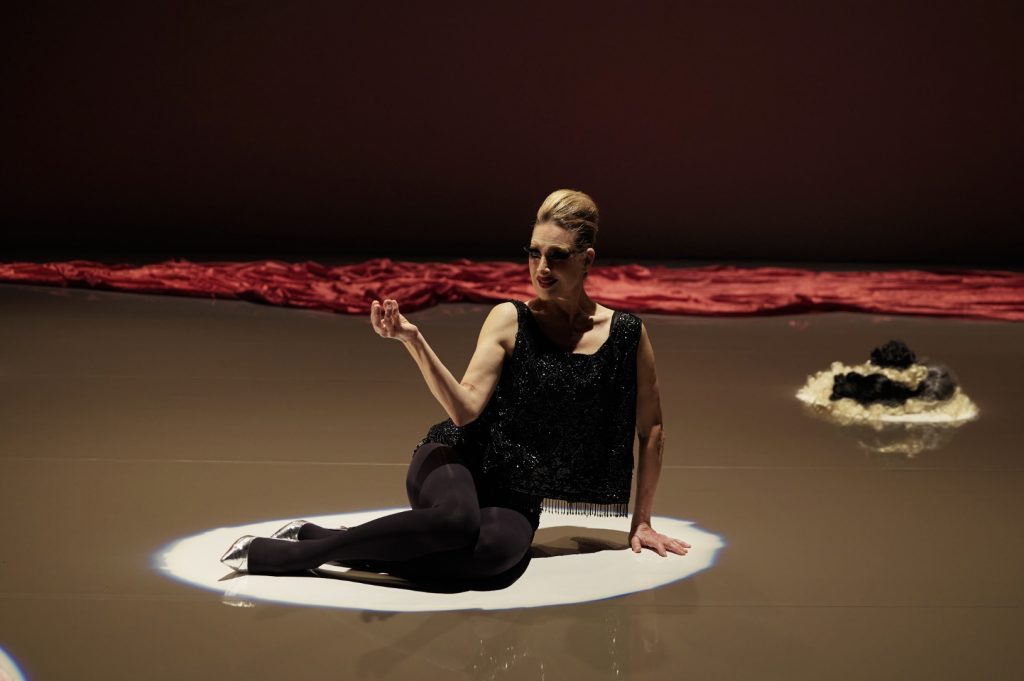 Photo by Allina Yang
On the Boards presented Monique Jenkinson (aka Fauxnique)’s work How do I look? last weekend. San Francisco based drag performer, dancer, and writer Fauxnique untangles the question of “getting over oneself” in this part roast, part dance, part stand up, and part performance art piece. The conception, creation, choreography, and design of the piece is by Jenkinson. The performance is by her drag persona Fauxnique, who is well known for being the first cisgender woman to win a major drag pageant in 2003. This stage is set up like a gallery, reflecting life as a performance artist and drag queen, with sculptural objects painted across the space. As Fauxnique interacts with each piece, we get an insight into her psyche.
In a black leotard and tights, with a fishnet unitard overlaid, she begins stuffing wigs under her bra straps to create fuzzy shoulder pads. Picking up a large circle of fabric, she fashions it into a grand cape, revealing its gold lining. With assistance of the wigs and costumes, Fauxnique does impressions of Joan Crawford, then her inner child Nina Ballerina, swirling the cape around her. Then she sits under the cape and does her impression of performance artist Marina Abramović. These impressions show us different subpersonalities that live in her brain, borrowing the “internal family systems” concept from psychotherapy, a model that aims to clarify the parts in order to help someone access their “self.”
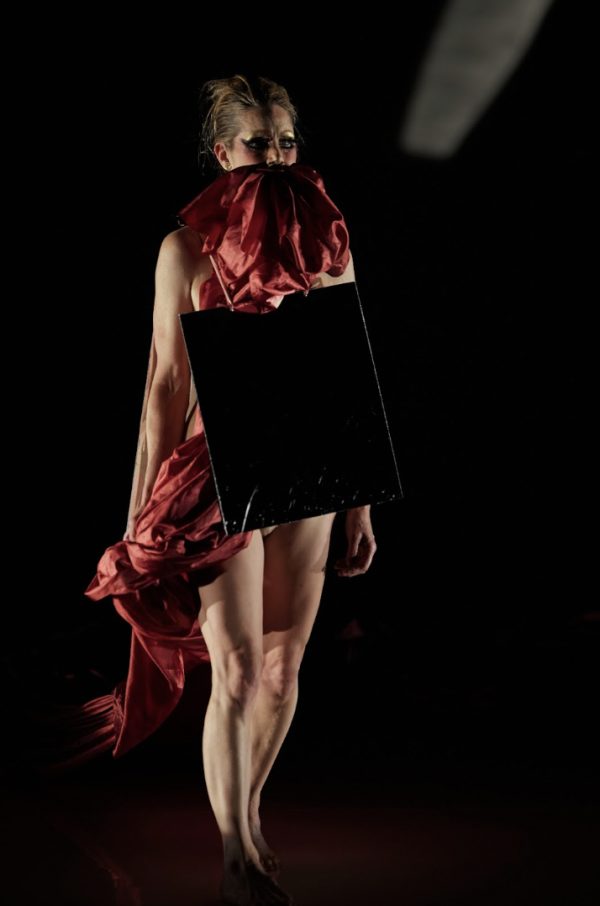 Photo by Allina Yang
Stuffing tissue paper into the fishnet unitard, Fauxnique asks “is this what a good person looks like?” The puffy pink tissue paper, trapped under the fishnet in bulbous clumps, resembles endometrial tissue. She asks the audience to “validate her feelings” by prompting the audience to participate in a call-and-response exercise. “I look like a feminist” she says. “You look like a feminist” the crowd responsively coos. “I look like I’m making a difference.” “You look like you’re making a difference.”This takes a somber turn later in the piece, when Fauxnique tells the audience she feels “desperate,” “old,” and “like a fool” and awaits their response. This act balances comedy with discomfort as the crowd echoes and reflects Fauxniques’ feelings.
Throughout the piece, the costume transformations aid in telling us which part of Fauxnique’s personality we are viewing. Fauxnique as a performance artist swims under the magenta sea of fabric, punching and shaking like a ghost. After the commotion, the fabric flies up in the air, falling off to reveal her mostly naked body, one end of the fabric river clamped between her teeth. Covering her chest and back are two rectangular mirrors hung on her shoulders with pink ribbon like a sandwich board sign. Standing before the crowd, she gazes at them, holding up a physical mirror to the crowd that previously reflected and affirmed her feelings.
Fauxnique begins roasting herself in the third person. During the roast, Fauxnique calls out her own self-indulgence of inviting people to sit in a theater and pay to give her their undivided attention. Known for singing live in her drag performances, Fauxnique gives us a taste in the most melancholic fashion. Slipping on kitten heels with gold tinsel pom poms, she does a headstand at the center of a small pastel pink fabric circle. As she flips over the fabric floats into a circular babydoll dress with a ruffled collar. Pulling out a small compact mirror, she places colorful sticker dots on her eyebrows and one red dot on her nose, then slips on a paper clown hat, and begins singing Elliot Smith’s “Pictures of Me” acapella–a song about feeling misrepresented in photographs and watching people die for the disease of fame. Re-contexualized by the clown costume, there is a knowledge that one might lose themselves in the chase for success as a performer, and still a desire to keep performing the song. Asking the audience to attempt to see her, while acknowledging the inherent faux-ness of the performance. The song becomes more aggressive, as Fauxnique slips back into her pink and gold skirt, swinging and repeating lyrics. She creates grand ripples with the skirt fabric, like the child Georgia O’Keefe and Loië Fuller, circling and swirling her arms.
Showcasing her ballet background, Fauxnique slips into a tutu made out of accordion-pleated magazines tied together by a string, a Chopova Lowena ballerina. Opera music plays as she frantically stages cleaning into a balletic performance. Fauxnique at the beginning of the piece admits she uses cleaning to combat depression in her real life. Jumping awkwardly and making eye contact, she meticulously packs all of the props, costumes, and objects neatly into a bright pink Ikea tote bag. With a clear floor, she begins exploring her identity as a contemporary dancer as a recorded conversation plays between herself and collaborator Jesse Hewitt. They discuss the desire to imitate others when dancing. Fauxnique kicks and jumps as the voice overhead vulnerably asks, “Is this something I am getting worse at over time?” Hewitt speaks to Fauxniques growth in the time he’s known her, assuring her that movement and dancers grow richer as they age.
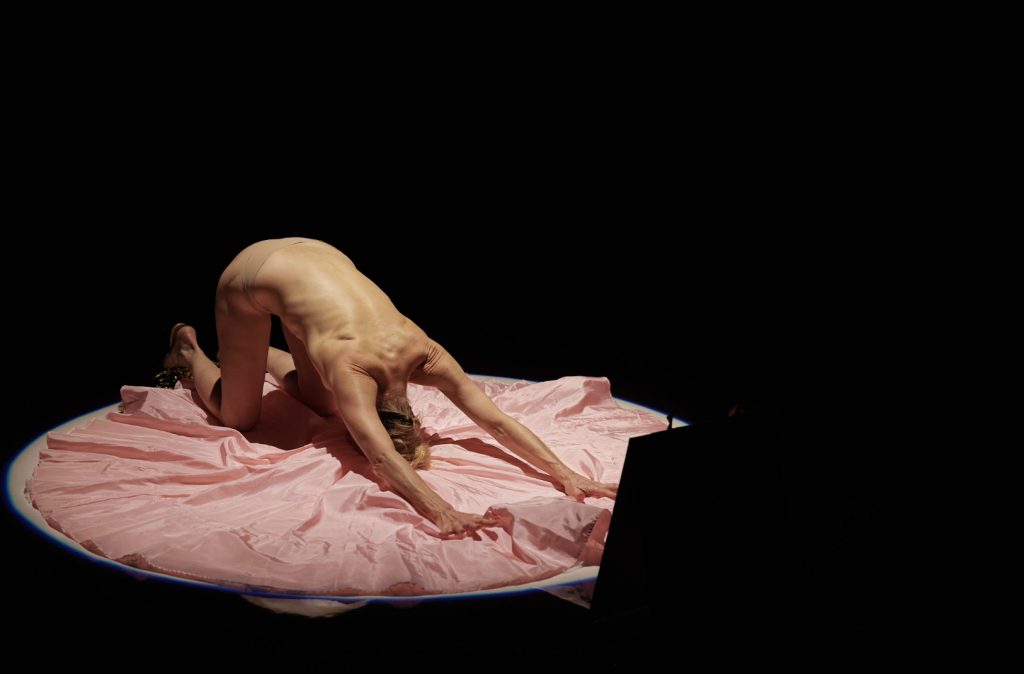 Photo by Allina Yang
The piece ends with Fauxnique approaching a microphone, wrapping a long sheet of mylar around her body to create a structured asymmetrical dress secured with duct tape. Into the microphone she tells us that the word gloss originally meant to explain rather than to shine, and the word essay meant an attempt. Floating into the audience, she invites the audience, for the first time, to look away from her and to focus on the blank stage as she slips away. Returning to Fauxniques’ identity as a writer, the piece ends like an essay. The lights on the blank stage restate each spotlight like a conclusion, with remembrance of where we went together. How do I look? is vulnerable and delightfully self-indulgent. In order to “get over one’s self,” we have to dive into the different parts of the self trying to figure out what makes her complete. While I left with more clarity on who Fauxnique is and how she looks, I was curious as to how Fauxnique sees others. As we navigate a time where the boundaries of drag performances are constantly being pushed and a simultaneously contentious one for queer people politically, I craved more insight into how Fauxnique sees the future of drag evolving.


