We are hot sardines in an aquarium, held separate from the performance space by sets of glass french doors. Laughing bodies pack the atrium, get cool relief from chilled bubbly waters, fill the space with warm exhales, and shout enthusiastic hellos to familiar faces. The venue is the Great Hall at Green Lake, a renovated 1921 building with tall ceilings and arched windows that bathe the wood floors in natural light. It has the feel of a church, auditorium, or school multipurpose room with a wide floor and narrow raised stage. The building’s architecture and spirit are mindfully invoked in the choreographic choices of Carol Davis in her piece WORN, a site-specific dance work, created in collaboration with Ally Elliott and Natalie Grant.
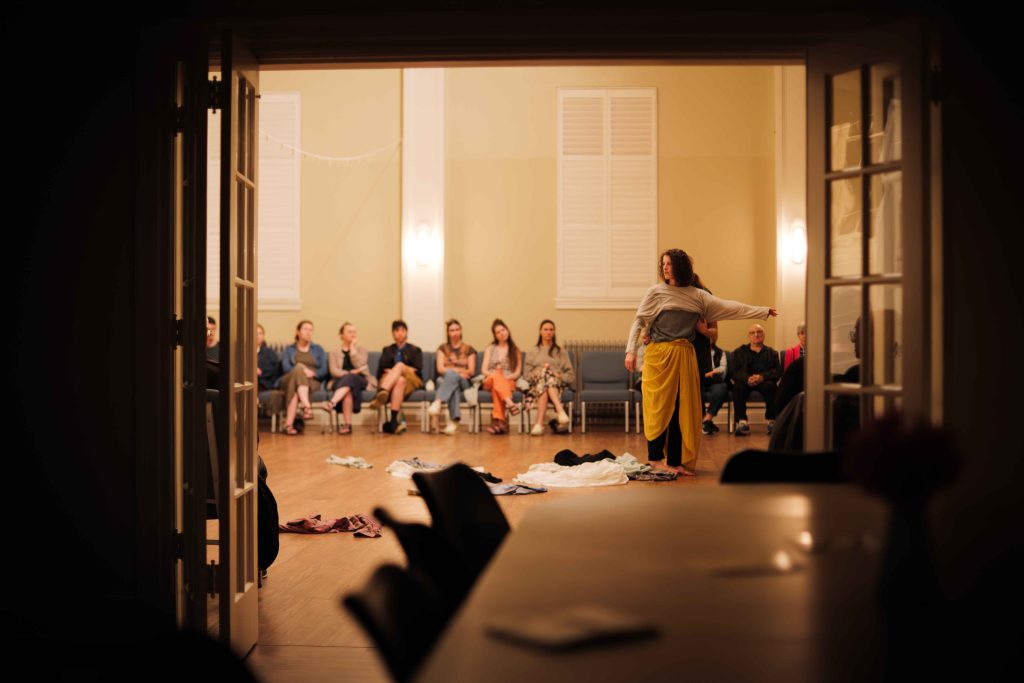
Pressed between the waiting bodies in the lobby space, I can see the open dance floor through the glass doors. A set of clotheslines suspend shirts, chore coats, and long skirts in shades of sky and stone. I catch glimpses of Grant lying on the wood-plank floor, gazing up to contemplate the clothes on the lines. She moves to survey the scene from a different angle, taking a seat in the still-empty audience rows.
The doors open and the audience moves into the spaciousness of the bright sanctuary. We sit in rows of chairs arranged in a wide, open U-shape and the laughter and conversations are slow to trickle to quiet.
Two small, perpendicular doors upstage right lead to an enclosed space that we cannot see from our seats. One door opens onto the floor, the other onto the raised platform stage. The three performers emerge from and disappear into this secret backstage space one at a time. They time their exits and entrances such that when one door closes, another door opens simultaneously. It is almost as if the doors are portals, and the bodies are replacing one another.
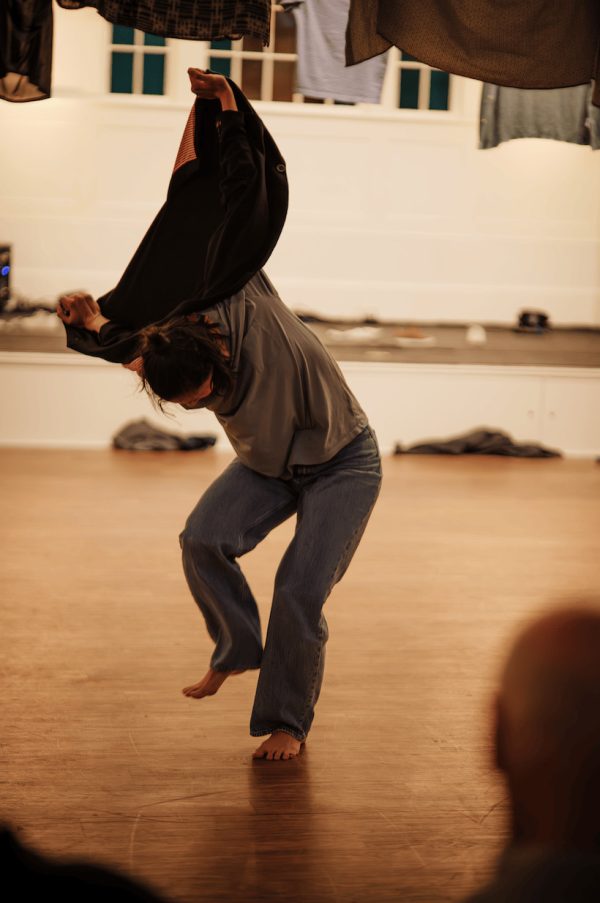
Davis, Elliott, and Grant take turns being alone in the space. They enter one at a time and take in the environment. They walk, pause, consider the clothes, put on jackets, furtively scan the environment, and move on. Their shifting focus draws my eyes around the space and I too examine windows, doors, floor, hallway, surfaces. Their pedestrian movements are scored by field recordings of what sounds like an urban playground. Audible cars and children make me think that these are recordings from this corner of Green Lake.
WORN responds beautifully to its site, using a variety of entrances and exits to effectively frame the dancers in ways that shift our planes of perception. The dancers slide into view horizontally along the floor, emerging from behind the masking of a distant doorframe. They dive and swirl through pools of window light. They slither behind our rows of chairs, and sometimes sit in the audience. Our gaze travels up, down, and sideways with the dancers as they hungrily gobble up space. The dancers do not use the raised stage for dancing. It becomes a stoop to sit on and shuffle across, and a vertical surface used to propel horizontal glides across the floor.
At times, the performers’ enjoyment is palpable. We feel their love of dance and the care they have for each other. Their unison movements demonstrate trust in each other and in well-practiced patterns executed by trained bodies. The space is large and they fill it with high-velocity slides, outstretched arms, and smiles. In other moments, we see the performers as timid and wary of something unnamed and unseen. Sometimes the dancers’ energy is mixed; one happy, two scared, or two joyous, one nervous. I keep trying to decode the dancers’ relationships to one another and to the clothing in the space, and it is a shifting target.
At times, clothing has the power to transform. In a playful vignette, Elliot and Davis pull long skirts from the clothes lines, put them on, and do a dance of escapist enjoyment together. Our focus then shifts to Grant slumped against the stage, wearing a backwards black blazer. The music becomes darker, with a clublike beat, and powerhouse-performer Grant positively detonates into a solo where she almost appears to have her head on backwards. Her limbs fly out, feet sickle, and joints roll and rotate like ball bearings. It is like the coat is wearing her and leading the movement, rather than the other way around. It ends too soon.
Clothing is never neutral and I am curious about the choices to associate carefree communion with long flowing skirts and inner solitary turmoil with blazers. These two clothing items feel particularly loaded with gender and class associations, while other clothing items are less immediately indexical. The dancers put on and take off a variety of outer layers but always remain fully clothed in activewear camisoles and long tapered pants.
The clothing takes on a sense of nostalgia in a scene where Davis and Grant take turns lifting each other up to touch the clothing on the line in a supportive gesture reminiscent of childhood, or of reaching toward a past life. The evening light through the large windows turns the emotional volume up on this recognizable intimation.
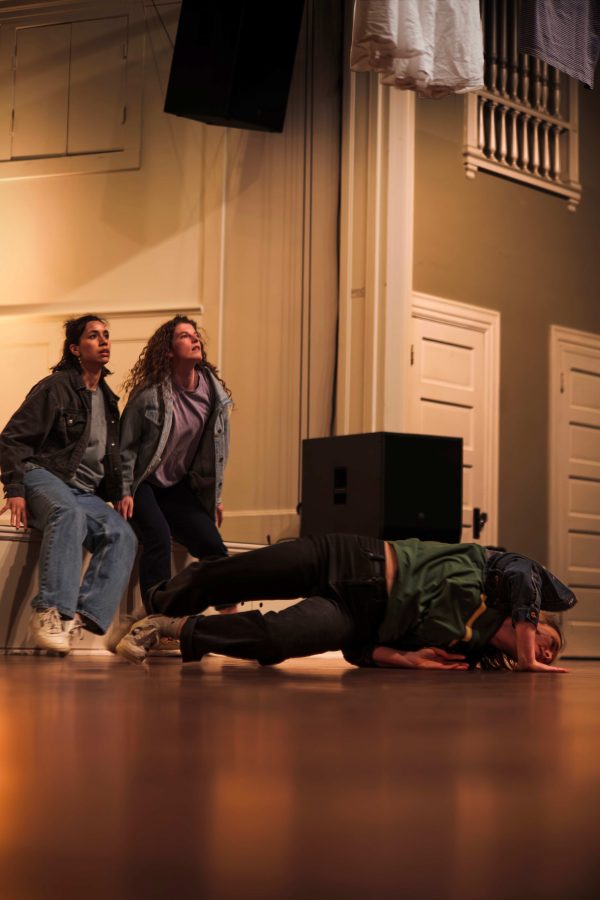
Elliot enters and desperately rips down all of the remaining shirts off of the line. All three dancers explore the clothing items, picking them up off the floor and climbing into and out of T-shirts, denim jackets, and button down shirts. They twist and pull the shirts, and use the force to twist and pull each other around the space. Heads go through arm holes, and arms go through head holes, but the shirts stay shirts, rather than transforming into hats, pants, or other symbolic objects. Grant, wearing nearly every item of clothing, breathing hard and sweating, is the final image of the piece.
WORN refers to the status of an item after it has adorned a body for a period of time. It can also describe tiredness and depletion. More positively, it can honor a well-trodden path, or the comfort of repeated actions. The duality of the word worn is evidenced in the work. Given that so much of the piece was imbued with a rather fraught energy, it was strangely uplifting. When I try to describe the piece in a word or two, I think of “heartwarming” and “extremely pleasant,” which seems frankly at odds with most of what happened. I believe that much of the effect of the piece comes from the building itself–its sun soaked wooden floors, the air filling the space above all of our heads, and a hundred years of spiritual imprints of the humans it’s hosted.
WORN was performed on Thursday, April 30th at 7:30pm and Friday, May 1st at 8pm at the Great Hall near Greenlake. It was produced by Carol Davis, and created in collaboration with performers Natalie Grant and Ally Elliott. View the program HERE.


