Walking into UW’s Meany 267 studio, we find the classroom transformed. The chatter of students cheering each other roars over the untz untz of the bass. Chairs are set up in the round, with a disco ball and rainbow lights dancing over the bouncing floor, inviting you to join in on the play. Amy O’Neal kicks off the evening, introducing you to the party and events about to unfold. Performances by local guest artists will be interspliced between student creations, sandwiched with another post-show party, returning to its original form. This evening of party, performance, and play is none other than O’Neal’s Hybrid Dance Lab, started in 2019, occurring in various iterations across Seattle, LA, DC, and Akron. O’Neal is the current Kawasaki Artist in Residence at UW, and a campus-based Hybrid Dance Lab brings students into the format. After they spent ten weeks learning from O’Neal, the Hybrid Dance Lab showcases their research in creative hybridity forms and cultural literacy alongside established local artists.
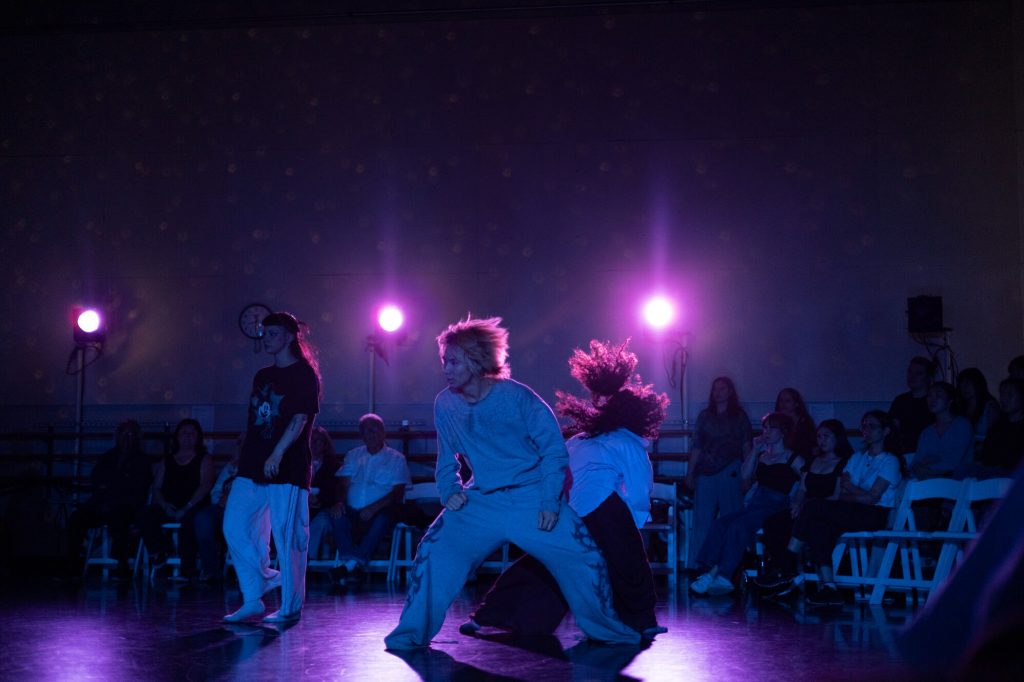 Students performing. Photo by Juan Rodriguez.
In a preshow speech, O’Neal expresses how the lab pulls from blending forms like contemporary dance, house, and classic hip hop party grooves. In the student choreographed String Pull Theory, the dancers perform a series of duets and trios in which one dancer pulls an invisible string to manipulate the movement of their partner(s). Each group adds their own flavor, some taking on the movements with aggression and control, like a puppet and puppeteer. Others take a softer approach, with slinky and sensual expressions, using the string to signal “come hither.” Across each pairing, the dancers oscillate from contemporary slides and balances, to grounded and heavy bouncing and grooves.
After the last duet, the two saunter together in the circle, making eye contact with the crowd. More dancers trickle in, creating a wash of people that spiral in the center like a whirlpool. As individuals flow out, dani tirrell and a golden floor light remain, casting a grand shadow of tirrell against the curtain. Donning all white, tirrell searches with hands, circling and pouring around, picking up feet stepping evenly. This performance is an excerpt from tirrell’s I don’t Understand a Word in the Bible, But Black Folks Made God Beautiful. Watching tirrell face the shadow is like watching one commune with an ancestor, or reckon with the becoming of one. Alysia Harris recites the death poem over Miles Davis’s “L’assassinat De Carala,” a sweet call back to tirrell’s recent work, Baada Ya Kifo. tirrell begins moving around the circle with quick feet and tiny steps, elbows folded close like a chicken. Rhythm picks up and tirrell bounces and opens arms in between the small steps. Facing the back again, tirell opens arms wide and free like a bird extending wings and feeling wind with acceptance and grace.
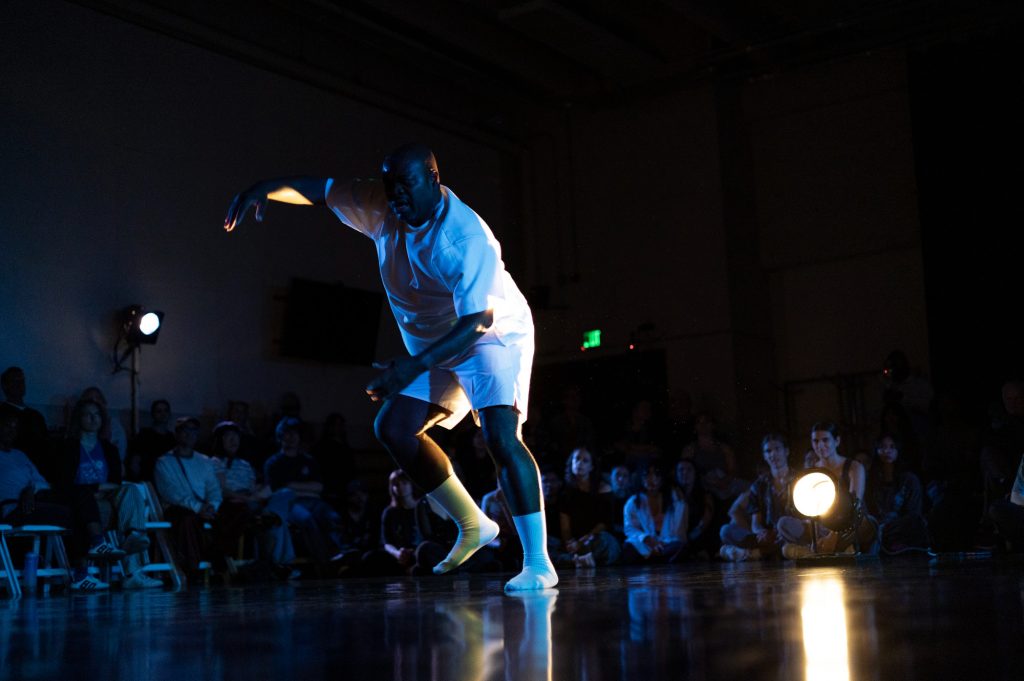 Dani Tirrell. Photo by Juan Rodriguez.
Micaiah “Pluto” Jeffery expresses similar ideas of acceptance, transcendence, and spiritual reckoning in I’m Tired. He comes out in a white jacket and pants, with a green silky scarf looped by his waist. He begins dancing with vigor in gestural movements that reflect the song’s lyrics. With plunging and pivoting motions, he fights and grasps his head to show discontentment. Removing the scarf he screams into it. Its muffled and chilling echo disrupts the previous flow. The scarf becomes a soft veil. With his head covered, he pops the jacket open, revealing a black tank top underneath the monochrome white. As Kendrick Lamar sings “Loving you is complicated,” he finds his way up. Traveling across the circle, he makes eye contact with the crowd moving with strength and earnestness. While harboring different movement qualities, textures, and language, there is a shared notion of watching someone navigate anguish, searching for acceptance and meaning in the motions.
The lights come up on Tracey Wong lying across a swiveling table. ah ma’s refuge begins with Wong waacking on the vertical plane, arms bouncing over head, legs drawing circles and spirals in the air. Slipping up onto her knees, she whacks upright arms reaching towards the sky. She glides across the stage, the table becoming a moving anchor and extension of her form. Wong’s explorations are innovative, as she transverses new planes and asks questions with her rolls and flicks. With expressive and furrowed brows, it is like she is deciphering a message. Swinging and sliding under the table like a trapeze artist, she pushes herself up with slow strength. She rides swirling waves, the table keeping her afloat. In the final moment of the piece, everything becomes clear and the piece is recontextualized. Wong kneels with elbows folded on the table, hands in a prayer, looking up at the ceiling with soft and inquisitive glisten. Wong makes external the internal sensations of praying to the ancestors at the kitchen table, asking for guidance from those who have come before you.
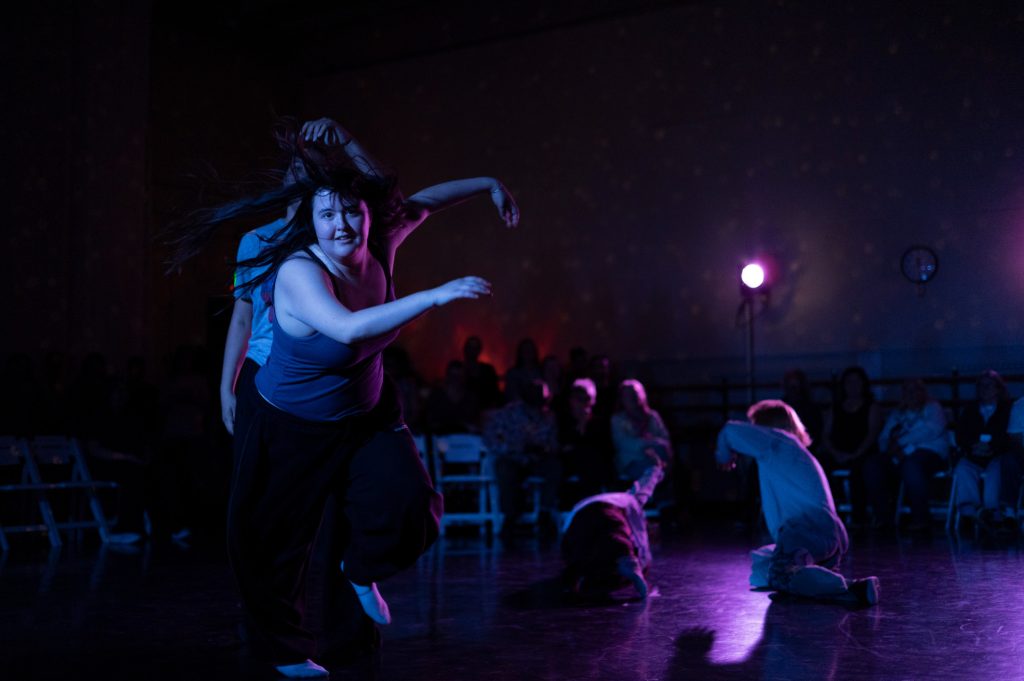 Students performing. Photo by Juan Rodriguez.
Interspliced between the guest artists, students show group numbers, solos, trios, and duets. These numbers are playful and experimental, as students rejoice throwing it back and balancing on one another. The students create a floor full of loose legs and A-town stomps, intermixing the moves with floating exploratory waves and lunging floor slides. A rotating soul train highlights student duets to everyone in the round, the train rotating smoothly with floaty house dance. With all the students on the floor, they suddenly begin pulling audience members onto the floor to learn a line dance to the song “Flex” by Cupid. A seamless and circular transition back into a lively collective party.
While the guest artists each trace their ancestral lineages, the student work and structure as a whole traces the lineages of these movement forms. Hybrid Dance Lab has worked over the past seven years to platform experimental street dance through new avenues honoring experimentation and fusion. Bringing the Lab to the academic space challenges systems of empirical knowledge production and examines who has historically been excluded from being a producer of knowledge. O’Neal facilitates a conversation surrounding cultural surrogacy and literacy through the lab. Additionally she creates opportunities for students and attendees to play and practice embodied knowledge production. Hybrid Dance Lab begins a dialogue, creating more questions regarding embodiment, culture, and hybridity in the academic space that the collective is still researching.
Hybrid Dance Lab occurred June 5 and 6 2026 at Meany Studio 267. A copy of the program can be viewed HERE. Featured photo by Juan Rodriguez.


